{"title":"Ru-Species-Functionalized Self-Supported In-Based Nanostructures Enabling High-Efficiency Water Electrolysis","authors":"Xi-Zheng Fan, Qing-Qing Pang","doi":"10.1002/ente.70561","DOIUrl":null,"url":null,"abstract":"<p>The design of highly efficient and durable electrocatalysts for water splitting is of great significance for renewable energy conversion and environmental protection. Herein, we report a facile strategy combining hydrothermal and annealing processes to fabricate high-performance electrocatalysts for the hydrogen evolution reaction (HER) and oxygen evolution reaction (OER), respectively. Notably, the In(OH)<sub>3</sub> cubes loaded with Ru NPs (denoted as Ru-In(OH)<sub>3</sub>/CC) exhibit excellent HER performance in an alkaline medium, achieving a low overpotential of 135 mV at a current density of 50 mA cm<sup>−2</sup>. Meanwhile, the hydrothermally derived RuO<sub>2</sub>-In<sub>2</sub>O<sub>3</sub>/CC catalyst delivers an overpotential of 380 mV at a current density of 50 mA cm<sup>−2</sup> for OER, outperforming most recently reported catalysts and commercial RuO<sub>2</sub>. Such superior electrocatalytic performance is attributed to the uniform dispersion of active Ru NPs enabled by the In(OH)<sub>3</sub> support and the enrichment of RuO<sub>2</sub> on the surface of In<sub>2</sub>O<sub>3</sub>. Furthermore, the two-electrode electrolyzer constructed with Ru-In(OH)<sub>3</sub>/CC (cathode) and RuO<sub>2</sub>-In<sub>2</sub>O<sub>3</sub>/CC (anode) requires only a cell voltage of 1.58 V to deliver 10 mA cm<sup>−2</sup> for overall water splitting and maintains a stable current output for 20 h.</p>","PeriodicalId":11573,"journal":{"name":"Energy technology","volume":"14 7","pages":""},"PeriodicalIF":3.6000,"publicationDate":"2026-07-08","publicationTypes":"Journal Article","fieldsOfStudy":null,"isOpenAccess":false,"openAccessPdf":"","citationCount":"0","resultStr":null,"platform":"Semanticscholar","paperid":null,"PeriodicalName":"Energy technology","FirstCategoryId":"5","ListUrlMain":"https://onlinelibrary.wiley.com/doi/10.1002/ente.70561","RegionNum":4,"RegionCategory":"工程技术","ArticlePicture":[],"TitleCN":null,"AbstractTextCN":null,"PMCID":null,"EPubDate":"","PubModel":"","JCR":"Q3","JCRName":"ENERGY & FUELS","Score":null,"Total":0}
引用次数: 0
Abstract
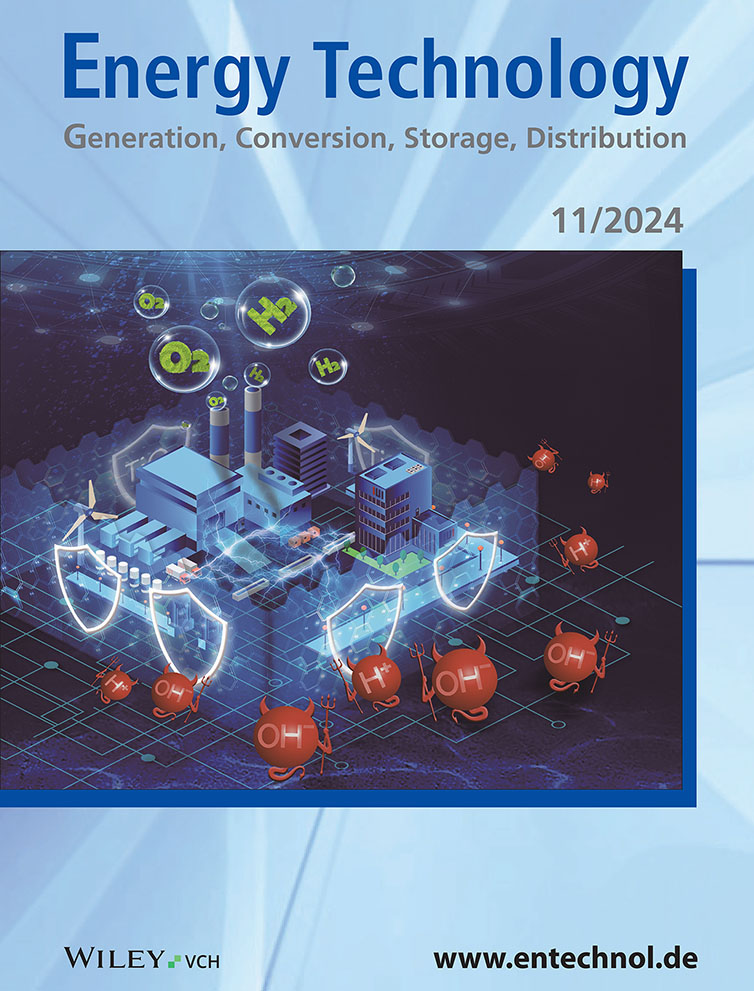
The design of highly efficient and durable electrocatalysts for water splitting is of great significance for renewable energy conversion and environmental protection. Herein, we report a facile strategy combining hydrothermal and annealing processes to fabricate high-performance electrocatalysts for the hydrogen evolution reaction (HER) and oxygen evolution reaction (OER), respectively. Notably, the In(OH)3 cubes loaded with Ru NPs (denoted as Ru-In(OH)3/CC) exhibit excellent HER performance in an alkaline medium, achieving a low overpotential of 135 mV at a current density of 50 mA cm−2. Meanwhile, the hydrothermally derived RuO2-In2O3/CC catalyst delivers an overpotential of 380 mV at a current density of 50 mA cm−2 for OER, outperforming most recently reported catalysts and commercial RuO2. Such superior electrocatalytic performance is attributed to the uniform dispersion of active Ru NPs enabled by the In(OH)3 support and the enrichment of RuO2 on the surface of In2O3. Furthermore, the two-electrode electrolyzer constructed with Ru-In(OH)3/CC (cathode) and RuO2-In2O3/CC (anode) requires only a cell voltage of 1.58 V to deliver 10 mA cm−2 for overall water splitting and maintains a stable current output for 20 h.
设计高效、耐用的水分解电催化剂对可再生能源转化和环境保护具有重要意义。在此,我们报告了一种结合水热和退火工艺的简单策略,分别为析氢反应(HER)和析氧反应(OER)制备高性能电催化剂。值得注意的是,负载Ru NPs的In(OH)3立方体(记为Ru-In(OH)3/CC)在碱性介质中表现出优异的HER性能,在电流密度为50 mA cm−2时实现了135 mV的低过电位。同时,水热衍生的RuO2- in2o3 /CC催化剂在电流密度为50 mA cm−2时,OER的过电位为380 mV,优于最近报道的催化剂和商业RuO2。这种优异的电催化性能归因于In(OH)3载体使活性Ru NPs均匀分散,以及在In2O3表面富集RuO2。此外,由Ru-In(OH)3/CC(阴极)和RuO2-In2O3/CC(阳极)组成的双电极电解槽只需要1.58 V的电池电压就可以提供10 mA cm - 2的整体水分解,并保持20小时的稳定电流输出。
期刊介绍:
Energy Technology provides a forum for researchers and engineers from all relevant disciplines concerned with the generation, conversion, storage, and distribution of energy.
This new journal shall publish articles covering all technical aspects of energy process engineering from different perspectives, e.g.,
new concepts of energy generation and conversion;
design, operation, control, and optimization of processes for energy generation (e.g., carbon capture) and conversion of energy carriers;
improvement of existing processes;
combination of single components to systems for energy generation;
design of systems for energy storage;
production processes of fuels, e.g., hydrogen, electricity, petroleum, biobased fuels;
concepts and design of devices for energy distribution.


 求助内容:
 应助结果提醒方式:


 京公网安备 11010802042870号


