
Mucosal tissue cues shape B cell memory through the IgA BCR

IF 16.4 1区 医学 Q1 IMMUNOLOGY
Maria Pia Holgado, Samuel Origlio, Lucas Bertoia, Myriam Moussa, Apurwa Trivedi, Frederic Fiore, Ana Zarubica, Emma Slack, Michelle A. Linterman, Michel Cogné, Claude Gregoire, Mauro Gaya
{"title":"Mucosal tissue cues shape B cell memory through the IgA BCR","authors":"Maria Pia Holgado,&nbsp;Samuel Origlio,&nbsp;Lucas Bertoia,&nbsp;Myriam Moussa,&nbsp;Apurwa Trivedi,&nbsp;Frederic Fiore,&nbsp;Ana Zarubica,&nbsp;Emma Slack,&nbsp;Michelle A. Linterman,&nbsp;Michel Cogné,&nbsp;Claude Gregoire,&nbsp;Mauro Gaya","doi":"10.1126/sciimmunol.adv1149","DOIUrl":null,"url":null,"abstract":"<div >B cells generate plasma cells (PCs) and memory B cells (MBCs) to combat recurrent pathogens. B cell receptor (BCR) affinity dictates fate decisions in response to model antigens, but the factors regulating B cell fate during infection remain unknown. Here, we used respiratory and gastrointestinal infection models to study B cell selection across barrier tissues in mice. Memory selection was governed by tissue-specific cues: Selection in the lung was skewed toward MBCs, whereas the gut favored PC entry, even in response to the same pathogen. Divergence was linked to differential BCR isotype usage across barrier tissues rather than differential affinity maturation. In the gut, the commensal-induced TGF-β–rich milieu promoted class-switching to IgA, which skewed selection toward PCs, a process that was counteracted by the IgA cytosolic tail domain. Thus, mucosal B cell selection integrates tissue-specific cues by relying on BCR isotype usage, with implications for nasal and oral vaccine development.</div>","PeriodicalId":21734,"journal":{"name":"Science Immunology","volume":"11 121","pages":""},"PeriodicalIF":16.4000,"publicationDate":"2026-07-17","publicationTypes":"Journal Article","fieldsOfStudy":null,"isOpenAccess":false,"openAccessPdf":"https://www.science.org/doi/reader/10.1126/sciimmunol.adv1149","citationCount":"0","resultStr":null,"platform":"Semanticscholar","paperid":null,"PeriodicalName":"Science Immunology","FirstCategoryId":"3","ListUrlMain":"https://www.science.org/doi/10.1126/sciimmunol.adv1149","RegionNum":1,"RegionCategory":"医学","ArticlePicture":[],"TitleCN":null,"AbstractTextCN":null,"PMCID":null,"EPubDate":"","PubModel":"","JCR":"Q1","JCRName":"IMMUNOLOGY","Score":null,"Total":0}
引用次数: 0

Abstract

B cells generate plasma cells (PCs) and memory B cells (MBCs) to combat recurrent pathogens. B cell receptor (BCR) affinity dictates fate decisions in response to model antigens, but the factors regulating B cell fate during infection remain unknown. Here, we used respiratory and gastrointestinal infection models to study B cell selection across barrier tissues in mice. Memory selection was governed by tissue-specific cues: Selection in the lung was skewed toward MBCs, whereas the gut favored PC entry, even in response to the same pathogen. Divergence was linked to differential BCR isotype usage across barrier tissues rather than differential affinity maturation. In the gut, the commensal-induced TGF-β–rich milieu promoted class-switching to IgA, which skewed selection toward PCs, a process that was counteracted by the IgA cytosolic tail domain. Thus, mucosal B cell selection integrates tissue-specific cues by relying on BCR isotype usage, with implications for nasal and oral vaccine development.

Abstract Image

粘膜组织信号通过IgA BCR形成B细胞记忆
B细胞产生浆细胞(pc)和记忆B细胞(MBCs)来对抗复发性病原体。B细胞受体(BCR)的亲和力决定了对模型抗原的反应的命运决定,但在感染期间调节B细胞命运的因素仍然未知。在这里,我们使用呼吸道和胃肠道感染模型来研究B细胞在小鼠屏障组织中的选择。记忆选择受到组织特异性线索的支配:肺中的选择倾向于MBCs,而肠道则倾向于PC进入,即使是对同一病原体的反应。分化与屏障组织中不同的BCR同种型使用有关,而不是与不同的亲和成熟度有关。在肠道中,评论诱导的富含TGF-β的环境促进了向IgA的类别转换,使选择偏向于pc,这一过程被IgA细胞质尾部结构域抵消。因此,粘膜B细胞选择通过依赖于BCR同种型的使用整合了组织特异性线索,这对鼻和口服疫苗的开发具有重要意义。
本文章由计算机程序翻译,如有差异,请以英文原文为准。
求助全文
约1分钟内获得全文 求助全文
来源期刊
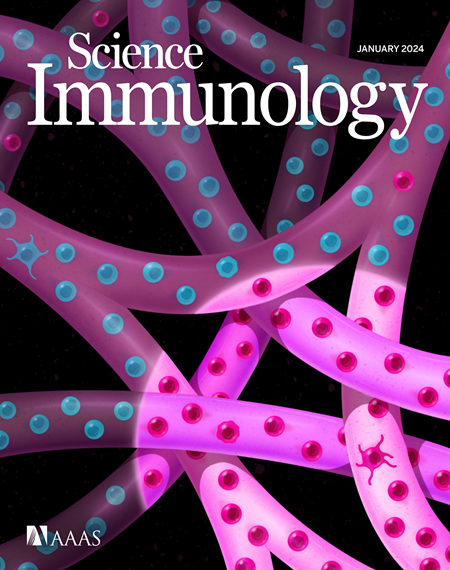
Science Immunology
Science Immunology Immunology and Microbiology-Immunology
CiteScore
32.90
自引率
2.00%
发文量
183
期刊介绍: Science Immunology is a peer-reviewed journal that publishes original research articles in the field of immunology. The journal encourages the submission of research findings from all areas of immunology, including studies on innate and adaptive immunity, immune cell development and differentiation, immunogenomics, systems immunology, structural immunology, antigen presentation, immunometabolism, and mucosal immunology. Additionally, the journal covers research on immune contributions to health and disease, such as host defense, inflammation, cancer immunology, autoimmunity, allergy, transplantation, and immunodeficiency. Science Immunology maintains the same high-quality standard as other journals in the Science family and aims to facilitate understanding of the immune system by showcasing innovative advances in immunology research from all organisms and model systems, including humans.

×
引用
GB/T 7714-2015
复制
MLA
复制
APA
复制
导出至
BibTeX EndNote RefMan NoteFirst NoteExpress
×
提示
您的信息不完整,为了账户安全,请先补充。
现在去补充
×
提示
您因"违规操作"
具体请查看互助需知
我知道了
×
提示
确定
请完成安全验证×
copy
已复制链接
快去分享给好友吧!
我知道了
右上角分享
点击右上角分享
0
联系我们:info@booksci.cn Book学术提供免费学术资源搜索服务,方便国内外学者检索中英文文献。致力于提供最便捷和优质的服务体验。 Copyright © 2023 布克学术 All rights reserved.
京ICP备2023020795号-1
ghs 京公网安备 11010802042870号
Book学术文献互助
Book学术文献互助群
群 号:604180095
Book学术官方微信
小红书


