
Measurement of Spatial Ability: Reevaluating and Revising Measures of Mental Rotation

IF 3.1 2区 心理学 Q1 PSYCHOLOGY, MULTIDISCIPLINARY
Intelligence Pub Date : 2026-07-01 Epub Date: 2026-06-19 DOI:10.1016/j.intell.2026.102040
Mitchell E. Munns, Mary Hegarty
{"title":"Measurement of Spatial Ability: Reevaluating and Revising Measures of Mental Rotation","authors":"Mitchell E. Munns,&nbsp;Mary Hegarty","doi":"10.1016/j.intell.2026.102040","DOIUrl":null,"url":null,"abstract":"<div><div>In order to accurately assess and characterize spatial ability, commonly used measures of this ability need to be evaluated psychometrically and compared to determine whether they measure the same or different constructs (Uttal, McKee, Simms, Hegarty, &amp; Newcombe, 2024). Here we examined computer-administered versions of three commonly used tests of mental rotation ability, the Flags Test (Thurstone &amp; Jeffrey, 1959), the Mental Rotations Test (Vandenberg &amp; Kuse, 1978), and the Revised Purdue Spatial Visualization Test (<span><span>Yoon, 2011</span></span>). On the basis of Item Response Theory (IRT) analyses, and concerns about the validity of some test items, we created shortened and refined versions of these tests, which maintained the high reliability of the original tests. The three refined test versions were then combined into a 35-item hybrid mental rotation test. The hybrid test showed high reliability and general factor saturation, and was best fit by a Hierarchical Bifactor IRT model, with all items loading on a general ability factor, and the items from each test also loading on subfactors reflecting test-specific differences. No evidence for a separate ability to mentally rotate 3-dimensional vs. 2-dimensional figures was found. The hybrid test showed high precision across a wide range of ability (±2 standard deviations from average) and a small gender difference in favor of men. The hybrid test functions well as an efficient measure of mental rotation ability across a wide range of difficulty that is less confounded by strategy, visual perception, and time constraints than the original individual tests.</div></div>","PeriodicalId":13862,"journal":{"name":"Intelligence","volume":"117 ","pages":"Article 102040"},"PeriodicalIF":3.1000,"publicationDate":"2026-07-01","publicationTypes":"Journal Article","fieldsOfStudy":null,"isOpenAccess":false,"openAccessPdf":"","citationCount":"0","resultStr":null,"platform":"Semanticscholar","paperid":null,"PeriodicalName":"Intelligence","FirstCategoryId":"102","ListUrlMain":"https://www.sciencedirect.com/science/article/pii/S0160289626000395","RegionNum":2,"RegionCategory":"心理学","ArticlePicture":[],"TitleCN":null,"AbstractTextCN":null,"PMCID":null,"EPubDate":"2026/6/19 0:00:00","PubModel":"Epub","JCR":"Q1","JCRName":"PSYCHOLOGY, MULTIDISCIPLINARY","Score":null,"Total":0}
引用次数: 0

Abstract

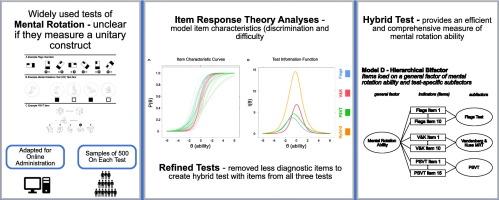
In order to accurately assess and characterize spatial ability, commonly used measures of this ability need to be evaluated psychometrically and compared to determine whether they measure the same or different constructs (Uttal, McKee, Simms, Hegarty, & Newcombe, 2024). Here we examined computer-administered versions of three commonly used tests of mental rotation ability, the Flags Test (Thurstone & Jeffrey, 1959), the Mental Rotations Test (Vandenberg & Kuse, 1978), and the Revised Purdue Spatial Visualization Test (Yoon, 2011). On the basis of Item Response Theory (IRT) analyses, and concerns about the validity of some test items, we created shortened and refined versions of these tests, which maintained the high reliability of the original tests. The three refined test versions were then combined into a 35-item hybrid mental rotation test. The hybrid test showed high reliability and general factor saturation, and was best fit by a Hierarchical Bifactor IRT model, with all items loading on a general ability factor, and the items from each test also loading on subfactors reflecting test-specific differences. No evidence for a separate ability to mentally rotate 3-dimensional vs. 2-dimensional figures was found. The hybrid test showed high precision across a wide range of ability (±2 standard deviations from average) and a small gender difference in favor of men. The hybrid test functions well as an efficient measure of mental rotation ability across a wide range of difficulty that is less confounded by strategy, visual perception, and time constraints than the original individual tests.
Abstract Image

空间能力的测量:心理旋转测量的再评价与修正
为了准确地评估和描述空间能力,需要对这种能力的常用测量方法进行心理测量学评估,并进行比较,以确定它们测量的是相同还是不同的结构(utal, McKee, Simms, Hegarty, & Newcombe, 2024)。在这里,我们研究了三种常用的心理旋转能力测试的计算机管理版本,旗帜测试(Thurstone & Jeffrey, 1959),心理旋转测试(Vandenberg & Kuse, 1978)和修订的普渡空间可视化测试(Yoon, 2011)。在项目反应理论(IRT)分析的基础上,考虑到一些测试项目的效度,我们创建了这些测试的缩短和改进版本,保持了原始测试的高信度。然后将三个改进的测试版本合并成一个35个项目的混合心理旋转测试。混合测试具有较高的信度和一般因子饱和度,并且最适合分层双因子IRT模型,所有测试项目都加载在一般能力因子上,每个测试项目也加载在反映测试特异性差异的子因子上。没有证据表明心理旋转三维和二维图形的能力是分开的。混合测试显示,在广泛的能力范围内,准确度很高(与平均值相差±2个标准差),而且性别差异很小,有利于男性。混合测试作为一种有效的测量心理旋转能力的方法,可以跨越各种难度,比原来的单个测试更少受到策略、视觉感知和时间限制的影响。
本文章由计算机程序翻译,如有差异,请以英文原文为准。
求助全文
约1分钟内获得全文 求助全文
来源期刊
Intelligence
Intelligence PSYCHOLOGY, MULTIDISCIPLINARY-
CiteScore
5.80
自引率
13.30%
发文量
64
审稿时长
69 days
期刊介绍: This unique journal in psychology is devoted to publishing original research and theoretical studies and review papers that substantially contribute to the understanding of intelligence. It provides a new source of significant papers in psychometrics, tests and measurement, and all other empirical and theoretical studies in intelligence and mental retardation.

×
引用
GB/T 7714-2015
复制
MLA
复制
APA
复制
导出至
BibTeX EndNote RefMan NoteFirst NoteExpress
×
提示
您的信息不完整,为了账户安全,请先补充。
现在去补充
×
提示
您因"违规操作"
具体请查看互助需知
我知道了
×
提示
确定
请完成安全验证×
copy
已复制链接
快去分享给好友吧!
我知道了
右上角分享
点击右上角分享
0
联系我们:info@booksci.cn Book学术提供免费学术资源搜索服务,方便国内外学者检索中英文文献。致力于提供最便捷和优质的服务体验。 Copyright © 2023 布克学术 All rights reserved.
京ICP备2023020795号-1
ghs 京公网安备 11010802042870号
Book学术文献互助
Book学术文献互助群
群 号:604180095
Book学术官方微信
小红书


