
LOPAL: Local Performance-Aware Active Learning From Imperfect Demonstrations

IF 5.3 2区 计算机科学 Q2 ROBOTICS
IEEE Robotics and Automation Letters Pub Date : 2026-07-01 Epub Date: 2026-03-29 DOI:10.1109/LRA.2026.3698364
Johannes Heidersberger;Shail Jadav;Dongheui Lee
{"title":"LOPAL: Local Performance-Aware Active Learning From Imperfect Demonstrations","authors":"Johannes Heidersberger;Shail Jadav;Dongheui Lee","doi":"10.1109/LRA.2026.3698364","DOIUrl":null,"url":null,"abstract":"Learning from Demonstration (LfD) enables intuitive robot skill acquisition by allowing robots to learn directly from human task demonstrations. However, current methods often fail to address the fact that due to suboptimal and inconsistent human behavior, the quality of the demonstration can vary within each demonstration. Therefore, we introduce LOPAL (LOcal Performance-aware Active Learning), an active learning approach that leverages this local demonstration quality information. Our approach consists of two synergistic components. First, a local performance-driven LfD method uses a Gaussian Mixture Model (GMM) to encode both the demonstrated trajectories and their associated local quality assessments. This enables the generation of trajectories that outperform the imperfect demonstrations by utilizing complementary local data of high performance. Second, active data acquisition allows to improve beyond the imperfect demonstrations by collecting additional informative samples. In areas missing good data, the user is actively requested to provide corrections through a shared autonomy (SA) mechanism, while the robot autonomously executes the learned behavior. The efficacy of LOPAL was validated in both a simulation and a real-world experiment. The results from a real-world pipe inspection task showed that the proposed approach can achieve up to 27.31% improvement in task performance while also reducing the effort required to collect the demonstrations.","PeriodicalId":13241,"journal":{"name":"IEEE Robotics and Automation Letters","volume":"11 7","pages":"9040-9047"},"PeriodicalIF":5.3000,"publicationDate":"2026-07-01","publicationTypes":"Journal Article","fieldsOfStudy":null,"isOpenAccess":false,"openAccessPdf":"https://ieeexplore.ieee.org/stamp/stamp.jsp?tp=&arnumber=11538996","citationCount":"0","resultStr":null,"platform":"Semanticscholar","paperid":null,"PeriodicalName":"IEEE Robotics and Automation Letters","FirstCategoryId":"94","ListUrlMain":"https://ieeexplore.ieee.org/document/11538996/","RegionNum":2,"RegionCategory":"计算机科学","ArticlePicture":[],"TitleCN":null,"AbstractTextCN":null,"PMCID":null,"EPubDate":"2026/3/29 0:00:00","PubModel":"Epub","JCR":"Q2","JCRName":"ROBOTICS","Score":null,"Total":0}
引用次数: 0

Abstract

Learning from Demonstration (LfD) enables intuitive robot skill acquisition by allowing robots to learn directly from human task demonstrations. However, current methods often fail to address the fact that due to suboptimal and inconsistent human behavior, the quality of the demonstration can vary within each demonstration. Therefore, we introduce LOPAL (LOcal Performance-aware Active Learning), an active learning approach that leverages this local demonstration quality information. Our approach consists of two synergistic components. First, a local performance-driven LfD method uses a Gaussian Mixture Model (GMM) to encode both the demonstrated trajectories and their associated local quality assessments. This enables the generation of trajectories that outperform the imperfect demonstrations by utilizing complementary local data of high performance. Second, active data acquisition allows to improve beyond the imperfect demonstrations by collecting additional informative samples. In areas missing good data, the user is actively requested to provide corrections through a shared autonomy (SA) mechanism, while the robot autonomously executes the learned behavior. The efficacy of LOPAL was validated in both a simulation and a real-world experiment. The results from a real-world pipe inspection task showed that the proposed approach can achieve up to 27.31% improvement in task performance while also reducing the effort required to collect the demonstrations.
从不完美的演示中进行局部性能感知的主动学习
从演示中学习(LfD)允许机器人直接从人工任务演示中学习,从而实现直观的机器人技能获取。然而,目前的方法往往不能解决这样一个事实,即由于次优和不一致的人类行为,演示的质量在每个演示中都可能有所不同。因此,我们引入了LOPAL(本地性能感知主动学习),这是一种利用本地演示质量信息的主动学习方法。我们的方法包括两个协同的组成部分。首先,局部性能驱动的LfD方法使用高斯混合模型(GMM)对演示的轨迹及其相关的局部质量评估进行编码。这使得通过利用互补的高性能局部数据生成的轨迹优于不完美的演示。其次,主动数据采集允许通过收集额外的信息样本来改进不完美的演示。在缺少良好数据的区域,通过共享自治(SA)机制主动请求用户提供更正,而机器人则自主执行学习行为。通过仿真和实际实验验证了LOPAL的有效性。实际管道检测任务的结果表明,所提出的方法可以将任务性能提高27.31%,同时还减少了收集演示所需的工作量。
本文章由计算机程序翻译,如有差异,请以英文原文为准。
求助全文
约1分钟内获得全文 求助全文
来源期刊
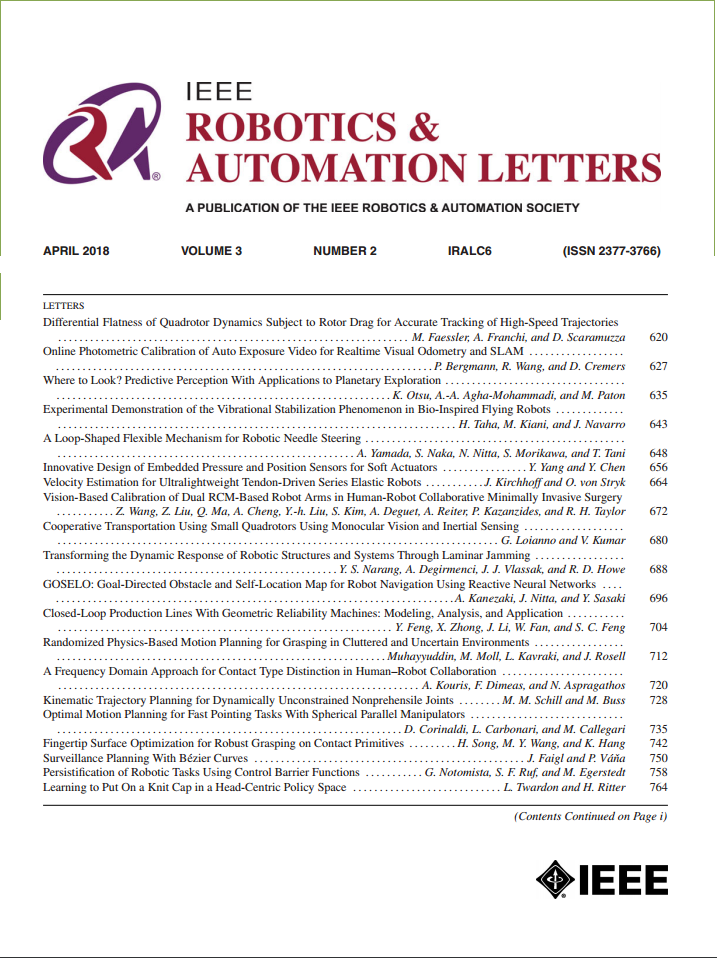
IEEE Robotics and Automation Letters
IEEE Robotics and Automation Letters Computer Science-Computer Science Applications
CiteScore
9.60
自引率
15.40%
发文量
1428
期刊介绍: The scope of this journal is to publish peer-reviewed articles that provide a timely and concise account of innovative research ideas and application results, reporting significant theoretical findings and application case studies in areas of robotics and automation.

×
引用
GB/T 7714-2015
复制
MLA
复制
APA
复制
导出至
BibTeX EndNote RefMan NoteFirst NoteExpress
×
提示
您的信息不完整,为了账户安全,请先补充。
现在去补充
×
提示
您因"违规操作"
具体请查看互助需知
我知道了
×
提示
确定
请完成安全验证×
copy
已复制链接
快去分享给好友吧!
我知道了
右上角分享
点击右上角分享
0
联系我们:info@booksci.cn Book学术提供免费学术资源搜索服务,方便国内外学者检索中英文文献。致力于提供最便捷和优质的服务体验。 Copyright © 2023 布克学术 All rights reserved.
京ICP备2023020795号-1
ghs 京公网安备 11010802042870号
Book学术文献互助
Book学术文献互助群
群 号:604180095
Book学术官方微信
小红书


