
Lie-Algebraic Approach to Geometric Nonlinear $\mathcal {H}_\infty$ Inverse Optimal Attitude Tracking on $SO(3)$

IF 5.3 2区 计算机科学 Q2 ROBOTICS
IEEE Robotics and Automation Letters Pub Date : 2026-07-01 Epub Date: 2026-06-04 DOI:10.1109/LRA.2026.3700377
Junsik Kim;Youngjun Joo;Youngjin Choi
{"title":"Lie-Algebraic Approach to Geometric Nonlinear $\\mathcal {H}_\\infty$ Inverse Optimal Attitude Tracking on $SO(3)$","authors":"Junsik Kim;Youngjun Joo;Youngjin Choi","doi":"10.1109/LRA.2026.3700377","DOIUrl":null,"url":null,"abstract":"This letter presents a geometric nonlinear <inline-formula><tex-math>$\\mathcal {H}_\\infty$</tex-math></inline-formula> inverse optimal attitude tracking framework formulated on <inline-formula><tex-math>$SO(3)$</tex-math></inline-formula> using its Lie algebra <inline-formula><tex-math>$\\mathfrak {so}(3)$</tex-math></inline-formula>. By adopting exponential coordinates <inline-formula><tex-math>$\\bm {\\xi }\\in \\mathfrak {so}(3)$</tex-math></inline-formula>, attitude errors are mapped directly onto the Lie algebra. This preserves a bijective, distortion-free relationship with the geodesic distance within the injectivity radius (<inline-formula><tex-math>$\\Vert \\bm {\\xi }\\Vert &lt; \\pi$</tex-math></inline-formula>), while eliminating singularities and unwinding issues inherent in Euler angles and quaternions. A sliding-mode-inspired nonlinear <inline-formula><tex-math>$\\mathcal {H}_\\infty$</tex-math></inline-formula> controller is developed, with robust stability established using the exponential coordinates and a systematic tuning methodology provided to facilitate practical implementation. Quadrotor simulations demonstrate faster convergence in large-angle maneuvers by mitigating the vanishing error and sluggish response of conventional methods. Experiments on a robotic manipulator validate the tuning rule for the prescribed disturbance attenuation level <inline-formula><tex-math>$\\gamma$</tex-math></inline-formula>, showing that the peak tracking error scales as <inline-formula><tex-math>$\\mathcal {O}(\\gamma ^{2})$</tex-math></inline-formula> for small gains and <inline-formula><tex-math>$\\mathcal {O}(\\gamma)$</tex-math></inline-formula> for large gains. These results demonstrate the robustness and predictability of the proposed framework and the effectiveness of Lie algebra-based attitude control on <inline-formula><tex-math>$SO(3)$</tex-math></inline-formula>.","PeriodicalId":13241,"journal":{"name":"IEEE Robotics and Automation Letters","volume":"11 7","pages":"8920-8927"},"PeriodicalIF":5.3000,"publicationDate":"2026-07-01","publicationTypes":"Journal Article","fieldsOfStudy":null,"isOpenAccess":false,"openAccessPdf":"","citationCount":"0","resultStr":null,"platform":"Semanticscholar","paperid":null,"PeriodicalName":"IEEE Robotics and Automation Letters","FirstCategoryId":"94","ListUrlMain":"https://ieeexplore.ieee.org/document/11551298/","RegionNum":2,"RegionCategory":"计算机科学","ArticlePicture":[],"TitleCN":null,"AbstractTextCN":null,"PMCID":null,"EPubDate":"2026/6/4 0:00:00","PubModel":"Epub","JCR":"Q2","JCRName":"ROBOTICS","Score":null,"Total":0}
引用次数: 0

Abstract

This letter presents a geometric nonlinear $\mathcal {H}_\infty$ inverse optimal attitude tracking framework formulated on $SO(3)$ using its Lie algebra $\mathfrak {so}(3)$. By adopting exponential coordinates $\bm {\xi }\in \mathfrak {so}(3)$, attitude errors are mapped directly onto the Lie algebra. This preserves a bijective, distortion-free relationship with the geodesic distance within the injectivity radius ($\Vert \bm {\xi }\Vert < \pi$), while eliminating singularities and unwinding issues inherent in Euler angles and quaternions. A sliding-mode-inspired nonlinear $\mathcal {H}_\infty$ controller is developed, with robust stability established using the exponential coordinates and a systematic tuning methodology provided to facilitate practical implementation. Quadrotor simulations demonstrate faster convergence in large-angle maneuvers by mitigating the vanishing error and sluggish response of conventional methods. Experiments on a robotic manipulator validate the tuning rule for the prescribed disturbance attenuation level $\gamma$, showing that the peak tracking error scales as $\mathcal {O}(\gamma ^{2})$ for small gains and $\mathcal {O}(\gamma)$ for large gains. These results demonstrate the robustness and predictability of the proposed framework and the effectiveness of Lie algebra-based attitude control on $SO(3)$.
几何非线性的lie -代数方法$\mathcal {H}_\infty$逆最优姿态跟踪 $SO(3)$
本文提出了一个几何非线性$\mathcal {H}_\infty$逆最优姿态跟踪框架,该框架利用李代数$\mathfrak {so}(3)$在$SO(3)$上表述。通过采用指数坐标$\bm {\xi }\in \mathfrak {so}(3)$,姿态误差直接映射到李代数上。这保留了与注入半径内测地线距离的双射、无扭曲关系($\Vert \bm {\xi }\Vert < \pi$),同时消除了欧拉角和四元数固有的奇点和unwind问题。开发了滑模启发的非线性$\mathcal {H}_\infty$控制器,使用指数坐标建立了鲁棒稳定性,并提供了系统调谐方法,以方便实际实施。四旋翼飞行器仿真结果表明,四旋翼飞行器在大角度机动中收敛速度更快,减小了传统方法的消失误差和响应滞后。在机械臂上的实验验证了对规定的干扰衰减水平$\gamma$的调谐规则,表明小增益的峰值跟踪误差尺度为$\mathcal {O}(\gamma ^{2})$,大增益的峰值跟踪误差尺度为$\mathcal {O}(\gamma)$。这些结果证明了所提出的框架的鲁棒性和可预测性,以及基于李代数的姿态控制在$SO(3)$上的有效性。
本文章由计算机程序翻译,如有差异,请以英文原文为准。
求助全文
约1分钟内获得全文 求助全文
来源期刊
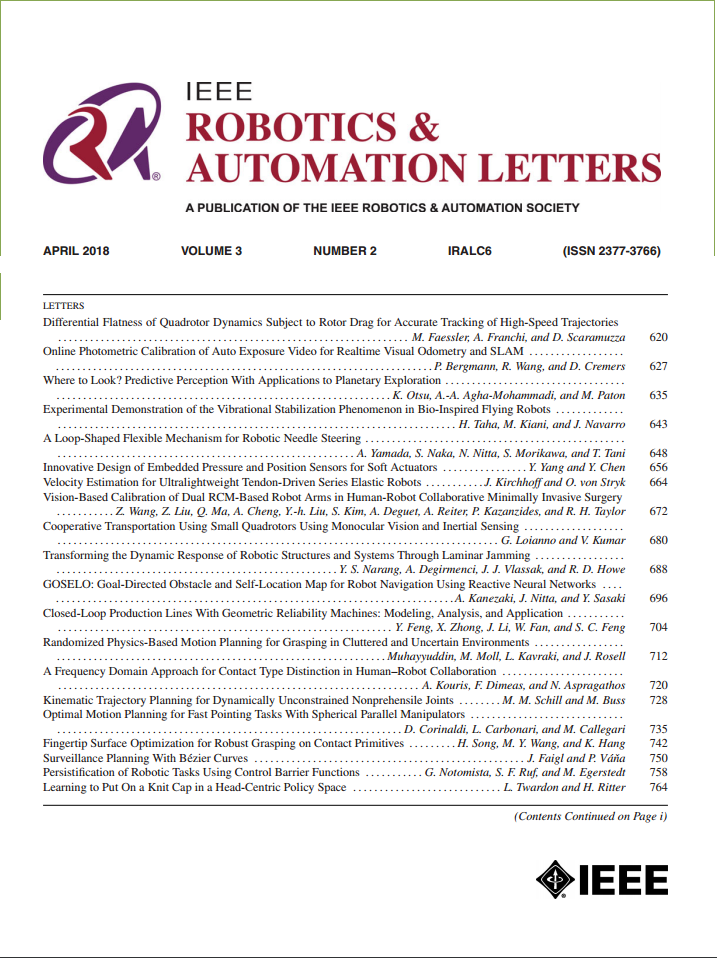
IEEE Robotics and Automation Letters
IEEE Robotics and Automation Letters Computer Science-Computer Science Applications
CiteScore
9.60
自引率
15.40%
发文量
1428
期刊介绍: The scope of this journal is to publish peer-reviewed articles that provide a timely and concise account of innovative research ideas and application results, reporting significant theoretical findings and application case studies in areas of robotics and automation.

×
引用
GB/T 7714-2015
复制
MLA
复制
APA
复制
导出至
BibTeX EndNote RefMan NoteFirst NoteExpress
×
提示
您的信息不完整,为了账户安全,请先补充。
现在去补充
×
提示
您因"违规操作"
具体请查看互助需知
我知道了
×
提示
确定
请完成安全验证×
copy
已复制链接
快去分享给好友吧!
我知道了
右上角分享
点击右上角分享
0
联系我们:info@booksci.cn Book学术提供免费学术资源搜索服务,方便国内外学者检索中英文文献。致力于提供最便捷和优质的服务体验。 Copyright © 2023 布克学术 All rights reserved.
京ICP备2023020795号-1
ghs 京公网安备 11010802042870号
Book学术文献互助
Book学术文献互助群
群 号:604180095
Book学术官方微信
小红书


