{"title":"Electrochemical Hydrogen Looping to Enable Efficient Reverse Osmosis Concentrate Valorization via pH-Mediated Mineral Precipitation","authors":"Sheraz Bashir, and , Taeyoung Kim*, ","doi":"10.1021/acs.estlett.6c00331","DOIUrl":null,"url":null,"abstract":"<p >Electrochemical technologies enable a chemical-free, pH-induced precipitation of scaling ions present in reverse osmosis concentrate (ROC) or brine, thereby advancing both water and resource recovery. Here, we pioneer a proof-of-concept electrochemical hydrogen-looping process that significantly reduces the energy consumption required for precipitation without generating byproducts, thereby opening a new pathway for brine valorization. The key innovation involves the reuse of hydrogen produced by the hydrogen evolution reaction (HER) for the hydrogen oxidation reaction (HOR). The OH<sup>–</sup> generated via the HER (5 mA cm<sup>–2</sup>) enabled >70% hardness reduction using a simulated brackish water ROC sample. The required cell voltage (0.89 V) was 66% lower than that coupled with the conventional oxygen evolution reaction (2.64 V). This reduction was achieved by the thermodynamically/kinetically favored HOR, which also suppressed the undesired chlorine evolution reaction. The energy consumption for precipitation (0.45 kWh kg<sup>–1</sup> as CaCO<sub>3</sub>) was reduced by approximately 90% relative to the previous study reporting the highest precipitation rate, while simultaneously achieving the highest productivity (2.43 kg CaCO<sub>3</sub> h<sup>–1</sup> m<sup>–2</sup>) reported to date. We also validated the process by recovering both CaCO<sub>3</sub> and Mg(OH)<sub>2</sub> from actual ROC samples, demonstrating its potential for brine mining. Overall, these findings establish electrochemical hydrogen looping as a promising strategy for brine valorization.</p>","PeriodicalId":37,"journal":{"name":"Environmental Science & Technology Letters Environ.","volume":"13 7","pages":"1016–1022"},"PeriodicalIF":7.3000,"publicationDate":"2026-07-14","publicationTypes":"Journal Article","fieldsOfStudy":null,"isOpenAccess":false,"openAccessPdf":"","citationCount":"0","resultStr":null,"platform":"Semanticscholar","paperid":null,"PeriodicalName":"Environmental Science & Technology Letters Environ.","FirstCategoryId":"1","ListUrlMain":"https://pubs.acs.org/doi/10.1021/acs.estlett.6c00331","RegionNum":2,"RegionCategory":"环境科学与生态学","ArticlePicture":[],"TitleCN":null,"AbstractTextCN":null,"PMCID":null,"EPubDate":"2026/6/11 0:00:00","PubModel":"Epub","JCR":"Q1","JCRName":"ENGINEERING, ENVIRONMENTAL","Score":null,"Total":0}
引用次数: 0
Abstract
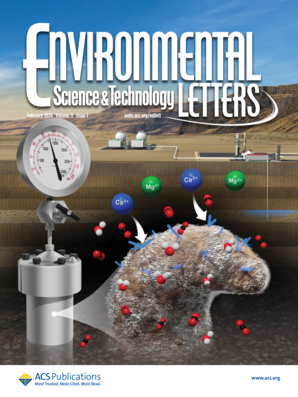
Electrochemical technologies enable a chemical-free, pH-induced precipitation of scaling ions present in reverse osmosis concentrate (ROC) or brine, thereby advancing both water and resource recovery. Here, we pioneer a proof-of-concept electrochemical hydrogen-looping process that significantly reduces the energy consumption required for precipitation without generating byproducts, thereby opening a new pathway for brine valorization. The key innovation involves the reuse of hydrogen produced by the hydrogen evolution reaction (HER) for the hydrogen oxidation reaction (HOR). The OH– generated via the HER (5 mA cm–2) enabled >70% hardness reduction using a simulated brackish water ROC sample. The required cell voltage (0.89 V) was 66% lower than that coupled with the conventional oxygen evolution reaction (2.64 V). This reduction was achieved by the thermodynamically/kinetically favored HOR, which also suppressed the undesired chlorine evolution reaction. The energy consumption for precipitation (0.45 kWh kg–1 as CaCO3) was reduced by approximately 90% relative to the previous study reporting the highest precipitation rate, while simultaneously achieving the highest productivity (2.43 kg CaCO3 h–1 m–2) reported to date. We also validated the process by recovering both CaCO3 and Mg(OH)2 from actual ROC samples, demonstrating its potential for brine mining. Overall, these findings establish electrochemical hydrogen looping as a promising strategy for brine valorization.
期刊介绍:
Environmental Science & Technology Letters serves as an international forum for brief communications on experimental or theoretical results of exceptional timeliness in all aspects of environmental science, both pure and applied. Published as soon as accepted, these communications are summarized in monthly issues. Additionally, the journal features short reviews on emerging topics in environmental science and technology.


 求助内容:
 应助结果提醒方式:


 京公网安备 11010802042870号


