
Genetically targeted photocatalytic organic dyes for spatiotemporally controlled organic synthesis in specific living cells
IF 24.5
1区 化学
Q1 CHEMISTRY, MULTIDISCIPLINARY
引用次数: 0
Abstract
The catalytic synthesis of many abiotic organic compounds is beyond the native capabilities of mammalian cells. Broadening the range of physiologically compatible, bond-forming catalytic reactions could enable the in situ synthesis of diverse molecules within living systems. By controlling these reactions in both specific cells and in physical space, this approach could offer transformative ways to modulate cellular behaviour and treat cells as distinct reaction vessels within organisms. Here we use genetic targeting to incorporate organic photocatalytic dyes onto and within cells to enable cell-type-specific and spatially defined catalysis. Photocatalysis can be restricted to individual cells using mild, green-to-red visible stimulation. The dyes catalyse cross-dehydrogenative C–H functionalization for the light- and cell-specific construction of C–C bonds in situ. Nuclear-localized assembly directs protein translocation with reversed transport directionality, illustrating the utility of this approach to both generate and enhance the function of chemical biology tools. We anticipate that the integration of synthetic catalysts with cell-specific targeting may lay an important foundation for future precision-directed abiotic chemical synthesis in living organisms. Adapting abiotic catalysis to living cells broadens the scope of in situ non-natural synthesis, but it is challenging to achieve synthetic versatility at cellular-level spatiotemporal organization. Now organic dyes have been shown to perform light- and genetically patternable photocatalytic synthesis, enabling in situ C–H functionalization and the construction of ligands for protein translocation.基因靶向光催化有机染料用于特定活细胞的时空控制有机合成
许多非生物有机化合物的催化合成超出了哺乳动物细胞的天然能力。扩大生理上兼容的范围,形成键的催化反应可以使生物系统内各种分子的原位合成成为可能。通过在特定细胞和物理空间中控制这些反应,这种方法可以提供变革性的方法来调节细胞行为,并将细胞视为生物体内独特的反应血管。在这里,我们使用基因靶向将有机光催化染料结合到细胞上和细胞内,以实现细胞类型特异性和空间定义的催化。光催化可以限制在单个细胞使用温和的,绿色到红色的可见刺激。染料催化交叉脱氢C-H功能化,用于原位构建光和细胞特异性的C-C键。核定位组装以反向运输方向指导蛋白质易位,说明了这种方法在生成和增强化学生物学工具功能方面的实用性。我们预计,合成催化剂与细胞特异性靶向的整合可能为未来生物体内精确定向的非生物化学合成奠定重要基础。
本文章由计算机程序翻译,如有差异,请以英文原文为准。
求助全文
约1分钟内获得全文
求助全文
来源期刊
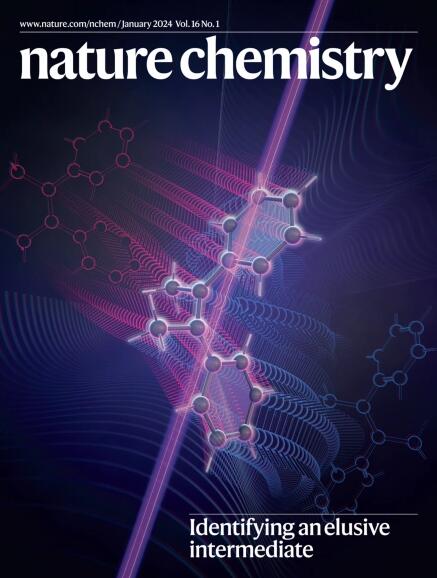
Nature chemistry
化学-化学综合
CiteScore
29.60
自引率
1.40%
发文量
226
审稿时长
1.7 months
期刊介绍:
Nature Chemistry is a monthly journal that publishes groundbreaking and significant research in all areas of chemistry. It covers traditional subjects such as analytical, inorganic, organic, and physical chemistry, as well as a wide range of other topics including catalysis, computational and theoretical chemistry, and environmental chemistry.
The journal also features interdisciplinary research at the interface of chemistry with biology, materials science, nanotechnology, and physics. Manuscripts detailing such multidisciplinary work are encouraged, as long as the central theme pertains to chemistry.
Aside from primary research, Nature Chemistry publishes review articles, news and views, research highlights from other journals, commentaries, book reviews, correspondence, and analysis of the broader chemical landscape. It also addresses crucial issues related to education, funding, policy, intellectual property, and the societal impact of chemistry.
Nature Chemistry is dedicated to ensuring the highest standards of original research through a fair and rigorous review process. It offers authors maximum visibility for their papers, access to a broad readership, exceptional copy editing and production standards, rapid publication, and independence from academic societies and other vested interests.
Overall, Nature Chemistry aims to be the authoritative voice of the global chemical community.
 求助内容:
 应助结果提醒方式:


 京公网安备 11010802042870号


