Cross-Linking Surface Chemistry Regulation by an Ionic Complex Anchored Interlayer for Stable Li Metal Batteries

IF 19.9 1区 材料科学 Q1 CHEMISTRY, MULTIDISCIPLINARY
Advanced Functional Materials Pub Date : 2026-08-03 Epub Date: 2026-07-09 DOI:10.1002/adfm.76917
Shun Wu, Zhendong Li, Yanyan Chen, Qinhao Mao, Yifei Cheng, Boyi Ma, Haoyang Shen, Zhenlian Chen, Deyu Wang, Zhe Peng
{"title":"Cross-Linking Surface Chemistry Regulation by an Ionic Complex Anchored Interlayer for Stable Li Metal Batteries","authors":"Shun Wu,&nbsp;Zhendong Li,&nbsp;Yanyan Chen,&nbsp;Qinhao Mao,&nbsp;Yifei Cheng,&nbsp;Boyi Ma,&nbsp;Haoyang Shen,&nbsp;Zhenlian Chen,&nbsp;Deyu Wang,&nbsp;Zhe Peng","doi":"10.1002/adfm.76917","DOIUrl":null,"url":null,"abstract":"<div>\n \n <p>Lithium (Li) metal batteries (LMBs) using a Li anode and nickel (Ni)-rich cathode constitute a promising powering solution for long-range electric vehicles. Unfortunately, both the Li anode and Ni-rich cathode suffer from surface deterioration-related failures. Herein, an ionic complex-anchored interlayer consisting of positively charged skeletons with conjugated π bonds, Li<sup>+</sup> ions, and functional anions is investigated to trigger a cross-linked surface chemistry regulation in LMBs. It is revealed that the Li<sup>+</sup> and anions electrostatically anchored on the interlayer can be released to alter the crossover electrochemistry of LMB for durable electrode interphases. Furthermore, by presetting the interlayer on a carbonaceous scaffold, an extended delocalization path of π electrons enables uniform adsorption of the anions, while the prelithiated carbon scaffold by Li<sup>+</sup> from the interlayer facilitates the anion decomposition to form a robust bilayer surface, affording reversible Li plating/stripping with high average coulombic efficiency beyond 99.5% over 500 cycles. Simultaneously, the modified cathode interphase withstands structural stability of the Ni-rich materials and mitigates current collector corrosion efficiently. These merits lead to significantly enhanced performance of LMBs, where stable cycling over 150 cycles is achieved for an anode-free pouch cell with a high cathode loading of 6 mAh cm<sup>−2</sup>.</p>\n </div>","PeriodicalId":112,"journal":{"name":"Advanced Functional Materials","volume":"36 62","pages":""},"PeriodicalIF":19.9000,"publicationDate":"2026-08-03","publicationTypes":"Journal Article","fieldsOfStudy":null,"isOpenAccess":false,"openAccessPdf":"","citationCount":"0","resultStr":null,"platform":"Semanticscholar","paperid":null,"PeriodicalName":"Advanced Functional Materials","FirstCategoryId":"88","ListUrlMain":"https://onlinelibrary.wiley.com/doi/10.1002/adfm.76917","RegionNum":1,"RegionCategory":"材料科学","ArticlePicture":[],"TitleCN":null,"AbstractTextCN":null,"PMCID":null,"EPubDate":"2026/7/9 0:00:00","PubModel":"Epub","JCR":"Q1","JCRName":"CHEMISTRY, MULTIDISCIPLINARY","Score":null,"Total":0}
引用次数: 0

Abstract

Lithium (Li) metal batteries (LMBs) using a Li anode and nickel (Ni)-rich cathode constitute a promising powering solution for long-range electric vehicles. Unfortunately, both the Li anode and Ni-rich cathode suffer from surface deterioration-related failures. Herein, an ionic complex-anchored interlayer consisting of positively charged skeletons with conjugated π bonds, Li+ ions, and functional anions is investigated to trigger a cross-linked surface chemistry regulation in LMBs. It is revealed that the Li+ and anions electrostatically anchored on the interlayer can be released to alter the crossover electrochemistry of LMB for durable electrode interphases. Furthermore, by presetting the interlayer on a carbonaceous scaffold, an extended delocalization path of π electrons enables uniform adsorption of the anions, while the prelithiated carbon scaffold by Li+ from the interlayer facilitates the anion decomposition to form a robust bilayer surface, affording reversible Li plating/stripping with high average coulombic efficiency beyond 99.5% over 500 cycles. Simultaneously, the modified cathode interphase withstands structural stability of the Ni-rich materials and mitigates current collector corrosion efficiently. These merits lead to significantly enhanced performance of LMBs, where stable cycling over 150 cycles is achieved for an anode-free pouch cell with a high cathode loading of 6 mAh cm−2.

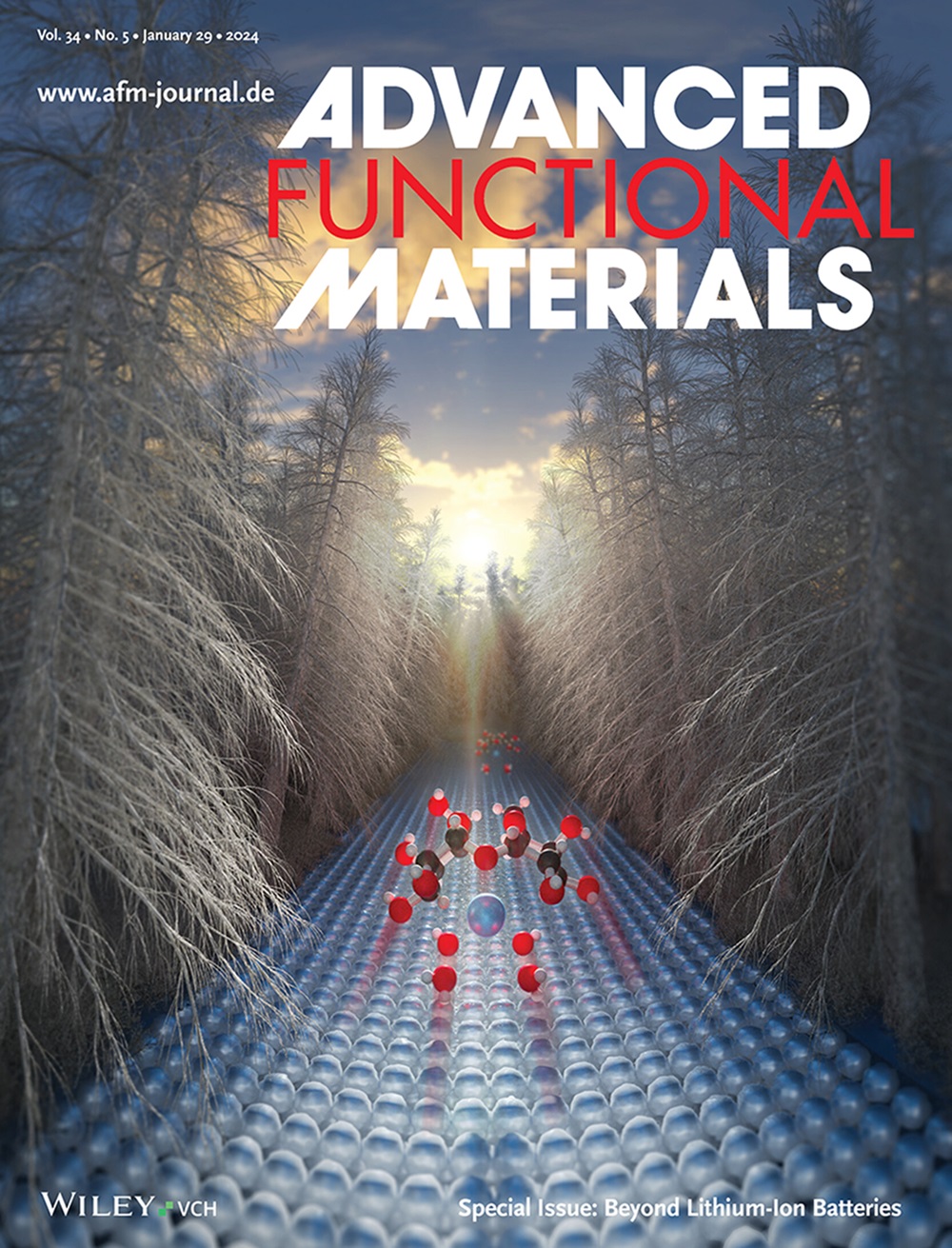
Abstract Image

Abstract Image

稳定锂金属电池中离子配合物锚定夹层的交联表面化学调控
提出了一种离子配合物锚定间层来改变锂金属电池的交叉电化学,从而实现阳极和阴极的交联表面化学调节,以稳定无阳极袋状电池。
本文章由计算机程序翻译,如有差异,请以英文原文为准。
求助全文
约1分钟内获得全文 求助全文
来源期刊
Advanced Functional Materials
Advanced Functional Materials 工程技术-材料科学:综合
CiteScore
29.50
自引率
4.20%
发文量
2086
审稿时长
2.1 months
期刊介绍: Firmly established as a top-tier materials science journal, Advanced Functional Materials reports breakthrough research in all aspects of materials science, including nanotechnology, chemistry, physics, and biology every week. Advanced Functional Materials is known for its rapid and fair peer review, quality content, and high impact, making it the first choice of the international materials science community.
×
引用
GB/T 7714-2015
复制
MLA
复制
APA
复制
导出至
BibTeX EndNote RefMan NoteFirst NoteExpress
×
提示
您的信息不完整,为了账户安全,请先补充。
现在去补充
×
提示
您因"违规操作"
具体请查看互助需知
我知道了
×
提示
确定
请完成安全验证×
copy
已复制链接
快去分享给好友吧!
我知道了
右上角分享
点击右上角分享
0
联系我们:info@booksci.cn Book学术提供免费学术资源搜索服务,方便国内外学者检索中英文文献。致力于提供最便捷和优质的服务体验。 Copyright © 2023 布克学术 All rights reserved.
京ICP备2023020795号-1
ghs 京公网安备 11010802042870号
Book学术文献互助
Book学术文献互助群
群 号:604180095
Book学术官方微信
小红书