Erik L Knight, Gideon Nave, Steven D Shaw, Coren Apicella, Pierre L Bonin, Anna Dreber, Shawn N Geniole, Magnus Johannesson, Dylan Manfredi, Pranjal Mehta, Valentina Proietti, Steven J Stanton, Francesca R Luberti, Triana Ortiz, Justin M Carré
{"title":"Does Testosterone Affect Cognitive Reflection? Evidence From a Double-Blind, Randomized Controlled Study of 1,000 Participants.","authors":"Erik L Knight, Gideon Nave, Steven D Shaw, Coren Apicella, Pierre L Bonin, Anna Dreber, Shawn N Geniole, Magnus Johannesson, Dylan Manfredi, Pranjal Mehta, Valentina Proietti, Steven J Stanton, Francesca R Luberti, Triana Ortiz, Justin M Carré","doi":"10.1177/09567976261458325","DOIUrl":null,"url":null,"abstract":"<p><p>The cognitive reflection test (CRT) measures reliance on intuitive thinking versus deliberate reasoning and predicts important real-world outcomes. Prior research has suggested that testosterone administration impaired CRT performance, but follow-up studies produced null results. To provide a rigorous test, we conducted a large, preregistered, double-blind, placebo-controlled experiment, unprecedented in size, with 1,000 adult men, as part of an adversarial collaboration. Participants received a single dose of intranasal testosterone or placebo, completed the CRT, and rated their confidence level. We found an insignificant treatment effect on the CRT, with the point estimate in the opposite direction of the original hypothesis (β<sub>LOGIT</sub> = 0.118, 95% confidence interval (CI) = [-0.099, 0.335]). In a second primary test, we found a significant negative treatment effect on confidence (β<sub>LOGIT</sub> = -0.329, 95% CI = [-0.558, -0.100]), which is also the opposite of our prediction. Our findings challenge earlier claims about testosterone's cognitive effects and highlight the importance of high-powered replications. Long-term or developmental testosterone effects remain potentially important but difficult to study.</p>","PeriodicalId":20745,"journal":{"name":"Psychological Science","volume":" ","pages":"463-476"},"PeriodicalIF":5.4000,"publicationDate":"2026-07-01","publicationTypes":"Journal Article","fieldsOfStudy":null,"isOpenAccess":false,"openAccessPdf":"https://www.ncbi.nlm.nih.gov/pmc/articles/PMC13428848/pdf/","citationCount":"0","resultStr":null,"platform":"Semanticscholar","paperid":null,"PeriodicalName":"Psychological Science","FirstCategoryId":"102","ListUrlMain":"https://doi.org/10.1177/09567976261458325","RegionNum":1,"RegionCategory":"心理学","ArticlePicture":[],"TitleCN":null,"AbstractTextCN":null,"PMCID":null,"EPubDate":"2026/7/2 0:00:00","PubModel":"Epub","JCR":"Q1","JCRName":"PSYCHOLOGY, MULTIDISCIPLINARY","Score":null,"Total":0}
引用次数: 0
Abstract
The cognitive reflection test (CRT) measures reliance on intuitive thinking versus deliberate reasoning and predicts important real-world outcomes. Prior research has suggested that testosterone administration impaired CRT performance, but follow-up studies produced null results. To provide a rigorous test, we conducted a large, preregistered, double-blind, placebo-controlled experiment, unprecedented in size, with 1,000 adult men, as part of an adversarial collaboration. Participants received a single dose of intranasal testosterone or placebo, completed the CRT, and rated their confidence level. We found an insignificant treatment effect on the CRT, with the point estimate in the opposite direction of the original hypothesis (βLOGIT = 0.118, 95% confidence interval (CI) = [-0.099, 0.335]). In a second primary test, we found a significant negative treatment effect on confidence (βLOGIT = -0.329, 95% CI = [-0.558, -0.100]), which is also the opposite of our prediction. Our findings challenge earlier claims about testosterone's cognitive effects and highlight the importance of high-powered replications. Long-term or developmental testosterone effects remain potentially important but difficult to study.
期刊介绍:
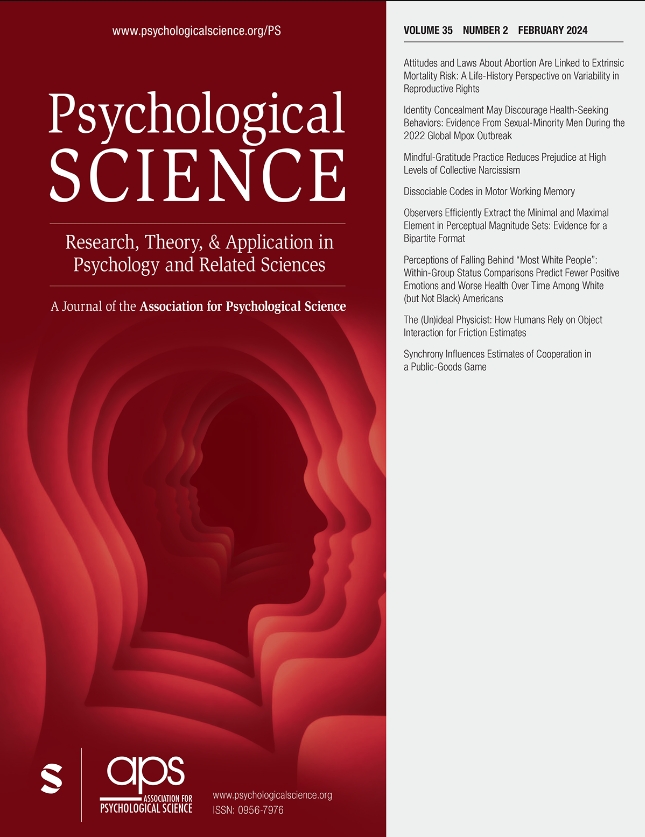
Psychological Science, the flagship journal of The Association for Psychological Science (previously the American Psychological Society), is a leading publication in the field with a citation ranking/impact factor among the top ten worldwide. It publishes authoritative articles covering various domains of psychological science, including brain and behavior, clinical science, cognition, learning and memory, social psychology, and developmental psychology. In addition to full-length articles, the journal features summaries of new research developments and discussions on psychological issues in government and public affairs. "Psychological Science" is published twelve times annually.

 求助内容:
 应助结果提醒方式:


 京公网安备 11010802042870号


