Yanping Li, Lanlan Gan, Yuanlin Wu, Yumeng Liu, Ni Zhang, Tingting Jiang, Jianhong Chen, Fang Liu, Dan Peng, Yao Liu
{"title":"A Critical Review of Cytochrome P450 Enzyme Inhibition by Herbal Phytochemicals: Implications for Drug Interaction Prediction and Herbal Safety.","authors":"Yanping Li, Lanlan Gan, Yuanlin Wu, Yumeng Liu, Ni Zhang, Tingting Jiang, Jianhong Chen, Fang Liu, Dan Peng, Yao Liu","doi":"10.1002/ptr.70414","DOIUrl":null,"url":null,"abstract":"<p><p>Cytochrome P450 (CYP450) enzymes are the most important phase I drug-metabolizing enzymes in humans, and regulation of their activity is directly related to drug efficacy and safety. As herbal medicines gain worldwide popularity, their concurrent use with drugs has become more common. The effect of phytochemicals from herbal sources on CYP450 activity is a critical factor contributing to clinical drug interactions. When CYP450 activity is inhibited, it is easy to cause the accumulation of substrate drugs and cause toxic side effects, or the formation of toxic intermediates due to altered metabolic pathways, which seriously threaten the medication safety of patients. However, only a limited number of herbs have been evaluated for their impact on CYP450 enzyme activity, and data on the inhibitory effects of key CYP450 isoforms involved in drug metabolism remain scarce. Particularly noteworthy is the lack of research on the mechanisms of herb-drug interactions (HDIs) and the constituents of compound herbs, which impedes comprehensive identification and evaluation of potential clinical risks. This paper provides a systematic summary of CYP450 phytochemical inhibitors such as alkaloids, quinones, flavonoids, terpenoids, and coumarins in herbal medicine. In addition to the common CYP450 isoforms (e.g., CYP1A1, CYP1A2, CYP2C9, CYP2C19, CYP2D6, CYP2E1, and CYP3A4), this review also focuses on some less frequently studied isoforms, including CYP1B1, CYP7A1, CYP8B1, CYP17A1, and CYP19A1. Through an in-depth analysis of the current research limitations, this study proposes targeted directions for technological innovation and research standardization, thereby providing a scientific basis for addressing the research gap in HDIs and herb-herb interactions (HHIs) and formulating strategies for the rational use of herbs and standards for safety evaluation.</p>","PeriodicalId":20110,"journal":{"name":"Phytotherapy Research","volume":" ","pages":"5672-5719"},"PeriodicalIF":8.1000,"publicationDate":"2026-10-01","publicationTypes":"Journal Article","fieldsOfStudy":null,"isOpenAccess":false,"openAccessPdf":"","citationCount":"0","resultStr":null,"platform":"Semanticscholar","paperid":null,"PeriodicalName":"Phytotherapy Research","FirstCategoryId":"3","ListUrlMain":"https://doi.org/10.1002/ptr.70414","RegionNum":2,"RegionCategory":"医学","ArticlePicture":[],"TitleCN":null,"AbstractTextCN":null,"PMCID":null,"EPubDate":"2026/7/2 0:00:00","PubModel":"Epub","JCR":"Q1","JCRName":"CHEMISTRY, MEDICINAL","Score":null,"Total":0}
引用次数: 0
Abstract
Cytochrome P450 (CYP450) enzymes are the most important phase I drug-metabolizing enzymes in humans, and regulation of their activity is directly related to drug efficacy and safety. As herbal medicines gain worldwide popularity, their concurrent use with drugs has become more common. The effect of phytochemicals from herbal sources on CYP450 activity is a critical factor contributing to clinical drug interactions. When CYP450 activity is inhibited, it is easy to cause the accumulation of substrate drugs and cause toxic side effects, or the formation of toxic intermediates due to altered metabolic pathways, which seriously threaten the medication safety of patients. However, only a limited number of herbs have been evaluated for their impact on CYP450 enzyme activity, and data on the inhibitory effects of key CYP450 isoforms involved in drug metabolism remain scarce. Particularly noteworthy is the lack of research on the mechanisms of herb-drug interactions (HDIs) and the constituents of compound herbs, which impedes comprehensive identification and evaluation of potential clinical risks. This paper provides a systematic summary of CYP450 phytochemical inhibitors such as alkaloids, quinones, flavonoids, terpenoids, and coumarins in herbal medicine. In addition to the common CYP450 isoforms (e.g., CYP1A1, CYP1A2, CYP2C9, CYP2C19, CYP2D6, CYP2E1, and CYP3A4), this review also focuses on some less frequently studied isoforms, including CYP1B1, CYP7A1, CYP8B1, CYP17A1, and CYP19A1. Through an in-depth analysis of the current research limitations, this study proposes targeted directions for technological innovation and research standardization, thereby providing a scientific basis for addressing the research gap in HDIs and herb-herb interactions (HHIs) and formulating strategies for the rational use of herbs and standards for safety evaluation.
期刊介绍:
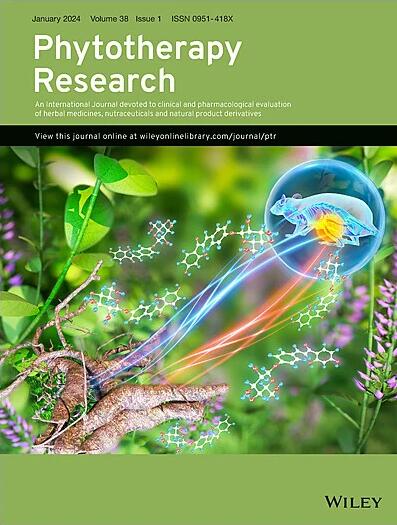
Phytotherapy Research is an internationally recognized pharmacological journal that serves as a trailblazing resource for biochemists, pharmacologists, and toxicologists. We strive to disseminate groundbreaking research on medicinal plants, pushing the boundaries of knowledge and understanding in this field.
Our primary focus areas encompass pharmacology, toxicology, and the clinical applications of herbs and natural products in medicine. We actively encourage submissions on the effects of commonly consumed food ingredients and standardized plant extracts. We welcome a range of contributions including original research papers, review articles, and letters.
By providing a platform for the latest developments and discoveries in phytotherapy, we aim to support the advancement of scientific knowledge and contribute to the improvement of modern medicine.

 求助内容:
 应助结果提醒方式:


 京公网安备 11010802042870号


