Kaiyu Hou, Biao Yang, Rong Zhao, Jinwei Zhang, Yun Duan
{"title":"Dose-dependent effects of biochar on low-temperature anammox: reactor performance, community variation, and functional potential.","authors":"Kaiyu Hou, Biao Yang, Rong Zhao, Jinwei Zhang, Yun Duan","doi":"10.1016/j.biortech.2026.135296","DOIUrl":null,"url":null,"abstract":"<p><p>Low temperature is a major constraint on the practical application of anaerobic ammonium oxidation (anammox). Although biochar has been reported to improve low-temperature anammox, the effect of dosage remains insufficiently understood. In this study, mature anammox sludge was amended with 0, 3, 7, and 9 g/L bamboo-derived biochar and operated under a stepwise temperature decrease from 35 to 15°C, followed by low-temperature operation for 70 d. Reactor performance, extracellular polymeric substances (EPS), microbial community composition, and metagenomic functional potential were analyzed to clarify the dose effect of biochar. Among the tested dosages, 7 g/L biochar achieved the highest nitrogen removal efficiency (48.6%) at 15°C, which was 12.8 percentage points higher than the control value of 35.8%. Biochar-amended reactors also showed higher EPS contents than the control, and the 7 g/L group better maintained the PN/PS ratio under low-temperature stress. Community analysis indicated a higher relative abundance of Candidatus Brocadia in the biochar-amended groups, especially at 7 g/L. Metagenomic analysis further showed higher abundance of genes associated with nitrogen metabolism, carbon metabolism, and EPS-related precursor synthesis in the 7 g/L group. These results suggest that an appropriate biochar dosage can improve low-temperature anammox performance and is associated with EPS stabilization, enrichment of key functional taxa, and enhanced functional potential. This study provides guidance for biochar dosage optimization in low-temperature anammox systems.</p>","PeriodicalId":258,"journal":{"name":"Bioresource Technology","volume":" ","pages":"135296"},"PeriodicalIF":8.2000,"publicationDate":"2026-11-01","publicationTypes":"Journal Article","fieldsOfStudy":null,"isOpenAccess":false,"openAccessPdf":"","citationCount":"0","resultStr":null,"platform":"Semanticscholar","paperid":null,"PeriodicalName":"Bioresource Technology","FirstCategoryId":"5","ListUrlMain":"https://doi.org/10.1016/j.biortech.2026.135296","RegionNum":1,"RegionCategory":"环境科学与生态学","ArticlePicture":[],"TitleCN":null,"AbstractTextCN":null,"PMCID":null,"EPubDate":"2026/7/2 0:00:00","PubModel":"Epub","JCR":"Q1","JCRName":"AGRICULTURAL ENGINEERING","Score":null,"Total":0}
引用次数: 0
Abstract
Low temperature is a major constraint on the practical application of anaerobic ammonium oxidation (anammox). Although biochar has been reported to improve low-temperature anammox, the effect of dosage remains insufficiently understood. In this study, mature anammox sludge was amended with 0, 3, 7, and 9 g/L bamboo-derived biochar and operated under a stepwise temperature decrease from 35 to 15°C, followed by low-temperature operation for 70 d. Reactor performance, extracellular polymeric substances (EPS), microbial community composition, and metagenomic functional potential were analyzed to clarify the dose effect of biochar. Among the tested dosages, 7 g/L biochar achieved the highest nitrogen removal efficiency (48.6%) at 15°C, which was 12.8 percentage points higher than the control value of 35.8%. Biochar-amended reactors also showed higher EPS contents than the control, and the 7 g/L group better maintained the PN/PS ratio under low-temperature stress. Community analysis indicated a higher relative abundance of Candidatus Brocadia in the biochar-amended groups, especially at 7 g/L. Metagenomic analysis further showed higher abundance of genes associated with nitrogen metabolism, carbon metabolism, and EPS-related precursor synthesis in the 7 g/L group. These results suggest that an appropriate biochar dosage can improve low-temperature anammox performance and is associated with EPS stabilization, enrichment of key functional taxa, and enhanced functional potential. This study provides guidance for biochar dosage optimization in low-temperature anammox systems.
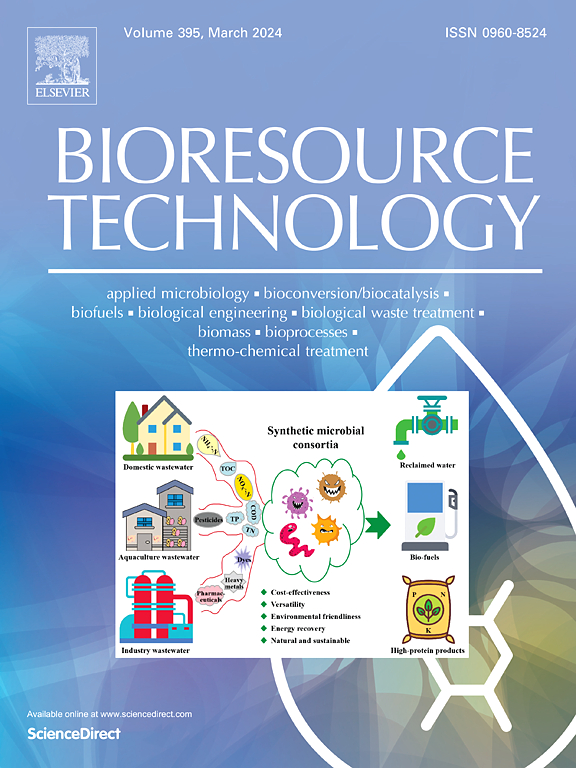
期刊介绍:
Bioresource Technology publishes original articles, review articles, case studies, and short communications covering the fundamentals, applications, and management of bioresource technology. The journal seeks to advance and disseminate knowledge across various areas related to biomass, biological waste treatment, bioenergy, biotransformations, bioresource systems analysis, and associated conversion or production technologies.
Topics include:
• Biofuels: liquid and gaseous biofuels production, modeling and economics
• Bioprocesses and bioproducts: biocatalysis and fermentations
• Biomass and feedstocks utilization: bioconversion of agro-industrial residues
• Environmental protection: biological waste treatment
• Thermochemical conversion of biomass: combustion, pyrolysis, gasification, catalysis.

 求助内容:
求助内容: 应助结果提醒方式:

 京公网安备 11010802042870号


