{"title":"[Mendelian randomization study on related factors for esophageal adenocarcinoma and Barrett's esophagus].","authors":"Y R Zhang, X T Yang, Y Zhong, X R Yang, M Lyu","doi":"10.3760/cma.j.cn112338-20251011-00711","DOIUrl":null,"url":null,"abstract":"<p><p><b>Objective:</b> To investigate the causal associations between 47 potential risk factors and the risks of Barrett's esophagus (BE) and esophageal adenocarcinoma (EAC) using Mendelian randomization (MR). <b>Methods:</b> Genome-wide association study summary statistics for 47 exposures, as well as for BE and EAC, were included. The causal associations were evaluated using the random-effects inverse variance weighted method. Horizontal pleiotropy was assessed using MR-Egger and MR-PRESSO methods. The Benjamini-Hochberg method was applied for multiple testing correction. <b>Results:</b> The MR analysis showed that waist-to-hip ratio, body fat percentage, trunk fat mass, trunk fat percentage, whole-body fat mass, and never smoking were causally associated with the risk of BE (adjusted <i>P</i><0.05). Body mass index, waist circumference, hip circumference, body fat percentage, trunk fat mass, trunk fat percentage, whole-body fat mass, basal metabolic rate, duration of regular smoking, educational attainment (college or above), and years of education were causally associated with the risk of EAC (adjusted <i>P</i><0.05). <b>Conclusions:</b> Genetically predicted obesity-related traits and never smoking were causally associated with the risk of BE. Obesity-related traits, basal metabolic rate, duration of regular smoking, educational attainment (college or above), and years of education were causally associated with the risk of EAC.</p>","PeriodicalId":23968,"journal":{"name":"中华流行病学杂志","volume":"47 6","pages":"1151-1157"},"PeriodicalIF":0.0000,"publicationDate":"2026-06-10","publicationTypes":"Journal Article","fieldsOfStudy":null,"isOpenAccess":false,"openAccessPdf":"","citationCount":"0","resultStr":null,"platform":"Semanticscholar","paperid":null,"PeriodicalName":"中华流行病学杂志","FirstCategoryId":"3","ListUrlMain":"https://doi.org/10.3760/cma.j.cn112338-20251011-00711","RegionNum":0,"RegionCategory":null,"ArticlePicture":[],"TitleCN":null,"AbstractTextCN":null,"PMCID":null,"EPubDate":"","PubModel":"","JCR":"Q1","JCRName":"Medicine","Score":null,"Total":0}
引用次数: 0
Abstract
Objective: To investigate the causal associations between 47 potential risk factors and the risks of Barrett's esophagus (BE) and esophageal adenocarcinoma (EAC) using Mendelian randomization (MR). Methods: Genome-wide association study summary statistics for 47 exposures, as well as for BE and EAC, were included. The causal associations were evaluated using the random-effects inverse variance weighted method. Horizontal pleiotropy was assessed using MR-Egger and MR-PRESSO methods. The Benjamini-Hochberg method was applied for multiple testing correction. Results: The MR analysis showed that waist-to-hip ratio, body fat percentage, trunk fat mass, trunk fat percentage, whole-body fat mass, and never smoking were causally associated with the risk of BE (adjusted P<0.05). Body mass index, waist circumference, hip circumference, body fat percentage, trunk fat mass, trunk fat percentage, whole-body fat mass, basal metabolic rate, duration of regular smoking, educational attainment (college or above), and years of education were causally associated with the risk of EAC (adjusted P<0.05). Conclusions: Genetically predicted obesity-related traits and never smoking were causally associated with the risk of BE. Obesity-related traits, basal metabolic rate, duration of regular smoking, educational attainment (college or above), and years of education were causally associated with the risk of EAC.
期刊介绍:
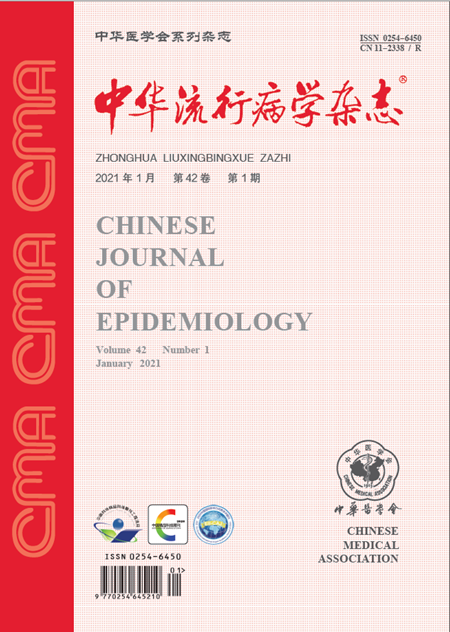
Chinese Journal of Epidemiology, established in 1981, is an advanced academic periodical in epidemiology and related disciplines in China, which, according to the principle of integrating theory with practice, mainly reports the major progress in epidemiological research. The columns of the journal include commentary, expert forum, original article, field investigation, disease surveillance, laboratory research, clinical epidemiology, basic theory or method and review, etc.
The journal is included by more than ten major biomedical databases and index systems worldwide, such as been indexed in Scopus, PubMed/MEDLINE, PubMed Central (PMC), Europe PubMed Central, Embase, Chemical Abstract, Chinese Science and Technology Paper and Citation Database (CSTPCD), Chinese core journal essentials overview, Chinese Science Citation Database (CSCD) core database, Chinese Biological Medical Disc (CBMdisc), and Chinese Medical Citation Index (CMCI), etc. It is one of the core academic journals and carefully selected core journals in preventive and basic medicine in China.

 求助内容:
 应助结果提醒方式:


 京公网安备 11010802042870号


