{"title":"Determination of Polychlorophenols in River Bottom Sediments Using Dynamic Online Preconcentration","authors":"A. S. Gubin, P. T. Sukhanov, A. A. Kushnir","doi":"10.1134/S1061934826700413","DOIUrl":null,"url":null,"abstract":"<p>An online system for the dynamic preconcentration of chlorophenols from bottom sediments is proposed. It comprises a preconcentration column with a magnetic sorbent based on aminated hypercrosslinked polystyrene immobilized by two magnets, a container with the sample solution, a sorbent suspension, and rinse water. After preconcentration, the analytes are desorbed with acetonitrile, and the magnetic sorbent is rinsed in a regeneration column with hexane, methanol, and water. A peristaltic pump moves the analyte solution and magnetic sorbent through the system, and performs desorption with acetonitrile. Control of the peristaltic pumps, magnets for sorbent immobilization, and sorbent movement through the system is automatic. Dynamic sample preparation enables 1550- to 2070-fold concentration. To determine analytes by GC-MS, derivatization is performed using N,O-bis(trimethylsilyl)trifluoroacetamide. GC-MS combined with dynamic preconcentration enables the determination of 16 di-, tri-, tetrachlorophenols, and pentachlorophenol in bottom sediments at levels of 3–8 ng/kg. Analysis of real samples reveals that all 16 chlorophenols from the control mixture are present in bottom sediments near the discharge point of municipal wastewater treatment plants. Dichloroparabens are also identified in some samples at these same points. In areas with active agricultural activity, 2,4-dichlorophenol is the main pollutant. Elevated levels of tri- and tetrachlorophenols are found in bottom sediments in water bodies located in forest fire zones.</p>","PeriodicalId":606,"journal":{"name":"Journal of Analytical Chemistry","volume":"81 :","pages":"942 - 955"},"PeriodicalIF":1.5000,"publicationDate":"2026-07-01","publicationTypes":"Journal Article","fieldsOfStudy":null,"isOpenAccess":false,"openAccessPdf":"","citationCount":"0","resultStr":null,"platform":"Semanticscholar","paperid":null,"PeriodicalName":"Journal of Analytical Chemistry","FirstCategoryId":"92","ListUrlMain":"https://link.springer.com/article/10.1134/S1061934826700413","RegionNum":4,"RegionCategory":"化学","ArticlePicture":[],"TitleCN":null,"AbstractTextCN":null,"PMCID":null,"EPubDate":"","PubModel":"","JCR":"Q4","JCRName":"CHEMISTRY, ANALYTICAL","Score":null,"Total":0}
引用次数: 0
Abstract
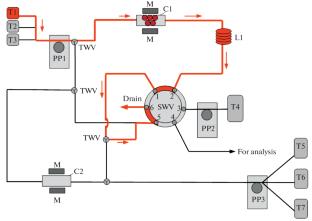
An online system for the dynamic preconcentration of chlorophenols from bottom sediments is proposed. It comprises a preconcentration column with a magnetic sorbent based on aminated hypercrosslinked polystyrene immobilized by two magnets, a container with the sample solution, a sorbent suspension, and rinse water. After preconcentration, the analytes are desorbed with acetonitrile, and the magnetic sorbent is rinsed in a regeneration column with hexane, methanol, and water. A peristaltic pump moves the analyte solution and magnetic sorbent through the system, and performs desorption with acetonitrile. Control of the peristaltic pumps, magnets for sorbent immobilization, and sorbent movement through the system is automatic. Dynamic sample preparation enables 1550- to 2070-fold concentration. To determine analytes by GC-MS, derivatization is performed using N,O-bis(trimethylsilyl)trifluoroacetamide. GC-MS combined with dynamic preconcentration enables the determination of 16 di-, tri-, tetrachlorophenols, and pentachlorophenol in bottom sediments at levels of 3–8 ng/kg. Analysis of real samples reveals that all 16 chlorophenols from the control mixture are present in bottom sediments near the discharge point of municipal wastewater treatment plants. Dichloroparabens are also identified in some samples at these same points. In areas with active agricultural activity, 2,4-dichlorophenol is the main pollutant. Elevated levels of tri- and tetrachlorophenols are found in bottom sediments in water bodies located in forest fire zones.
提出了一种用于海底沉积物中氯酚动态预富集的在线系统。它包括带有磁性吸附剂的预浓缩柱,磁性吸附剂基于两个磁铁固定的胺化超交联聚苯乙烯,含有样品溶液的容器,吸附剂悬浮液和漂洗水。预浓缩后,分析物用乙腈解吸,磁性吸附剂在再生柱中用己烷、甲醇和水冲洗。蠕动泵使分析液和磁性吸附剂通过系统,并用乙腈进行脱附。蠕动泵的控制,吸附剂固定磁铁,吸附剂运动通过系统是自动的。动态样品制备使1550- 2070倍的浓度。用气相色谱-质谱法测定分析物,衍生化用N, o -二(三甲基硅基)三氟乙酰胺进行。气相色谱-质谱联用动态预富集,可在3-8 ng/kg的浓度下测定底沉积物中的16种二氯、三氯、四氯酚和五氯酚。对实际样品的分析表明,来自对照混合物的所有16种氯酚都存在于城市污水处理厂排放点附近的底部沉积物中。在这些相同地点的一些样品中也发现了二氯对苯二甲酸酯。在农业活动活跃的地区,2,4-二氯酚是主要污染物。在森林火区水体的底部沉积物中发现三氯酚和四氯酚含量升高。
期刊介绍:
The Journal of Analytical Chemistry is an international peer reviewed journal that covers theoretical and applied aspects of analytical chemistry; it informs the reader about new achievements in analytical methods, instruments and reagents. Ample space is devoted to problems arising in the analysis of vital media such as water and air. Consideration is given to the detection and determination of metal ions, anions, and various organic substances. The journal welcomes manuscripts from all countries in the English or Russian language.


 求助内容:
求助内容: 应助结果提醒方式:

 京公网安备 11010802042870号


