Smartphone Application-Based Rapid Antioxidant Evaluation of Musa paradisiaca Peel Extract with Gas Chromatography-Mass Spectrometry Chemical Profiling
{"title":"Smartphone Application-Based Rapid Antioxidant Evaluation of Musa paradisiaca Peel Extract with Gas Chromatography-Mass Spectrometry Chemical Profiling","authors":"Si Eon Lee, Moon-Moo Kim","doi":"10.1134/S1061934825603330","DOIUrl":null,"url":null,"abstract":"<p>The increasing demand for rapid and cost-effective analytical methods has led to the development of smartphone-based applications for biochemical assays to assess antioxidant activity. In this study, the antioxidant activity of <i>Musa paradisiaca</i> peel ethyl acetate fraction (<b>MPPEF</b>) was evaluated using a conventional spectrophotometer and a smartphone application designed to quantify radical scavenging activity. Antioxidant capacity was assessed through reducing power and 2,2-diphenyl-1-picrylhydrazyl (<b>DPPH</b>) radical scavenging assays. For vitamin C, the reducing power assay showed a consistent concentration-dependent pattern between spectrophotometer and smartphone measurements, supporting the reliability of the mobile-based approach. In the DPPH radical scavenging assay, the mobile-based method also exhibited clear concentration-dependent behavior, further validating the method. Similarly, MPPEF exhibited clear dose-dependent antioxidant activity in both reducing power and DPPH radical assays, and the smartphone-based analysis showed comparable concentration-dependent trends to those obtained with the spectrophotometer. These findings suggest that smartphone-based colorimetric analysis not only demonstrates a consistent pattern with conventional spectrophotometry but also serves as a practical and portable alternative for antioxidant evaluation.</p>","PeriodicalId":606,"journal":{"name":"Journal of Analytical Chemistry","volume":"81 :","pages":"1049 - 1057"},"PeriodicalIF":1.5000,"publicationDate":"2026-07-01","publicationTypes":"Journal Article","fieldsOfStudy":null,"isOpenAccess":false,"openAccessPdf":"","citationCount":"0","resultStr":null,"platform":"Semanticscholar","paperid":null,"PeriodicalName":"Journal of Analytical Chemistry","FirstCategoryId":"92","ListUrlMain":"https://link.springer.com/article/10.1134/S1061934825603330","RegionNum":4,"RegionCategory":"化学","ArticlePicture":[],"TitleCN":null,"AbstractTextCN":null,"PMCID":null,"EPubDate":"","PubModel":"","JCR":"Q4","JCRName":"CHEMISTRY, ANALYTICAL","Score":null,"Total":0}
引用次数: 0
Abstract
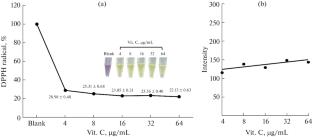
The increasing demand for rapid and cost-effective analytical methods has led to the development of smartphone-based applications for biochemical assays to assess antioxidant activity. In this study, the antioxidant activity of Musa paradisiaca peel ethyl acetate fraction (MPPEF) was evaluated using a conventional spectrophotometer and a smartphone application designed to quantify radical scavenging activity. Antioxidant capacity was assessed through reducing power and 2,2-diphenyl-1-picrylhydrazyl (DPPH) radical scavenging assays. For vitamin C, the reducing power assay showed a consistent concentration-dependent pattern between spectrophotometer and smartphone measurements, supporting the reliability of the mobile-based approach. In the DPPH radical scavenging assay, the mobile-based method also exhibited clear concentration-dependent behavior, further validating the method. Similarly, MPPEF exhibited clear dose-dependent antioxidant activity in both reducing power and DPPH radical assays, and the smartphone-based analysis showed comparable concentration-dependent trends to those obtained with the spectrophotometer. These findings suggest that smartphone-based colorimetric analysis not only demonstrates a consistent pattern with conventional spectrophotometry but also serves as a practical and portable alternative for antioxidant evaluation.
期刊介绍:
The Journal of Analytical Chemistry is an international peer reviewed journal that covers theoretical and applied aspects of analytical chemistry; it informs the reader about new achievements in analytical methods, instruments and reagents. Ample space is devoted to problems arising in the analysis of vital media such as water and air. Consideration is given to the detection and determination of metal ions, anions, and various organic substances. The journal welcomes manuscripts from all countries in the English or Russian language.

 求助内容:
求助内容: 应助结果提醒方式:

 京公网安备 11010802042870号


