
Postbiotic Lactobacillus sakei CVL-001 promotes mucosal tolerance via NOD2-dependent programming of tolerogenic CD11c+ antigen-presenting cells
IF 5.5
2区 医学
Q1 IMMUNOLOGY
引用次数: 0
Abstract
Postbiotics offer improved safety and stability over live probiotics for modulating intestinal immunity, yet the receptor-mediated mechanisms underlying mucosal tolerance remain unclear. Nucleotide-binding oligomerization domain 2 (NOD2), a cytosolic sensor of bacterial cell wall components and a major genetic risk factor for inflammatory bowel disease (IBD), may link microbial signals to regulatory immune programs. Here, we show that heat-killed Lactobacillus sakei CVL-001 (HK CVL-001) promotes intestinal homeostasis through NOD2 signaling. HK CVL-001, but not its culture supernatant, significantly alleviated dextran sulfate sodium (DSS)-induced colitis, whereas this protection was completely lost in NOD2−/− mice. Treatment suppressed pro-inflammatory cytokines (IL-6, IL-1β), increased IL-10, and expanded Foxp3+ regulatory T cells (Tregs) and CD103+ tolerogenic antigen-presenting cell (APC) populations. In vitro, HK CVL-001 directly induced CD103 expression in BMDCs in a NOD2-dependent manner, enhancing their capacity to drive Treg differentiation. This effect was accompanied by upregulation of Irf8 and Irf4, along with expansion of both CD11b− and CD11b+ CD103+ APC populations. A functional role for NOD2 signaling within CD11c+ APCs was confirmed using CD11c-Cre × NOD2fl/fl mice and adoptive transfer experiments. These findings support a NOD2-dependent CD11c+ APC–Treg regulatory axis underlying postbiotic-induced mucosal tolerance.
生后的堺乳酸菌CVL-001通过nod2依赖性编程的耐受性CD11c+抗原呈递细胞促进粘膜耐受。
与活益生菌相比,后益生菌在调节肠道免疫方面具有更高的安全性和稳定性,但受体介导的粘膜耐受机制尚不清楚。核苷酸结合寡聚结构域2 (NOD2)是细菌细胞壁成分的细胞质传感器,也是炎症性肠病(IBD)的主要遗传危险因素,可能将微生物信号与调节免疫程序联系起来。本研究表明,热灭活的堺乳酸菌CVL-001 (HK CVL-001)通过NOD2信号通路促进肠道稳态。HK CVL-001,而不是其培养上清,显著减轻了葡聚糖硫酸钠(DSS)诱导的结肠炎,而这种保护在NOD2-/-小鼠中完全丧失。治疗抑制了促炎细胞因子(IL-6, IL-1β),增加了IL-10,扩大了Foxp3+调节性T细胞(Tregs)和CD103+耐受性抗原呈递细胞(APC)群体。在体外,HK CVL-001以nod2依赖的方式直接诱导BMDCs中CD103的表达,增强其驱动Treg分化的能力。这种效应伴随着Irf8和Irf4的上调,以及CD11b-和CD11b+ CD103+ APC群体的扩增。通过CD11c- cre × NOD2fl/fl小鼠和过继性转移实验证实了NOD2信号在CD11c+ APCs中的功能作用。这些发现支持了nod2依赖性CD11c+ APC-Treg调控轴在生物后诱导的粘膜耐受中的作用。
本文章由计算机程序翻译,如有差异,请以英文原文为准。
求助全文
约1分钟内获得全文
求助全文
来源期刊
Mucosal Immunology
医学-免疫学
CiteScore
16.60
自引率
3.80%
发文量
100
审稿时长
12 days
期刊介绍:
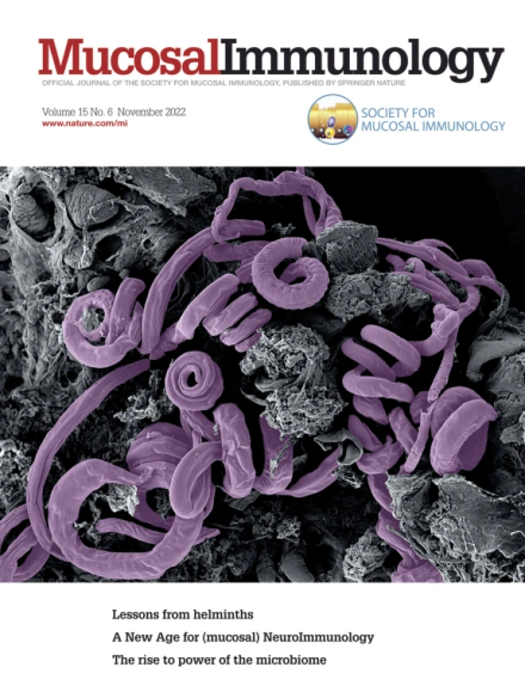
Mucosal Immunology, the official publication of the Society of Mucosal Immunology (SMI), serves as a forum for both basic and clinical scientists to discuss immunity and inflammation involving mucosal tissues. It covers gastrointestinal, pulmonary, nasopharyngeal, oral, ocular, and genitourinary immunology through original research articles, scholarly reviews, commentaries, editorials, and letters. The journal gives equal consideration to basic, translational, and clinical studies and also serves as a primary communication channel for the SMI governing board and its members, featuring society news, meeting announcements, policy discussions, and job/training opportunities advertisements.
 求助内容:
 应助结果提醒方式:


 京公网安备 11010802042870号


