Bo Xiang, Kui Yan, Ying Zhang, Wenxiao Wu, Zhuo Zeng, Fan Zhang, Shangfeng Wang
{"title":"Antiaromaticity-Based General Molecular Design of Activatable Near-Infrared Photoacoustic Probes with High Acoustic Loudness","authors":"Bo Xiang, Kui Yan, Ying Zhang, Wenxiao Wu, Zhuo Zeng, Fan Zhang, Shangfeng Wang","doi":"10.1021/cbmi.5c00198","DOIUrl":null,"url":null,"abstract":"<p>Photoacoustic (PA) imaging offers\r\nhigh spatial resolution and deep\r\ntissue penetration, and the development of activatable PA probes has\r\ngreatly expanded its potential for detecting disease-associated molecular\r\nbiomarkers. Optimization of the probe performance has long been a\r\ncentral challenge. Recently, the proposed acoustic loudness factor\r\n(ALF = ε × <em>k</em><sub>nr</sub>) established\r\nthat strong absorption and ultrafast nonradiative decay are key for\r\nmaximizing PA output, yet a general molecular design strategy under\r\nthis framework remains elusive. Here we report PhAF, an antiaromatic\r\nfluorene dye platform in which ground-state antiaromaticity and excited-state\r\naromaticity reversal under Baird’s rule induce strong vibronic\r\ncoupling and naturally high <em>k</em><sub>nr</sub>. PhAF\r\nexhibits maximal absorption at 950 nm, an ultrashort 3.37 ps lifetime,\r\nand a high ALF of 7.25 × 10<sup>15</sup> M<sup>–1</sup> cm<sup>–1</sup> s<sup>–1</sup>, while maintaining\r\nexcellent stability in aqueous and biological media. Masking the aniline\r\ndonor as an amide yielded nitroreductase-responsive PhAF-N and peroxynitrite-responsive\r\nPhAF-R, both showing robust in vivo imaging of tumor hypoxia and drug-induced\r\nliver injury. This work establishes a molecular foundation for designing\r\nhigh-performance activatable PA probes for future theranostic applications.</p>","PeriodicalId":53181,"journal":{"name":"Chemical & Biomedical Imaging","volume":"4 6","pages":"1153–1162"},"PeriodicalIF":6.7000,"publicationDate":"2026-06-22","publicationTypes":"Journal Article","fieldsOfStudy":null,"isOpenAccess":false,"openAccessPdf":"","citationCount":"0","resultStr":null,"platform":"Semanticscholar","paperid":null,"PeriodicalName":"Chemical & Biomedical Imaging","FirstCategoryId":"1085","ListUrlMain":"https://pubs.acs.org/doi/10.1021/cbmi.5c00198","RegionNum":0,"RegionCategory":null,"ArticlePicture":[],"TitleCN":null,"AbstractTextCN":null,"PMCID":null,"EPubDate":"2026/1/5 0:00:00","PubModel":"Epub","JCR":"","JCRName":"","Score":null,"Total":0}
引用次数: 0
Abstract
Photoacoustic (PA) imaging offers
high spatial resolution and deep
tissue penetration, and the development of activatable PA probes has
greatly expanded its potential for detecting disease-associated molecular
biomarkers. Optimization of the probe performance has long been a
central challenge. Recently, the proposed acoustic loudness factor
(ALF = ε × knr) established
that strong absorption and ultrafast nonradiative decay are key for
maximizing PA output, yet a general molecular design strategy under
this framework remains elusive. Here we report PhAF, an antiaromatic
fluorene dye platform in which ground-state antiaromaticity and excited-state
aromaticity reversal under Baird’s rule induce strong vibronic
coupling and naturally high knr. PhAF
exhibits maximal absorption at 950 nm, an ultrashort 3.37 ps lifetime,
and a high ALF of 7.25 × 10¹⁵ M–1 cm–1 s–1, while maintaining
excellent stability in aqueous and biological media. Masking the aniline
donor as an amide yielded nitroreductase-responsive PhAF-N and peroxynitrite-responsive
PhAF-R, both showing robust in vivo imaging of tumor hypoxia and drug-induced
liver injury. This work establishes a molecular foundation for designing
high-performance activatable PA probes for future theranostic applications.
期刊介绍:
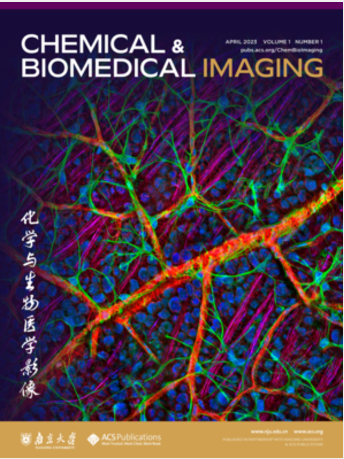
Chemical & Biomedical Imaging is a peer-reviewed open access journal devoted to the publication of cutting-edge research papers on all aspects of chemical and biomedical imaging. This interdisciplinary field sits at the intersection of chemistry physics biology materials engineering and medicine. The journal aims to bring together researchers from across these disciplines to address cutting-edge challenges of fundamental research and applications.Topics of particular interest include but are not limited to:Imaging of processes and reactionsImaging of nanoscale microscale and mesoscale materialsImaging of biological interactions and interfacesSingle-molecule and cellular imagingWhole-organ and whole-body imagingMolecular imaging probes and contrast agentsBioluminescence chemiluminescence and electrochemiluminescence imagingNanophotonics and imagingChemical tools for new imaging modalitiesChemical and imaging techniques in diagnosis and therapyImaging-guided drug deliveryAI and machine learning assisted imaging


 求助内容:
 应助结果提醒方式:


 京公网安备 11010802042870号


