
A novel metabolic complementation pattern: The synergistic response between Sogatella furcifera and its symbionts under chitosan oligosaccharide stress sprayed on rice
IF 2.6
2区 农林科学
Q1 ENTOMOLOGY
Journal of insect physiology
Pub Date : 2026-07-01
Epub Date: 2026-06-25
DOI:10.1016/j.jinsphys.2026.105019
引用次数: 0
Abstract
Background
Insects and their symbionts respond synergistically to environmental changes, and metabolites are one of the important linkers in their interaction. Little is known about how plant growth regulators (PGR) affect planthoppers and their interacting symbiotic bacteria through sprayed rice.
Results
Here, we observed abnormalities in the planthopper's growth length and developmental duration when rice seedlings treated with near-field concentrations of chitosan oligosaccharide (COS) were fed to first-instar nymphs of the white-backed planthopper (WBPH, Sogatella furcifera) for one week. The differentially expressed genes of WBPH were mostly enriched in downregulated metabolic pathways, suggesting the potential involvement of its symbionts. Amplicon sequencing results validated our hypothesis that the abundance of Acetobacteraceae Unclassified (closely related to Asaia sp.) was significantly increased (from an average of 1.24% to 74.68%) under COS stress, manifested in a significant upregulation of three major metabolic pathways involving carbohydrates, lipids, and amino acids. Analysis of their shared differential metabolites and the resulting three bioindicators' interaction networks revealed a close triangular relationship among them. They exhibited reciprocal changes in main metabolic functions confirming that metabolites are important intermediaries between insects and symbiotic bacteria.
Conclusion
Our research provides a reference for the scientific use of PGR and the exploration of insect-symbiotic interaction mechanisms.
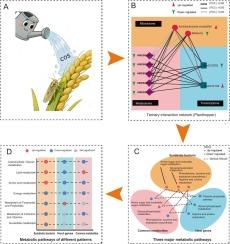
一种新的代谢互补模式:低聚壳聚糖胁迫下水稻施施水蛭及其共生体的协同响应。
背景:昆虫及其共生体对环境变化具有协同响应作用,代谢物是昆虫及其共生体相互作用的重要纽带之一。关于植物生长调节剂(PGR)如何通过喷洒水稻影响飞虱及其相互作用的共生细菌,我们知之甚少。结果:用近场浓度的壳寡糖(COS)处理过的水稻幼苗饲喂白背飞虱(Sogatella furcifera)一龄若虫一周后,飞虱的生长长度和发育持续时间发生了异常。WBPH的差异表达基因主要富集在下调的代谢途径中,提示其共生体可能参与其中。扩增子测序结果证实了我们的假设,即COS胁迫下Acetobacteraceae Unclassified(与Asaia sp.密切相关)的丰度显著增加(从平均1.24%增加到74.68%),表现为碳水化合物、脂质和氨基酸三种主要代谢途径的显著上调。对它们共有的差异代谢物和由此产生的三种生物指标相互作用网络的分析表明,它们之间存在密切的三角关系。它们在主要代谢功能上表现出相互的变化,证实了代谢物是昆虫和共生细菌之间重要的中介。结论:本研究为PGR的科学利用和昆虫共生相互作用机制的探索提供了参考。
本文章由计算机程序翻译,如有差异,请以英文原文为准。
求助全文
约1分钟内获得全文
求助全文
来源期刊
Journal of insect physiology
生物-昆虫学
CiteScore
4.50
自引率
4.50%
发文量
77
审稿时长
57 days
期刊介绍:
All aspects of insect physiology are published in this journal which will also accept papers on the physiology of other arthropods, if the referees consider the work to be of general interest. The coverage includes endocrinology (in relation to moulting, reproduction and metabolism), pheromones, neurobiology (cellular, integrative and developmental), physiological pharmacology, nutrition (food selection, digestion and absorption), homeostasis, excretion, reproduction and behaviour. Papers covering functional genomics and molecular approaches to physiological problems will also be included. Communications on structure and applied entomology can be published if the subject matter has an explicit bearing on the physiology of arthropods. Review articles and novel method papers are also welcomed.
 求助内容:
求助内容: 应助结果提醒方式:

 京公网安备 11010802042870号


