Krushna A. Chaudhari, Kedar S. Mathpati, Ashish R. Alte
{"title":"Artificial intelligence and machine learning in drug discovery and development: a comprehensive review","authors":"Krushna A. Chaudhari, Kedar S. Mathpati, Ashish R. Alte","doi":"10.1186/s43094-026-00997-6","DOIUrl":null,"url":null,"abstract":"<div><p>The drug discovery and development process is a complex, resource-intensive, and high-risk endeavour, traditionally characterized by long timelines, high costs, and low success rates. Recent advancements in artificial intelligence (AI) have transformed this landscape by enabling data-driven, predictive, and efficient strategies across the entire drug development pipeline. AI technologies, including machine learning (ML), deep learning (DL), and neural networks, have been employed for target identification, lead discovery, structure-based drug design, ADME/T prediction, toxicity assessment, and de novo molecule generation. AI-driven tools and platforms, such as DeepChem, AlphaFold, and IBM Watson, facilitate virtual screening, chemical space exploration, and patient-specific clinical trial optimization. Additionally, AI has revolutionized advanced applications in drug delivery, including nanorobotics and synergistic combination therapies, and has enhanced nanomedicine formulations for improved efficacy and safety. Despite its transformative potential, AI adoption faces challenges, including data scarcity, high costs, skill gaps, regulatory constraints, and the black box phenomenon. Nevertheless, with appropriate strategies, AI promises to accelerate drug discovery, reduce costs, improve success rates, and enable the development of safer and more effective therapeutics, marking a paradigm shift in pharmaceutical research and development.</p></div>","PeriodicalId":577,"journal":{"name":"Future Journal of Pharmaceutical Sciences","volume":"12 1","pages":""},"PeriodicalIF":4.5000,"publicationDate":"2026-06-26","publicationTypes":"Journal Article","fieldsOfStudy":null,"isOpenAccess":false,"openAccessPdf":"https://link.springer.com/content/pdf/10.1186/s43094-026-00997-6.pdf","citationCount":"0","resultStr":null,"platform":"Semanticscholar","paperid":null,"PeriodicalName":"Future Journal of Pharmaceutical Sciences","FirstCategoryId":"1085","ListUrlMain":"https://link.springer.com/article/10.1186/s43094-026-00997-6","RegionNum":0,"RegionCategory":null,"ArticlePicture":[],"TitleCN":null,"AbstractTextCN":null,"PMCID":null,"EPubDate":"","PubModel":"","JCR":"Q2","JCRName":"PHARMACOLOGY & PHARMACY","Score":null,"Total":0}
引用次数: 0
Abstract
The drug discovery and development process is a complex, resource-intensive, and high-risk endeavour, traditionally characterized by long timelines, high costs, and low success rates. Recent advancements in artificial intelligence (AI) have transformed this landscape by enabling data-driven, predictive, and efficient strategies across the entire drug development pipeline. AI technologies, including machine learning (ML), deep learning (DL), and neural networks, have been employed for target identification, lead discovery, structure-based drug design, ADME/T prediction, toxicity assessment, and de novo molecule generation. AI-driven tools and platforms, such as DeepChem, AlphaFold, and IBM Watson, facilitate virtual screening, chemical space exploration, and patient-specific clinical trial optimization. Additionally, AI has revolutionized advanced applications in drug delivery, including nanorobotics and synergistic combination therapies, and has enhanced nanomedicine formulations for improved efficacy and safety. Despite its transformative potential, AI adoption faces challenges, including data scarcity, high costs, skill gaps, regulatory constraints, and the black box phenomenon. Nevertheless, with appropriate strategies, AI promises to accelerate drug discovery, reduce costs, improve success rates, and enable the development of safer and more effective therapeutics, marking a paradigm shift in pharmaceutical research and development.
期刊介绍:
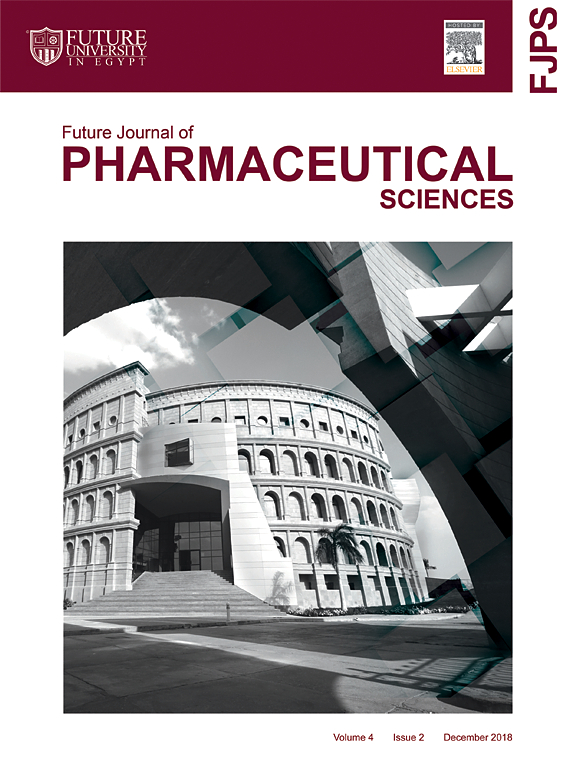
Future Journal of Pharmaceutical Sciences (FJPS) is the official journal of the Future University in Egypt. It is a peer-reviewed, open access journal which publishes original research articles, review articles and case studies on all aspects of pharmaceutical sciences and technologies, pharmacy practice and related clinical aspects, and pharmacy education. The journal publishes articles covering developments in drug absorption and metabolism, pharmacokinetics and dynamics, drug delivery systems, drug targeting and nano-technology. It also covers development of new systems, methods and techniques in pharmacy education and practice. The scope of the journal also extends to cover advancements in toxicology, cell and molecular biology, biomedical research, clinical and pharmaceutical microbiology, pharmaceutical biotechnology, medicinal chemistry, phytochemistry and nutraceuticals.

 求助内容:
 应助结果提醒方式:


 京公网安备 11010802042870号


