Chloe A Teasdale, Sean Locke, Zachary Shahn, Saskia Rueda, Elizabeth A Kelly, Francisco Bolumar, Heidi E Jones
{"title":"Age-period-cohort analysis of low birth weight, early-term delivery, induction, and cesarean-section, US births 1990-2019.","authors":"Chloe A Teasdale, Sean Locke, Zachary Shahn, Saskia Rueda, Elizabeth A Kelly, Francisco Bolumar, Heidi E Jones","doi":"10.1093/aje/kwag147","DOIUrl":null,"url":null,"abstract":"<p><p>We conducted an age-period-cohort (APC) analysis to distinguish age, period, and cohort effects underlying temporal trends in low birth weight (LBW: <2500 g), early-term deliveries (ETD: 37-38 weeks), induction, and cesarean-section (c-section) using US birth records from 1994-2019 for all singleton, first, full-term (37-44 weeks gestation) births (n = 8 194 523). Using the APC-interaction method, we estimated age, period, and cohort effects as odds ratios with 95% CI. Age and period effects were observed for all outcomes. Pregnant women/people aged 40-44 years had increased odds of LBW (OR 1.23, 95% CI, 1.19-1.26), ETD (OR 1.24, 95% CI, 1.23-1.26), induction (OR 1.05, 95% CI, 1.04-1.06), and c-section (OR 2.28, 95% CI, 2.26-2.30) compared to the total population. Odds of LBW (OR 1.14, 95% CI, 1.13-1.16), ETD (OR 1.11, 95% CI, 1.10-1.12), and induction (OR 1.71, 95%,CI, 1.70-1.72) were higher in 2019 compared to the study period average. Cohort effects not explained by age and period effects were observed for women aged 40-44 years in 2019 indicated by higher odds of ETD (OR 1.08, 95% CI, 1.05-1.10), induction (1.10, 95% CI, 1.07-1.12), and c-section (OR 1.09, 95% CI, 1.06-1.11). These findings suggest obstetric management of pregnant women ≥40 years changed in recent decades in ways not expected based on age and temporal trends alone.</p>","PeriodicalId":7472,"journal":{"name":"American journal of epidemiology","volume":" ","pages":"2640-2647"},"PeriodicalIF":4.1000,"publicationDate":"2026-10-07","publicationTypes":"Journal Article","fieldsOfStudy":null,"isOpenAccess":false,"openAccessPdf":"https://www.ncbi.nlm.nih.gov/pmc/articles/PMC13642371/pdf/","citationCount":"0","resultStr":null,"platform":"Semanticscholar","paperid":null,"PeriodicalName":"American journal of epidemiology","FirstCategoryId":"3","ListUrlMain":"https://doi.org/10.1093/aje/kwag147","RegionNum":2,"RegionCategory":"医学","ArticlePicture":[],"TitleCN":null,"AbstractTextCN":null,"PMCID":null,"EPubDate":"","PubModel":"","JCR":"Q1","JCRName":"PUBLIC, ENVIRONMENTAL & OCCUPATIONAL HEALTH","Score":null,"Total":0}
引用次数: 0
Abstract
We conducted an age-period-cohort (APC) analysis to distinguish age, period, and cohort effects underlying temporal trends in low birth weight (LBW: <2500 g), early-term deliveries (ETD: 37-38 weeks), induction, and cesarean-section (c-section) using US birth records from 1994-2019 for all singleton, first, full-term (37-44 weeks gestation) births (n = 8 194 523). Using the APC-interaction method, we estimated age, period, and cohort effects as odds ratios with 95% CI. Age and period effects were observed for all outcomes. Pregnant women/people aged 40-44 years had increased odds of LBW (OR 1.23, 95% CI, 1.19-1.26), ETD (OR 1.24, 95% CI, 1.23-1.26), induction (OR 1.05, 95% CI, 1.04-1.06), and c-section (OR 2.28, 95% CI, 2.26-2.30) compared to the total population. Odds of LBW (OR 1.14, 95% CI, 1.13-1.16), ETD (OR 1.11, 95% CI, 1.10-1.12), and induction (OR 1.71, 95%,CI, 1.70-1.72) were higher in 2019 compared to the study period average. Cohort effects not explained by age and period effects were observed for women aged 40-44 years in 2019 indicated by higher odds of ETD (OR 1.08, 95% CI, 1.05-1.10), induction (1.10, 95% CI, 1.07-1.12), and c-section (OR 1.09, 95% CI, 1.06-1.11). These findings suggest obstetric management of pregnant women ≥40 years changed in recent decades in ways not expected based on age and temporal trends alone.
期刊介绍:
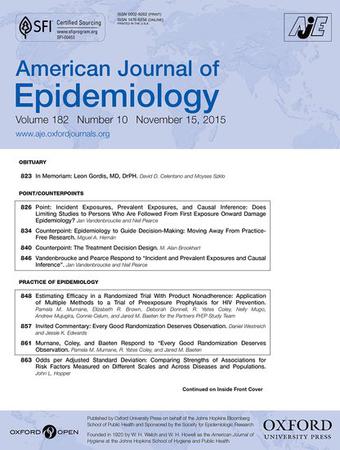
The American Journal of Epidemiology is the oldest and one of the premier epidemiologic journals devoted to the publication of empirical research findings, opinion pieces, and methodological developments in the field of epidemiologic research.
It is a peer-reviewed journal aimed at both fellow epidemiologists and those who use epidemiologic data, including public health workers and clinicians.

 求助内容:
 应助结果提醒方式:


 京公网安备 11010802042870号


