
Singlet fission mediates carotenoid-to-bacteriochlorophyll energy transfer in purple photosynthetic bacteria
IF 24.5
1区 化学
Q1 CHEMISTRY, MULTIDISCIPLINARY
引用次数: 0
Abstract
Photosynthesis, the foundation of most life, begins when sunlight is captured by (bacterio)chlorophyll ((B)Chl) and carotenoid (Crt) pigments. These molecules are arranged so that captured energy migrates rapidly to reaction centres, where it is stored as a charge separation. The complementary absorption of Crt and (B)Chl pigments, and rapid energy transfer between them, underpins solar harvesting. Here we report a Crt-to-BChl energy transfer mechanism mediated by singlet fission, in which a high-energy singlet exciton (with spin quantum number S = 0) is converted into two low-energy triplet (S = 1) excitons. In purple photosynthetic bacteria, the Crt S2 singlet exciton splits into Crt and BChl triplet excitons on adjacent sites. Once formed, the triplets transfer cooperatively to BChl and onwards to reaction centres. Energy is transferred from a singlet Crt state, via the spin-protected long-lived triplet pair, to a singlet BChl state. Thus, this singlet fission-mediated mechanism augments solar energy harvesting for photosynthesis. The biological role of singlet fission—where two excitons are generated by one photon—is poorly understood. Now it has been shown that heterofission occurs in bacterial light-harvesting complexes, creating a triplet-pair reservoir that enhances carotenoid-to-bacteriochlorophyll energy transfer efficiency and temporarily staggers energy delivery to the reaction centre.紫色光合细菌单线态裂变介导类胡萝卜素到细菌叶绿素的能量转移。
光合作用,大多数生命的基础,开始于光被(细菌)叶绿素((B)Chl)和类胡萝卜素(Crt)色素捕获。这些分子的排列使捕获的能量迅速迁移到反应中心,在那里它被储存为电荷分离。Crt和(B)Chl颜料的互补吸收,以及它们之间快速的能量转移,是太阳能收集的基础。本文报道了一种由单线态裂变介导的crt - bchl能量传递机制,其中一个高能单线态激子(自旋量子数S = 0)转化为两个低能三态激子(S = 1)。在紫色光合细菌中,Crt S2单线态激子在相邻位置分裂为Crt和BChl三重态激子。一旦形成,三联体就会协同转移到BChl并继续转移到反应中心。能量通过受自旋保护的长寿命三重态对从单线态Crt转移到单线态BChl。因此,这种单线态裂变介导的机制增加了光合作用的太阳能收集。
本文章由计算机程序翻译,如有差异,请以英文原文为准。
求助全文
约1分钟内获得全文
求助全文
来源期刊
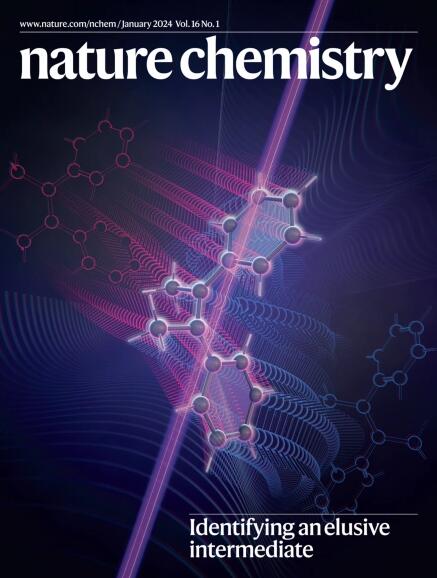
Nature chemistry
化学-化学综合
CiteScore
29.60
自引率
1.40%
发文量
226
审稿时长
1.7 months
期刊介绍:
Nature Chemistry is a monthly journal that publishes groundbreaking and significant research in all areas of chemistry. It covers traditional subjects such as analytical, inorganic, organic, and physical chemistry, as well as a wide range of other topics including catalysis, computational and theoretical chemistry, and environmental chemistry.
The journal also features interdisciplinary research at the interface of chemistry with biology, materials science, nanotechnology, and physics. Manuscripts detailing such multidisciplinary work are encouraged, as long as the central theme pertains to chemistry.
Aside from primary research, Nature Chemistry publishes review articles, news and views, research highlights from other journals, commentaries, book reviews, correspondence, and analysis of the broader chemical landscape. It also addresses crucial issues related to education, funding, policy, intellectual property, and the societal impact of chemistry.
Nature Chemistry is dedicated to ensuring the highest standards of original research through a fair and rigorous review process. It offers authors maximum visibility for their papers, access to a broad readership, exceptional copy editing and production standards, rapid publication, and independence from academic societies and other vested interests.
Overall, Nature Chemistry aims to be the authoritative voice of the global chemical community.
 求助内容:
 应助结果提醒方式:


 京公网安备 11010802042870号


