{"title":"Atomic-Scale Full-Size Engineering of Platinum Nanozymes Enables High-Efficiency Catalytic Therapy","authors":"Xinshuo Zhao, Chaoyi Hong, Hao Xu, Ruofei Zhang*, Yutong Feng, Xiubo Yang, Leming Sun, Zhe Gao, Hui Yang, Yong Qin*, Kelong Fan* and Jiankang Zhang*, ","doi":"10.1021/acsnano.6c06389","DOIUrl":null,"url":null,"abstract":"<p >Metal particle size has a significant influence on the activity of nanozymes, yet size-dependent nanozymatic catalysis under the same metal loadings in full scale (from single atom, cluster to nanoparticle) is a challenging task and has been rarely reported. Herein, porous SiO<sub>2</sub> nanoflower surface-confined Pt-based nanozymes with the same metal loadings but different particle sizes were rationally designed and synthesized for antibacterial and cascade catalytic tumor therapy. The particle size–activity relationship is well established, presenting a volcanic curve, and the Pt<sub>NC</sub>/SiO<sub>2</sub> nanocluster (NC) nanozyme exhibits optimized peroxidase-like activity and bactericidal efficacy compared with SAzyme and nanozyme. Furthermore, a synergistic therapeutic platform (Lap@Pt<sub>NC</sub>/SiO<sub>2</sub>) is constructed through the adsorption of the prodrug β-lapachone (Lap), achieving high-efficiency cascade enzymatic catalysis for tumor therapy thereby. The cluster nanozymes not only present optimized activity during the full-size engineering but also demonstrate great potential in next-generation antibacterial and tumor catalytic therapy.</p>","PeriodicalId":21,"journal":{"name":"ACS Nano","volume":"20 26","pages":"19056–19068"},"PeriodicalIF":17.3000,"publicationDate":"2026-07-07","publicationTypes":"Journal Article","fieldsOfStudy":null,"isOpenAccess":false,"openAccessPdf":"","citationCount":"0","resultStr":null,"platform":"Semanticscholar","paperid":null,"PeriodicalName":"ACS Nano","FirstCategoryId":"88","ListUrlMain":"https://pubs.acs.org/doi/10.1021/acsnano.6c06389","RegionNum":1,"RegionCategory":"材料科学","ArticlePicture":[],"TitleCN":null,"AbstractTextCN":null,"PMCID":null,"EPubDate":"2026/6/22 0:00:00","PubModel":"Epub","JCR":"Q1","JCRName":"CHEMISTRY, MULTIDISCIPLINARY","Score":null,"Total":0}
引用次数: 0
Abstract
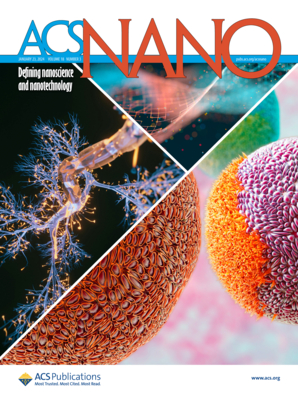
Metal particle size has a significant influence on the activity of nanozymes, yet size-dependent nanozymatic catalysis under the same metal loadings in full scale (from single atom, cluster to nanoparticle) is a challenging task and has been rarely reported. Herein, porous SiO2 nanoflower surface-confined Pt-based nanozymes with the same metal loadings but different particle sizes were rationally designed and synthesized for antibacterial and cascade catalytic tumor therapy. The particle size–activity relationship is well established, presenting a volcanic curve, and the PtNC/SiO2 nanocluster (NC) nanozyme exhibits optimized peroxidase-like activity and bactericidal efficacy compared with SAzyme and nanozyme. Furthermore, a synergistic therapeutic platform (Lap@PtNC/SiO2) is constructed through the adsorption of the prodrug β-lapachone (Lap), achieving high-efficiency cascade enzymatic catalysis for tumor therapy thereby. The cluster nanozymes not only present optimized activity during the full-size engineering but also demonstrate great potential in next-generation antibacterial and tumor catalytic therapy.
期刊介绍:
ACS Nano, published monthly, serves as an international forum for comprehensive articles on nanoscience and nanotechnology research at the intersections of chemistry, biology, materials science, physics, and engineering. The journal fosters communication among scientists in these communities, facilitating collaboration, new research opportunities, and advancements through discoveries. ACS Nano covers synthesis, assembly, characterization, theory, and simulation of nanostructures, nanobiotechnology, nanofabrication, methods and tools for nanoscience and nanotechnology, and self- and directed-assembly. Alongside original research articles, it offers thorough reviews, perspectives on cutting-edge research, and discussions envisioning the future of nanoscience and nanotechnology.


 求助内容:
 应助结果提醒方式:


 京公网安备 11010802042870号


