
Grassland restoration increases crop yields through local climate regulation
IF 26.9
1区 地球科学
Q1 ENVIRONMENTAL SCIENCES
引用次数: 0
Abstract
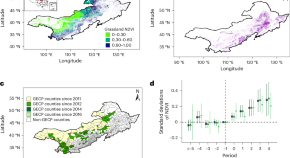
Ecosystem protection and food security are often viewed as competing goals, creating a critical policy dilemma for agricultural regions. Here we show that grassland restoration under China’s Grassland Ecological Compensation Policy significantly enhances maize yields through local climate regulation. Using a difference-in-differences design with county-level panel data, we find that restored grasslands reduce growing-season temperatures by 0.1 °C and increase precipitation by 11.48 mm, thereby mitigating heat and drought stress during critical reproductive stages. These changes extend the reproductive growing period by 0.93 days, increase yields by 7.76% (0.437 t ha−1) and reduce crop shortfall risk by 25.9%. Yield gains alone offset more than 80% of programme costs within 5 years and the additional production could alleviate 10% of the maize import deficit in the Northern Spring Maize Region. Our findings highlight ecosystem restoration as a scalable strategy for achieving climate-resilient food security in regions similar to our study area. The authors assess the impacts of China’s Grassland Ecological Compensation Policy on climate and maize yields. They demonstrate reduced temperature and increased precipitation, which are linked to increased crop yields that partially offset restoration costs.

草原恢复通过当地气候调节提高作物产量
生态系统保护和粮食安全往往被视为相互竞争的目标,这给农业地区造成了严重的政策困境。研究表明,中国草地生态补偿政策下的草地恢复通过局部气候调节显著提高了玉米产量。利用县级面板数据的差异中差设计,我们发现恢复草原使生长季温度降低了0.1°C,降水增加了11.48 mm,从而缓解了关键繁殖阶段的高温和干旱胁迫。这些变化使生殖生长期延长0.93天,产量增加7.76% (0.437 t ha - 1),作物短缺风险降低25.9%。单是产量的增加就能在5年内抵消80%以上的项目成本,增加的产量可以缓解北部春玉米地区10%的玉米进口赤字。我们的研究结果强调,在与我们研究区域相似的地区,生态系统恢复是实现气候适应型粮食安全的可扩展战略。
本文章由计算机程序翻译,如有差异,请以英文原文为准。
求助全文
约1分钟内获得全文
求助全文
来源期刊
Nature Climate Change
ENVIRONMENTAL SCIENCES-METEOROLOGY & ATMOSPHERIC SCIENCES
CiteScore
40.30
自引率
1.60%
发文量
267
审稿时长
4-8 weeks
期刊介绍:
Nature Climate Change is dedicated to addressing the scientific challenge of understanding Earth's changing climate and its societal implications. As a monthly journal, it publishes significant and cutting-edge research on the nature, causes, and impacts of global climate change, as well as its implications for the economy, policy, and the world at large.
The journal publishes original research spanning the natural and social sciences, synthesizing interdisciplinary research to provide a comprehensive understanding of climate change. It upholds the high standards set by all Nature-branded journals, ensuring top-tier original research through a fair and rigorous review process, broad readership access, high standards of copy editing and production, rapid publication, and independence from academic societies and other vested interests.
Nature Climate Change serves as a platform for discussion among experts, publishing opinion, analysis, and review articles. It also features Research Highlights to highlight important developments in the field and original reporting from renowned science journalists in the form of feature articles.
Topics covered in the journal include adaptation, atmospheric science, ecology, economics, energy, impacts and vulnerability, mitigation, oceanography, policy, sociology, and sustainability, among others.
 求助内容:
求助内容: 应助结果提醒方式:

 京公网安备 11010802042870号


