
A global early warning system for predicting exposure of biodiversity to extreme heat
IF 26.9
1区 地球科学
Q1 ENVIRONMENTAL SCIENCES
引用次数: 0
Abstract
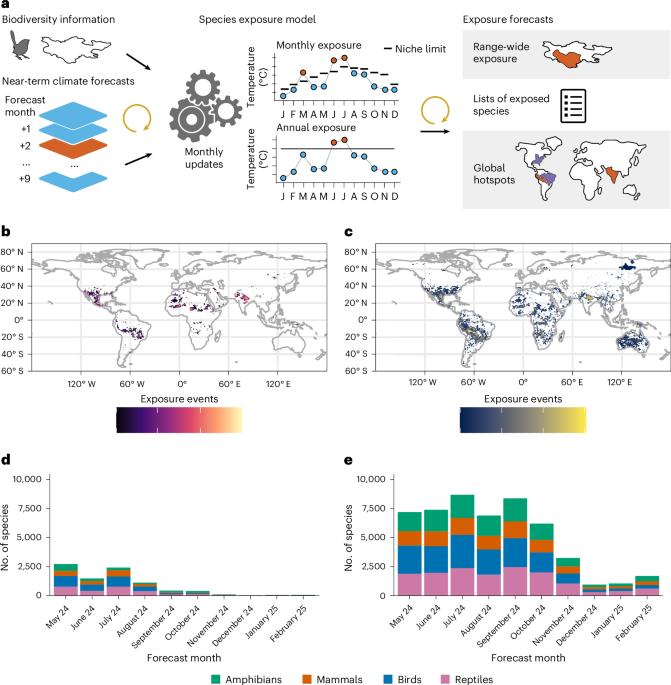
Effective biodiversity conservation during periods of rapid environmental change requires identifying the species and regions at greatest risk. However, most predictions focus on biodiversity shifts several decades ahead, offering limited guidance for immediate conservation action. Here we develop an early warning system for biodiversity based on 9-month seasonal weather forecasts combined with species-specific historical temperature limits. In May 2024, we predicted that >3,500 vertebrate species (out of 30,585 species), including >1,250 species of conservation concern, would be substantially exposed to extreme temperatures 1–2 months in advance on average. Mexico, Sub-Saharan Africa and the Himalayas were predicted to face the highest threats during this forecast period. Early evidence suggests that exposure in these regions likely negatively impacted some species populations. Such advance notice can enable rapid actions to monitor and mitigate these extreme events for sensitive species and regions. The authors develop an early warning system to predict the risks of extreme temperatures for 30,585 vertebrates 1–9 months in advance. They identify species and regions at risk and highlight the potential for early warning systems to maximize management activities that mitigate negative outcomes.
一个预测生物多样性暴露于极端高温的全球预警系统
在快速环境变化时期,有效的生物多样性保护需要确定面临最大风险的物种和地区。然而,大多数预测都集中在未来几十年的生物多样性变化上,为立即采取保护行动提供了有限的指导。本文基于9个月的季节天气预报,结合物种特有的历史温度限制,建立了生物多样性预警系统。在2024年5月,我们预测在30,585种脊椎动物中,有4,53,500种(包括1,1,250种保护物种)将平均提前1-2个月暴露在极端温度下。预计墨西哥、撒哈拉以南非洲和喜马拉雅山在这一预测期内面临的威胁最大。早期证据表明,这些地区的暴露可能对某些物种种群产生负面影响。这样的提前通知可以快速采取行动,监测和减轻这些极端事件对敏感物种和地区的影响。
本文章由计算机程序翻译,如有差异,请以英文原文为准。
求助全文
约1分钟内获得全文
求助全文
来源期刊
Nature Climate Change
ENVIRONMENTAL SCIENCES-METEOROLOGY & ATMOSPHERIC SCIENCES
CiteScore
40.30
自引率
1.60%
发文量
267
审稿时长
4-8 weeks
期刊介绍:
Nature Climate Change is dedicated to addressing the scientific challenge of understanding Earth's changing climate and its societal implications. As a monthly journal, it publishes significant and cutting-edge research on the nature, causes, and impacts of global climate change, as well as its implications for the economy, policy, and the world at large.
The journal publishes original research spanning the natural and social sciences, synthesizing interdisciplinary research to provide a comprehensive understanding of climate change. It upholds the high standards set by all Nature-branded journals, ensuring top-tier original research through a fair and rigorous review process, broad readership access, high standards of copy editing and production, rapid publication, and independence from academic societies and other vested interests.
Nature Climate Change serves as a platform for discussion among experts, publishing opinion, analysis, and review articles. It also features Research Highlights to highlight important developments in the field and original reporting from renowned science journalists in the form of feature articles.
Topics covered in the journal include adaptation, atmospheric science, ecology, economics, energy, impacts and vulnerability, mitigation, oceanography, policy, sociology, and sustainability, among others.
 求助内容:
求助内容: 应助结果提醒方式:

 京公网安备 11010802042870号


