
Fault-free analogue computing with imperfect hardware
IF 42.3
1区 工程技术
Q1 ENGINEERING, ELECTRICAL & ELECTRONIC
引用次数: 0
Abstract
Memristor-based analogue in-memory computing can compute with physical laws, performing computations directly within memory. However, the inherent susceptibility of analogue systems to device failures and variations limits their precision and reliability, and existing fault-tolerance techniques, including redundancy and retraining, often prove insufficient or impractical for many applications. Here we report a fault-free matrix representation in which any target matrix is decomposed into a product of two adjustable submatrices programmed onto the analogue hardware. This indirect, adaptive representation allows mathematical optimization to bypass faulty devices and simultaneously eliminate differential pairs, enhancing computational density. Our memristor-based system achieves a cosine similarity of over 99.999% for a discrete Fourier transform matrix, despite a 39% device fault rate. Using this method, we also demonstrate a 56-fold bit-error-rate reduction in a wireless communication prototype and improvements of over 194% in density and 164% in energy efficiency in cross-domain benchmarks compared with state-of-the-art techniques on large matrices. The approach is applicable to other emerging memories, as well as non-electrical substrates such as photonic and quantum systems. A matrix representation in which any target matrix is decomposed into the product of two adjustable submatrices allows analogue in-memory computing systems to be immune to hardware faults and increase density.


硬件不完善的无故障模拟计算
基于忆阻器的模拟内存计算可以根据物理定律进行计算,直接在内存中进行计算。然而,模拟系统对设备故障和变化的固有敏感性限制了它们的精度和可靠性,现有的容错技术,包括冗余和再培训,往往证明对许多应用来说是不够的或不切实际的。在这里,我们报告了一种无故障矩阵表示,其中任何目标矩阵都被分解为两个可调子矩阵的乘积,这些子矩阵被编程到模拟硬件上。这种间接的,自适应的表示允许数学优化绕过故障设备,同时消除差分对,提高计算密度。尽管器件故障率为39%,但我们基于忆阻器的系统在离散傅里叶变换矩阵中实现了超过99.999%的余弦相似度。使用这种方法,我们还证明了在无线通信原型中误码率降低了56倍,在跨域基准测试中,与大型矩阵上最先进的技术相比,密度提高了194%以上,能效提高了164%。该方法适用于其他新兴存储器,以及光子和量子系统等非电基板。
本文章由计算机程序翻译,如有差异,请以英文原文为准。
求助全文
约1分钟内获得全文
求助全文
来源期刊
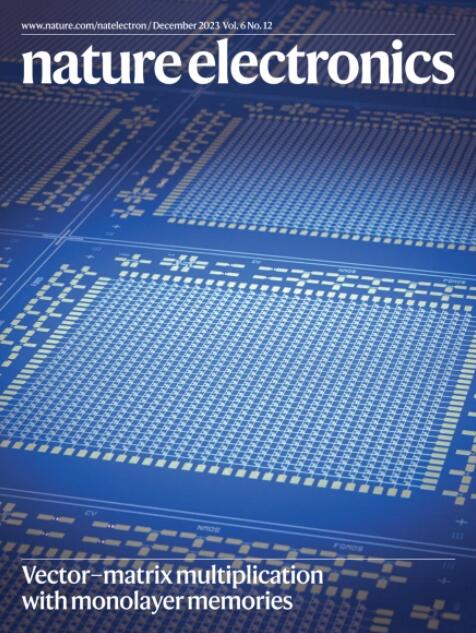
Nature Electronics
Engineering-Electrical and Electronic Engineering
CiteScore
47.50
自引率
2.30%
发文量
159
期刊介绍:
Nature Electronics is a comprehensive journal that publishes both fundamental and applied research in the field of electronics. It encompasses a wide range of topics, including the study of new phenomena and devices, the design and construction of electronic circuits, and the practical applications of electronics. In addition, the journal explores the commercial and industrial aspects of electronics research.
The primary focus of Nature Electronics is on the development of technology and its potential impact on society. The journal incorporates the contributions of scientists, engineers, and industry professionals, offering a platform for their research findings. Moreover, Nature Electronics provides insightful commentary, thorough reviews, and analysis of the key issues that shape the field, as well as the technologies that are reshaping society.
Like all journals within the prestigious Nature brand, Nature Electronics upholds the highest standards of quality. It maintains a dedicated team of professional editors and follows a fair and rigorous peer-review process. The journal also ensures impeccable copy-editing and production, enabling swift publication. Additionally, Nature Electronics prides itself on its editorial independence, ensuring unbiased and impartial reporting.
In summary, Nature Electronics is a leading journal that publishes cutting-edge research in electronics. With its multidisciplinary approach and commitment to excellence, the journal serves as a valuable resource for scientists, engineers, and industry professionals seeking to stay at the forefront of advancements in the field.
 求助内容:
 应助结果提醒方式:


 京公网安备 11010802042870号


