
A bit-parallel molybdenum disulfide computer built through multi-level co-optimization
IF 42.3
1区 工程技术
Q1 ENGINEERING, ELECTRICAL & ELECTRONIC
引用次数: 0
Abstract
The sustainable development of artificial intelligence requires energy-efficient computing technology. Two-dimensional semiconductor digital electronics could potentially provide such capabilities, and promising single devices and small circuits have been developed. However, very large-scale integration remains challenging due to the inability to control atomic-scale defects and mesoscopic device variations, as well as the lack of macroscopic variation-aware design methodology. Here we report a molybdenum disulfide computer that combines a 0.5-μm industrial fabrication process and a back-end-of-line-integrated academia laboratory process. The computer comprises 1,433 transistors interconnected by four metal layers within a compact footprint, offering an integration density of around 9,336 transistors per square millimetre. The computer can store data on-chip in the register file and perform arithmetic operations on multiple-bit data parallelly at a 1-kHz clock frequency. Key to the development of this system is a multi-level co-optimization methodology that spans transistor, standard cell, logic synthesis and interconnect design. By combining a 0.5-μm industrial fabrication process and a back-end-of-line academia laboratory process, as well as using a multi-level co-optimization methodology, a molybdenum disulfide computer can be fabricated that comprises 1,433 transistors interconnected by four metal layers.

多级协同优化构建的位并行二硫化钼计算机
人工智能的可持续发展需要高效节能的计算技术。二维半导体数字电子学可能提供这样的能力,并且已经开发出有前途的单器件和小电路。然而,由于无法控制原子尺度的缺陷和介观器件的变化,以及缺乏宏观变化感知的设计方法,非常大规模的集成仍然具有挑战性。在这里,我们报告了一种二硫化钼计算机,它结合了0.5 μm工业制造工艺和后端线集成的学术实验室工艺。这台计算机由1433个晶体管组成,通过四个金属层相互连接,集成密度约为每平方毫米9336个晶体管。该计算机可以将数据存储在芯片上的寄存器文件中,并以1khz时钟频率并行地对多位数据进行算术运算。该系统开发的关键是一种跨越晶体管、标准单元、逻辑合成和互连设计的多层次协同优化方法。
本文章由计算机程序翻译,如有差异,请以英文原文为准。
求助全文
约1分钟内获得全文
求助全文
来源期刊
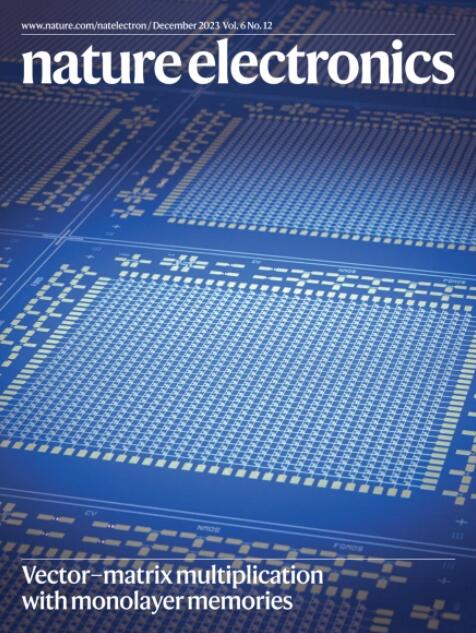
Nature Electronics
Engineering-Electrical and Electronic Engineering
CiteScore
47.50
自引率
2.30%
发文量
159
期刊介绍:
Nature Electronics is a comprehensive journal that publishes both fundamental and applied research in the field of electronics. It encompasses a wide range of topics, including the study of new phenomena and devices, the design and construction of electronic circuits, and the practical applications of electronics. In addition, the journal explores the commercial and industrial aspects of electronics research.
The primary focus of Nature Electronics is on the development of technology and its potential impact on society. The journal incorporates the contributions of scientists, engineers, and industry professionals, offering a platform for their research findings. Moreover, Nature Electronics provides insightful commentary, thorough reviews, and analysis of the key issues that shape the field, as well as the technologies that are reshaping society.
Like all journals within the prestigious Nature brand, Nature Electronics upholds the highest standards of quality. It maintains a dedicated team of professional editors and follows a fair and rigorous peer-review process. The journal also ensures impeccable copy-editing and production, enabling swift publication. Additionally, Nature Electronics prides itself on its editorial independence, ensuring unbiased and impartial reporting.
In summary, Nature Electronics is a leading journal that publishes cutting-edge research in electronics. With its multidisciplinary approach and commitment to excellence, the journal serves as a valuable resource for scientists, engineers, and industry professionals seeking to stay at the forefront of advancements in the field.
 求助内容:
 应助结果提醒方式:


 京公网安备 11010802042870号


