
Exogenous microbial agents interact with housefly larvae to reshape the microbiome and accelerate cellulose degradation in silkworm (Bombyx mori) excrement
IF 2.6
2区 农林科学
Q1 ENTOMOLOGY
Journal of insect physiology
Pub Date : 2026-07-01
Epub Date: 2026-06-16
DOI:10.1016/j.jinsphys.2026.105017
引用次数: 0
Abstract
Silkworm (Bombyx mori) excrement accumulates in large quantities and causes severe environmental pollution, with highly crystalline cellulose limiting efficient resource utilization. The development of effective cellulose-degrading bacterial technologies is crucial for advancing biotechnological applications. This study investigated the effects of exogenous microbial agents and housefly larvae composting on cellulose biodegradation in silkworm excrement. After six days, the cellulose content decreased by 52.6%, 58.2%, and 64.0% in the treatment groups, respectively, which was significantly greater than the 39.41% reduction in the control group without exogenous agents. The combination of exogenous microbial agents and housefly larvae reshaped the bacterial community, increasing the relative abundance of cellulose-degrading taxa. Specifically, Firmicutes and Actinobacteria were enriched, and the abundances of Bacillus, Pseudomonas, and Cellulosimicrobium increased. Functional predictions via PICRUSt indicated that carbohydrate metabolism was predicted to dominate bacterial activity, while Tax4Fun analysis suggested that exogenous agents were associated with increased predicted abundances of endo-β-1,4-glucanase and exo-β-1,4-glucanase genes in excrement, which may relate to accelerated cellulose degradation. This study suggests that the combination of exogenous microbial agents and housefly larvae could promote cellulose-degrading bacterial populations and the genetic potential for cellulase activity, representing a possible strategy for silkworm excrement bioconversion
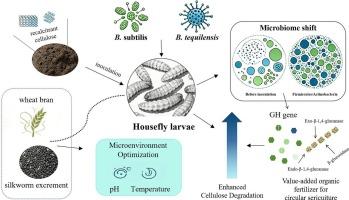
外源性微生物制剂与家蝇幼虫相互作用,重塑微生物组,加速家蚕粪便中纤维素的降解。
家蚕(Bombyx mori)粪便大量堆积,造成严重的环境污染,高结晶纤维素限制了资源的有效利用。开发有效的纤维素降解细菌技术对于推进生物技术的应用至关重要。研究了外源微生物剂和家蝇幼虫堆肥对家蚕粪便中纤维素生物降解的影响。6 d后,各处理组的纤维素含量分别下降了52.6%、58.2%和64.0%,显著大于未添加外源剂的对照组的39.41%。外源微生物剂和家蝇幼虫的结合重塑了细菌群落,增加了纤维素降解类群的相对丰度。具体来说,厚壁菌门和放线菌门富集,芽孢杆菌、假单胞菌和纤维素微生物的丰度增加。通过PICRUSt进行的功能预测表明,碳水化合物代谢预计将主导细菌活性,而Tax4Fun分析表明,外源药物与粪便中内切-β-1,4-葡聚糖酶和外切-β-1,4-葡聚糖酶基因的预测丰度增加有关,这可能与纤维素降解加速有关。本研究表明,外源微生物制剂与家蝇幼虫的结合可以促进纤维素降解细菌的数量和纤维素酶活性的遗传潜力,为家蚕粪便生物转化提供了可能的策略。
本文章由计算机程序翻译,如有差异,请以英文原文为准。
求助全文
约1分钟内获得全文
求助全文
来源期刊
Journal of insect physiology
生物-昆虫学
CiteScore
4.50
自引率
4.50%
发文量
77
审稿时长
57 days
期刊介绍:
All aspects of insect physiology are published in this journal which will also accept papers on the physiology of other arthropods, if the referees consider the work to be of general interest. The coverage includes endocrinology (in relation to moulting, reproduction and metabolism), pheromones, neurobiology (cellular, integrative and developmental), physiological pharmacology, nutrition (food selection, digestion and absorption), homeostasis, excretion, reproduction and behaviour. Papers covering functional genomics and molecular approaches to physiological problems will also be included. Communications on structure and applied entomology can be published if the subject matter has an explicit bearing on the physiology of arthropods. Review articles and novel method papers are also welcomed.
 求助内容:
求助内容: 应助结果提醒方式:

 京公网安备 11010802042870号


