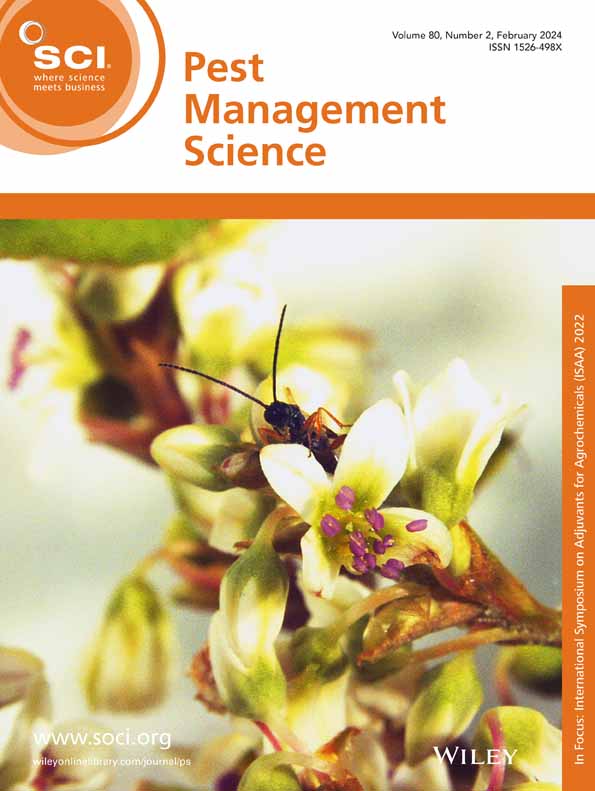
Identification of broadly expressed nervous system-related genes as effective RNAi targets in the brown marmorated stink bug, Halyomorpha halys.

IF 4.2 1区 农林科学 Q1 AGRONOMY
Pest Management Science Pub Date : 2026-10-01 Epub Date: 2026-06-12 DOI:10.1002/ps.71021
Nirakar Panda, Aline Koch, Venkata Partha Sarathi Amineni
{"title":"Identification of broadly expressed nervous system-related genes as effective RNAi targets in the brown marmorated stink bug, Halyomorpha halys.","authors":"Nirakar Panda, Aline Koch, Venkata Partha Sarathi Amineni","doi":"10.1002/ps.71021","DOIUrl":null,"url":null,"abstract":"<p><strong>Background: </strong>The brown marmorated stink bug, Halyomorpha halys (BMSB), is an invasive polyphagous pest causing major losses in fruit and field crops in Europe and the Americas. With insecticide options increasingly limited by resistance and regulatory restrictions, RNA interference (RNAi) offers a species-specific alternative. As RNAi is fully functional in BMSB following hemolymph injection, we evaluated neuronal and neuron-associated genes as systemic RNAi targets using dsRNA microinjection.</p><p><strong>Results: </strong>A literature screen of >80 insect RNAi targets identified 12 neuronal/synaptic genes, from which five were selected in BMSB: acetylcholinesterase (HhAChE), alpha-soluble NSF attachment protein (HhAsnap), Shaker (HhSh), tyrosine hydroxylase (HhTh) and Ras opposite protein (HhRop). Previously published transcriptomic data showed HhAChE, HhSh and HhTh were enriched in brain/central nervous system, whereas HhAsnap and HhRop were broadly expressed at higher abundance. Adults injected with dsRNA (334-364 bp; 2 μL, 1000 ng/μL) targeting HhAsnap or HhRop showed strong mortality: 96.8% (30/31) and 100% (34/34) by Day (D)13, respectively (log-rank, P < 0.0001). By contrast, there was no significant difference between insects injected with dsRNA targeting HhAche, HhSh and HhTh and the negative controls. Feeding assays showed >60% reductions in salivary sheath formation from D4 to D8 after dsAsnap or dsRop treatment. Quantitative real-time (qRT)-PCR at 72 h confirmed ~58% knockdown of HhRop, whereas HhAChE and HhAsnap showed no significant whole-body depletion.</p><p><strong>Conclusion: </strong>Broadly and highly expressed targets (HhAsnap, HhRop) were associated with strong mortality and feeding suppression, whereas brain-enriched targets did not. Expression breadth and transcript abundance appear critical for RNAi responsiveness in BMSB, identifying HhAsnap and HhRop as promising candidates for oral or spray-based RNAi control. © 2026 The Author(s). Pest Management Science published by John Wiley & Sons Ltd on behalf of Society of Chemical Industry.</p>","PeriodicalId":218,"journal":{"name":"Pest Management Science","volume":" ","pages":"9870-9878"},"PeriodicalIF":4.2000,"publicationDate":"2026-10-01","publicationTypes":"Journal Article","fieldsOfStudy":null,"isOpenAccess":false,"openAccessPdf":"https://www.ncbi.nlm.nih.gov/pmc/articles/PMC13569117/pdf/","citationCount":"0","resultStr":null,"platform":"Semanticscholar","paperid":null,"PeriodicalName":"Pest Management Science","FirstCategoryId":"97","ListUrlMain":"https://doi.org/10.1002/ps.71021","RegionNum":1,"RegionCategory":"农林科学","ArticlePicture":[],"TitleCN":null,"AbstractTextCN":null,"PMCID":null,"EPubDate":"2026/6/12 0:00:00","PubModel":"Epub","JCR":"Q1","JCRName":"AGRONOMY","Score":null,"Total":0}
引用次数: 0

Abstract

Background: The brown marmorated stink bug, Halyomorpha halys (BMSB), is an invasive polyphagous pest causing major losses in fruit and field crops in Europe and the Americas. With insecticide options increasingly limited by resistance and regulatory restrictions, RNA interference (RNAi) offers a species-specific alternative. As RNAi is fully functional in BMSB following hemolymph injection, we evaluated neuronal and neuron-associated genes as systemic RNAi targets using dsRNA microinjection.

Results: A literature screen of >80 insect RNAi targets identified 12 neuronal/synaptic genes, from which five were selected in BMSB: acetylcholinesterase (HhAChE), alpha-soluble NSF attachment protein (HhAsnap), Shaker (HhSh), tyrosine hydroxylase (HhTh) and Ras opposite protein (HhRop). Previously published transcriptomic data showed HhAChE, HhSh and HhTh were enriched in brain/central nervous system, whereas HhAsnap and HhRop were broadly expressed at higher abundance. Adults injected with dsRNA (334-364 bp; 2 μL, 1000 ng/μL) targeting HhAsnap or HhRop showed strong mortality: 96.8% (30/31) and 100% (34/34) by Day (D)13, respectively (log-rank, P < 0.0001). By contrast, there was no significant difference between insects injected with dsRNA targeting HhAche, HhSh and HhTh and the negative controls. Feeding assays showed >60% reductions in salivary sheath formation from D4 to D8 after dsAsnap or dsRop treatment. Quantitative real-time (qRT)-PCR at 72 h confirmed ~58% knockdown of HhRop, whereas HhAChE and HhAsnap showed no significant whole-body depletion.

Conclusion: Broadly and highly expressed targets (HhAsnap, HhRop) were associated with strong mortality and feeding suppression, whereas brain-enriched targets did not. Expression breadth and transcript abundance appear critical for RNAi responsiveness in BMSB, identifying HhAsnap and HhRop as promising candidates for oral or spray-based RNAi control. © 2026 The Author(s). Pest Management Science published by John Wiley & Sons Ltd on behalf of Society of Chemical Industry.

棕纹蝽广泛表达的神经系统相关基因作为有效RNAi靶点的鉴定。
背景:褐纹臭虫(Halyomorpha halys, BMSB)是一种入侵性多食性害虫,对欧洲和美洲的水果和大田作物造成重大损失。随着杀虫剂的选择越来越受到抗性和监管限制的限制,RNA干扰(RNAi)提供了一种物种特异性的替代方法。由于RNAi在血淋巴注射后在BMSB中完全发挥作用,我们使用dsRNA显微注射来评估神经元和神经元相关基因作为全身RNAi靶点。结果:对bbbb80个昆虫RNAi靶点进行文献筛选,鉴定出12个神经元/突触基因,其中在BMSB中筛选出5个:乙酰胆碱酯酶(HhAChE)、α可溶性NSF附着蛋白(HhAsnap)、Shaker (HhSh)、酪氨酸羟化酶(HhTh)和Ras相反蛋白(HhRop)。先前发表的转录组学数据显示,HhAChE、HhSh和HhTh富集于脑/中枢神经系统,而HhAsnap和HhRop则以更高的丰度广泛表达。注射以HhAsnap或HhRop为靶点的dsRNA (334- 364bp; 2 μL, 1000 ng/μL)的成人显示出较强的死亡率:在第13天(D)时分别为96.8%(30/31)和100% (34/34)(log-rank, P), dsAsnap或dsRop处理后,D4至D8的唾液鞘形成减少60%。实时荧光定量pcr (Quantitative real-time, qRT -PCR)在72h时证实HhRop蛋白下调58%,而HhAChE和HhAsnap蛋白未出现明显的全身缺失。结论:广泛表达和高表达的靶蛋白(HhAsnap, HhRop)与高致死率和摄食抑制相关,而脑富集靶蛋白与高致死率和摄食抑制无关。表达宽度和转录物丰度对BMSB的RNAi反应性至关重要,确定HhAsnap和HhRop是口服或喷雾型RNAi控制的有希望的候选者。©2026作者。由John Wiley & Sons Ltd代表化学工业协会出版的《害虫管理科学》。
本文章由计算机程序翻译,如有差异,请以英文原文为准。
求助全文
约1分钟内获得全文 求助全文
来源期刊
Pest Management Science
Pest Management Science 农林科学-昆虫学
CiteScore
7.90
自引率
9.80%
发文量
553
审稿时长
4.8 months
期刊介绍: Pest Management Science is the international journal of research and development in crop protection and pest control. Since its launch in 1970, the journal has become the premier forum for papers on the discovery, application, and impact on the environment of products and strategies designed for pest management. Published for SCI by John Wiley & Sons Ltd.

×
引用
GB/T 7714-2015
复制
MLA
复制
APA
复制
导出至
BibTeX EndNote RefMan NoteFirst NoteExpress
×
提示
您的信息不完整,为了账户安全,请先补充。
现在去补充
×
提示
您因"违规操作"
具体请查看互助需知
我知道了
×
提示
确定
请完成安全验证×
copy
已复制链接
快去分享给好友吧!
我知道了
右上角分享
点击右上角分享
0
联系我们:info@booksci.cn Book学术提供免费学术资源搜索服务,方便国内外学者检索中英文文献。致力于提供最便捷和优质的服务体验。 Copyright © 2023 布克学术 All rights reserved.
京ICP备2023020795号-1
ghs 京公网安备 11010802042870号
Book学术文献互助
Book学术文献互助群
群 号:604180095
Book学术官方微信
小红书