Hum Kala Rana, Santosh Kumar Rana, Jacob B Landis, Hang Sun, Dong Luo
{"title":"Decoding the genomic basis of adaptive capacity and vulnerability in the high-altitude <i>Saussurea obvallata</i> complex.","authors":"Hum Kala Rana, Santosh Kumar Rana, Jacob B Landis, Hang Sun, Dong Luo","doi":"10.1016/j.pld.2025.12.004","DOIUrl":null,"url":null,"abstract":"<p><p>Decoding how adaptation and vulnerability are distributed across rugged landscape is essential for anticipating biodiversity responses to climatic change. We investigated the <i>Saussurea obvallata</i> complex, a group of closely related lineages distributed across the Himalayan-Hengduan Mountains (HHM), to ask how climatic heterogeneity and historical isolation shape genomic variation, ecological divergence, and the speciation continuum. To address these questions, we integrated plastome and RAD-seq based nuclear SNPs with genotype-environment association (GEA) analyses, gradient forest (GF), generalized dissimilarity modeling (GDM), and ensemble species distribution models (SDMs). Projected genomic offset under future climate scenarios (2070) and ensemble SDMs were used to map genomic vulnerability and forecast habitat shifts. Nuclear SNPs resolve shallow divergence and cytonuclear discordance consistent with incomplete lineages sorting and episodic introgression. After formally accounting for background population structure and spatial effects, the pure environmental fraction remains modest but significant, with within-population label-permutation nulls falling well below observed values. Concordant signals across partial redundancy analysis, latent factor mixed model (notably June cloud metrics), and GF/GDM (temperature seasonality, slope/elevation, cloud regime) indicate a genuine environment-linked component of allele-frequency turnover, while acknowledging that reduced-representation data may under detect polygenic architecture. Genomic offset maps highlight vulnerability hotspots along the southern Western and Eastern Himalayas and parts of the Hengduan Mountains, whereas the central HHM shows lower offset and potential refugial stability. Together, results support a speciation continuum shaped by both isolation and environmental selection and motivate a dual conservation strategy: safeguard diversity-rich, low-offset refugia while mitigating risk in high-offset peripheral regions through enhanced connectivity, microrefugia, and genomic monitoring.</p>","PeriodicalId":20224,"journal":{"name":"Plant Diversity","volume":"48 3","pages":"474-486"},"PeriodicalIF":5.9000,"publicationDate":"2025-12-16","publicationTypes":"Journal Article","fieldsOfStudy":null,"isOpenAccess":false,"openAccessPdf":"https://www.ncbi.nlm.nih.gov/pmc/articles/PMC13250314/pdf/","citationCount":"0","resultStr":null,"platform":"Semanticscholar","paperid":null,"PeriodicalName":"Plant Diversity","FirstCategoryId":"99","ListUrlMain":"https://doi.org/10.1016/j.pld.2025.12.004","RegionNum":1,"RegionCategory":"生物学","ArticlePicture":[],"TitleCN":null,"AbstractTextCN":null,"PMCID":null,"EPubDate":"2026/5/1 0:00:00","PubModel":"eCollection","JCR":"Q1","JCRName":"PLANT SCIENCES","Score":null,"Total":0}
引用次数: 0
Abstract
Decoding how adaptation and vulnerability are distributed across rugged landscape is essential for anticipating biodiversity responses to climatic change. We investigated the Saussurea obvallata complex, a group of closely related lineages distributed across the Himalayan-Hengduan Mountains (HHM), to ask how climatic heterogeneity and historical isolation shape genomic variation, ecological divergence, and the speciation continuum. To address these questions, we integrated plastome and RAD-seq based nuclear SNPs with genotype-environment association (GEA) analyses, gradient forest (GF), generalized dissimilarity modeling (GDM), and ensemble species distribution models (SDMs). Projected genomic offset under future climate scenarios (2070) and ensemble SDMs were used to map genomic vulnerability and forecast habitat shifts. Nuclear SNPs resolve shallow divergence and cytonuclear discordance consistent with incomplete lineages sorting and episodic introgression. After formally accounting for background population structure and spatial effects, the pure environmental fraction remains modest but significant, with within-population label-permutation nulls falling well below observed values. Concordant signals across partial redundancy analysis, latent factor mixed model (notably June cloud metrics), and GF/GDM (temperature seasonality, slope/elevation, cloud regime) indicate a genuine environment-linked component of allele-frequency turnover, while acknowledging that reduced-representation data may under detect polygenic architecture. Genomic offset maps highlight vulnerability hotspots along the southern Western and Eastern Himalayas and parts of the Hengduan Mountains, whereas the central HHM shows lower offset and potential refugial stability. Together, results support a speciation continuum shaped by both isolation and environmental selection and motivate a dual conservation strategy: safeguard diversity-rich, low-offset refugia while mitigating risk in high-offset peripheral regions through enhanced connectivity, microrefugia, and genomic monitoring.
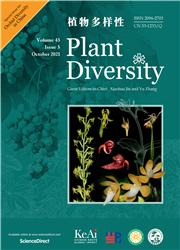
Plant DiversityAgricultural and Biological Sciences-Ecology, Evolution, Behavior and Systematics
CiteScore
8.30
自引率
6.20%
发文量
1863
审稿时长
35 days
期刊介绍:
Plant Diversity (formerly Plant Diversity and Resources) is an international plant science journal that publishes substantial original research and review papers that
advance our understanding of the past and current distribution of plants,
contribute to the development of more phylogenetically accurate taxonomic classifications,
present new findings on or insights into evolutionary processes and mechanisms that are of interest to the community of plant systematic and evolutionary biologists.
While the focus of the journal is on biodiversity, ecology and evolution of East Asian flora, it is not limited to these topics. Applied evolutionary issues, such as climate change and conservation biology, are welcome, especially if they address conceptual problems. Theoretical papers are equally welcome. Preference is given to concise, clearly written papers focusing on precisely framed questions or hypotheses. Papers that are purely descriptive have a low chance of acceptance.
Fields covered by the journal include:
plant systematics and taxonomy-
evolutionary developmental biology-
reproductive biology-
phylo- and biogeography-
evolutionary ecology-
population biology-
conservation biology-
palaeobotany-
molecular evolution-
comparative and evolutionary genomics-
physiology-
biochemistry

 求助内容:
 应助结果提醒方式:


 京公网安备 11010802042870号


