
Phase to performance: The advancing role of molybdenum carbides in reverse water-gas shift reaction
IF 17.2
1区 化学
Q1 CHEMISTRY, APPLIED
Chinese Journal of Catalysis
Pub Date : 2026-06-01
Epub Date: 2026-06-11
DOI:10.1016/S1872-2067(26)65036-X
引用次数: 0
Abstract
Molybdenum carbides (MoCx) are rapidly emerging as efficient catalysts for the reverse water-gas shift (RWGS) reaction, outperforming conventional transition metals with their unique blend of noble-metal-like reactivity, exceptional thermal stability, and scalability. Recent advances in 2024–2025 have unlocked the excellent potential of the previously underexplored α-MoC phase, revealing unprecedented activity, robust CO selectivity, and dynamic carbidic carbon participation in CO2 activation. These advances, alongside in situ mechanistic insights and phase-activity correlations, make a compelling case for MoCx as a transformative platform for RWGS and downstream CO2 valorization. Despite these advances, critical questions remain regarding the precise role of surface carbon vacancies, the long-term stability of MoCx under dynamic RWGS conditions, the scalability of synthesis methods, and the durability for industrial deployment. This perspective provides the first focused synthesis of recent developments, while outlining current challenges and future research opportunities needed to position MoCx catalysts at the forefront of circular carbon technologies and industrial CO2 utilization.
相转性能:碳化钼在水气倒转反应中的推进作用
碳化钼(mox)正迅速成为水气逆向转换(RWGS)反应的高效催化剂,其独特的类似贵金属的反应活性、优异的热稳定性和可扩展性优于传统过渡金属。2024-2025年的最新进展揭示了之前未被开发的α-MoC相的巨大潜力,揭示了前所未有的活性,强大的CO选择性和动态碳化碳参与CO2活化。这些进展,再加上原位机理和相活性相关性,使MoCx成为RWGS和下游二氧化碳增值的变革性平台。尽管取得了这些进展,但关于表面碳空位的确切作用、动态RWGS条件下MoCx的长期稳定性、合成方法的可扩展性以及工业部署的耐久性等关键问题仍然存在。这一观点提供了最近发展的第一个重点综合,同时概述了当前的挑战和未来的研究机会,需要将MoCx催化剂定位在循环碳技术和工业二氧化碳利用的前沿。
本文章由计算机程序翻译,如有差异,请以英文原文为准。
求助全文
约1分钟内获得全文
求助全文
来源期刊
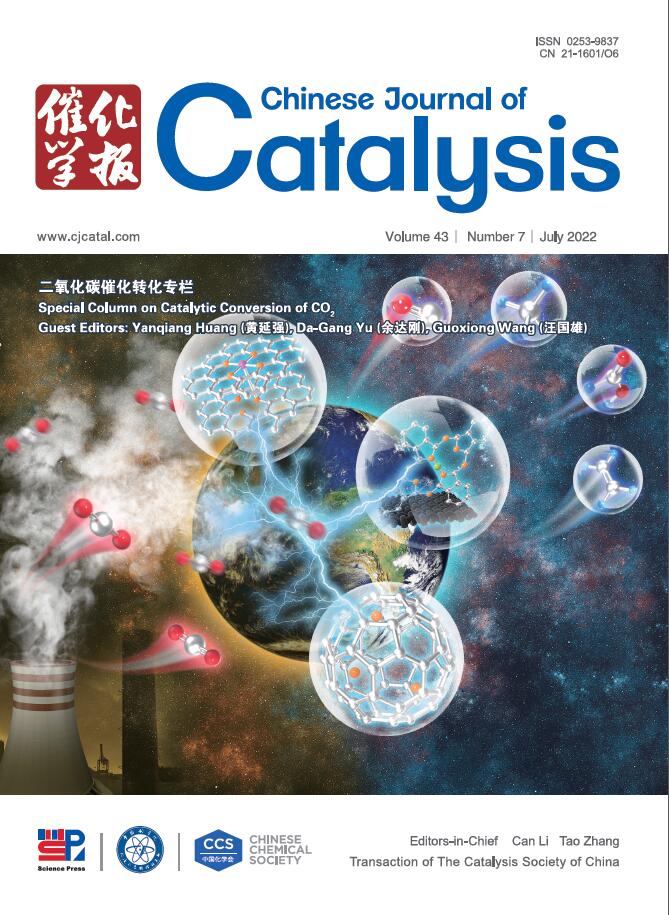
Chinese Journal of Catalysis
工程技术-工程:化工
CiteScore
25.80
自引率
10.30%
发文量
235
审稿时长
1.2 months
期刊介绍:
The journal covers a broad scope, encompassing new trends in catalysis for applications in energy production, environmental protection, and the preparation of materials, petroleum chemicals, and fine chemicals. It explores the scientific foundation for preparing and activating catalysts of commercial interest, emphasizing representative models.The focus includes spectroscopic methods for structural characterization, especially in situ techniques, as well as new theoretical methods with practical impact in catalysis and catalytic reactions.The journal delves into the relationship between homogeneous and heterogeneous catalysis and includes theoretical studies on the structure and reactivity of catalysts.Additionally, contributions on photocatalysis, biocatalysis, surface science, and catalysis-related chemical kinetics are welcomed.
 求助内容:
 应助结果提醒方式:


 京公网安备 11010802042870号


