Integrated Pharmacophore, Docking, Machine Learning, and Molecular Dynamics Approach for the Discovery and Validation of LuxS Quorum-Sensing Inhibitors to Combat Antibiotic Resistance
Mariyam Nawaz, Mahmood Ahmed, Kayode Raheem, Mohammed H. AL Mughram, Muhammad Jadoon Khan, Khalid J. Alzahrani, Muhammad Muddassar
{"title":"Integrated Pharmacophore, Docking, Machine Learning, and Molecular Dynamics Approach for the Discovery and Validation of LuxS Quorum-Sensing Inhibitors to Combat Antibiotic Resistance","authors":"Mariyam Nawaz, Mahmood Ahmed, Kayode Raheem, Mohammed H. AL Mughram, Muhammad Jadoon Khan, Khalid J. Alzahrani, Muhammad Muddassar","doi":"10.1002/cplu.70190","DOIUrl":null,"url":null,"abstract":"<p>Antibiotic resistance is a major global health problem that reduces the effectiveness of traditional antibiotics. Quorum sensing (QS) refers to a signaling mechanism mediated by small signaling molecules (autoinducers) that regulates the bacterial ability to resist the action of antibiotics. The LuxS enzyme is involved in the QS pathway and cleaves S-ribosylhomocysteine (SRH) into 4,5-dihydroxy-2,3-pentanedione (DPD), which is then converted into its active form, autoinducer-2 (AI-2). This role in the QS pathway makes LuxS an attractive therapeutic target for developing new drugs to inhibit AI-2 formation. Therefore, this study presents an integrated computational framework combining pharmacophore-based virtual screening with machine learning (ML)-guided prioritization to identify potential LuxS inhibitors. Unlike conventional docking approaches, the ML models incorporate residue-level interaction features to refine hit selection. The identified top hits demonstrated stable binding profiles and favorable energetics during molecular dynamics simulations and MM/PBSA analysis. These findings highlight the effectiveness of the proposed workflow in improving hit prioritization and provide a rational strategy for designing QS inhibitors to combat antibiotic resistance.</p>","PeriodicalId":148,"journal":{"name":"ChemPlusChem","volume":"91 6","pages":""},"PeriodicalIF":3.1000,"publicationDate":"2026-06-09","publicationTypes":"Journal Article","fieldsOfStudy":null,"isOpenAccess":false,"openAccessPdf":"","citationCount":"0","resultStr":null,"platform":"Semanticscholar","paperid":null,"PeriodicalName":"ChemPlusChem","FirstCategoryId":"92","ListUrlMain":"https://onlinelibrary.wiley.com/doi/10.1002/cplu.70190","RegionNum":4,"RegionCategory":"化学","ArticlePicture":[],"TitleCN":null,"AbstractTextCN":null,"PMCID":null,"EPubDate":"","PubModel":"","JCR":"Q2","JCRName":"CHEMISTRY, MULTIDISCIPLINARY","Score":null,"Total":0}
引用次数: 0
Abstract
Antibiotic resistance is a major global health problem that reduces the effectiveness of traditional antibiotics. Quorum sensing (QS) refers to a signaling mechanism mediated by small signaling molecules (autoinducers) that regulates the bacterial ability to resist the action of antibiotics. The LuxS enzyme is involved in the QS pathway and cleaves S-ribosylhomocysteine (SRH) into 4,5-dihydroxy-2,3-pentanedione (DPD), which is then converted into its active form, autoinducer-2 (AI-2). This role in the QS pathway makes LuxS an attractive therapeutic target for developing new drugs to inhibit AI-2 formation. Therefore, this study presents an integrated computational framework combining pharmacophore-based virtual screening with machine learning (ML)-guided prioritization to identify potential LuxS inhibitors. Unlike conventional docking approaches, the ML models incorporate residue-level interaction features to refine hit selection. The identified top hits demonstrated stable binding profiles and favorable energetics during molecular dynamics simulations and MM/PBSA analysis. These findings highlight the effectiveness of the proposed workflow in improving hit prioritization and provide a rational strategy for designing QS inhibitors to combat antibiotic resistance.
期刊介绍:
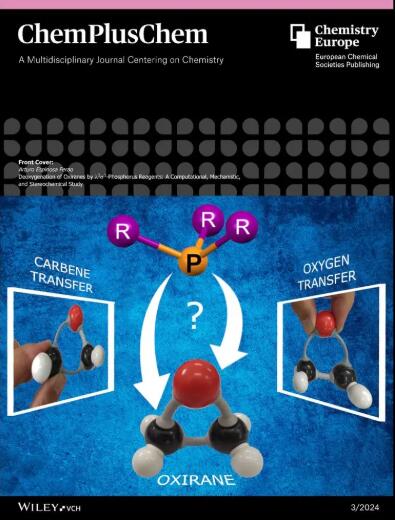
ChemPlusChem is a peer-reviewed, general chemistry journal that brings readers the very best in multidisciplinary research centering on chemistry. It is published on behalf of Chemistry Europe, an association of 16 European chemical societies.
Fully comprehensive in its scope, ChemPlusChem publishes articles covering new results from at least two different aspects (subfields) of chemistry or one of chemistry and one of another scientific discipline (one chemistry topic plus another one, hence the title ChemPlusChem). All suitable submissions undergo balanced peer review by experts in the field to ensure the highest quality, originality, relevance, significance, and validity.


 求助内容:
 应助结果提醒方式:


 京公网安备 11010802042870号


