
Induction of cortical on/off periods in awake mice fulfills sleep functions
IF 20.3
1区 医学
Q1 NEUROSCIENCES
引用次数: 0
Abstract
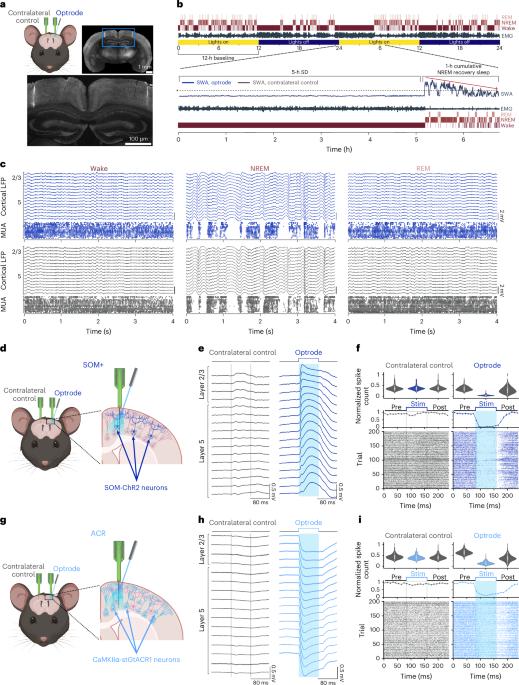
In mammals, slow-wave sleep is characterized by synchronized neuronal activity that alternates between on and off periods. Slow-wave activity (SWA) and synchrony reflect sleep need, are correlated with synaptic strength in cortical circuits and promote synaptic downselection and memory consolidation. Here we assessed whether these core benefits of sleep can be obtained during waking. We locally induced alternating on/off periods during wakefulness using optogenetics in mice. This led to a local ipsilateral reduction in SWA and synchrony during subsequent sleep, and to reduced markers of synaptic strength. Moreover, bilateral induction of off periods over sensorimotor cortex during sleep deprivation restored memory consolidation. Thus, inducing on/off activity during wakefulness is sufficient to reduce local sleep need and fulfill core functions of sleep. Driessen et al. show that core benefits of sleep—reduced local sleep pressure, renormalized synaptic strength and memory consolidation—can be reproduced in awake, behaving mice by inducing sleep-like on/off activity patterns in cortex.
在清醒的小鼠中诱导皮质开启/关闭周期实现睡眠功能。
在哺乳动物中,慢波睡眠的特点是同步的神经元活动在开和关周期之间交替。慢波活动(SWA)和同步性反映了睡眠需求,与皮层回路中的突触强度相关,并促进突触下行选择和记忆巩固。在这里,我们评估了睡眠的这些核心益处是否可以在清醒时获得。我们利用光遗传学技术局部诱导小鼠清醒时的交替开/关周期。这导致局部同侧SWA和同步性在随后的睡眠中减少,并导致突触强度标记物减少。此外,在睡眠剥夺期间,感觉运动皮层的双侧诱导关闭期恢复了记忆巩固。因此,在清醒时诱导开/关活动足以减少局部睡眠需求,实现睡眠的核心功能。
本文章由计算机程序翻译,如有差异,请以英文原文为准。
求助全文
约1分钟内获得全文
求助全文
来源期刊
Nature neuroscience
医学-神经科学
CiteScore
38.60
自引率
1.20%
发文量
212
审稿时长
1 months
期刊介绍:
Nature Neuroscience, a multidisciplinary journal, publishes papers of the utmost quality and significance across all realms of neuroscience. The editors welcome contributions spanning molecular, cellular, systems, and cognitive neuroscience, along with psychophysics, computational modeling, and nervous system disorders. While no area is off-limits, studies offering fundamental insights into nervous system function receive priority.
The journal offers high visibility to both readers and authors, fostering interdisciplinary communication and accessibility to a broad audience. It maintains high standards of copy editing and production, rigorous peer review, rapid publication, and operates independently from academic societies and other vested interests.
In addition to primary research, Nature Neuroscience features news and views, reviews, editorials, commentaries, perspectives, book reviews, and correspondence, aiming to serve as the voice of the global neuroscience community.
 求助内容:
求助内容: 应助结果提醒方式:

 京公网安备 11010802042870号


