Muhammad Mudassir Hassan, Zhuo Chen, Fanjie Xia*, Rui Fang, Xinlei Tang, Chunxia Zhao, Shan Hu* and Jinsong Wu*,
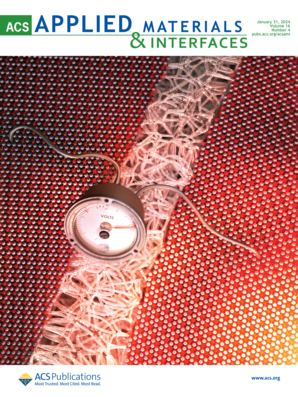
{"title":"Atomic Imaging Reveals Low-Hysteresis Oxygen Redox in Transition Metal Vacancy-Engineered Sodium Ion Cathodes","authors":"Muhammad Mudassir Hassan, Zhuo Chen, Fanjie Xia*, Rui Fang, Xinlei Tang, Chunxia Zhao, Shan Hu* and Jinsong Wu*, ","doi":"10.1021/acsami.6c02320","DOIUrl":null,"url":null,"abstract":"<p >Voltage hysteresis has long been considered a bottleneck toward achieving fully reversible oxygen redox in layered oxide cathodes. Despite tremendous attempts, most reported strategies are based on elemental doping or compositional complexity to overcome this obstacle. Herein, we have surprisingly achieved a very small voltage hysteresis of ∼91 mV over repeated cycles in compositionally simple P2-type Na<sub>3/4</sub>Mn<sub>13/16</sub>□<sub>3/16</sub>O<sub>2</sub>. We have shown that introducing deliberate transition metal (TM) vacancies promotes the Mn<sup>4+</sup> population that induces a ribbon-like superstructure, which improves the local structural framework and reduces lattice strain. Spectroscopic analysis in support of theoretical studies indicates that TM vacancy engineering promoted π-type Mn–O hybridization, which stabilized oxygen holes and inhibited O–O dimer formation. In situ X-ray diffraction in combination with HAADF-STEM reveals single-phase reversible lattice evolution without TM migration. These results indicate TM vacancy engineering is an effective parameter to tune key factors like the Mn<sup>4+</sup> content and superstructure to achieve reversible oxygen redox by stabilizing the electronic structure and lattice framework, providing a promising strategy to develop sustainable high-capacity, low-hysteresis sodium ion cathodes.</p>","PeriodicalId":5,"journal":{"name":"ACS Applied Materials & Interfaces","volume":"18 24","pages":"33802–33813"},"PeriodicalIF":7.8000,"publicationDate":"2026-06-24","publicationTypes":"Journal Article","fieldsOfStudy":null,"isOpenAccess":false,"openAccessPdf":"","citationCount":"0","resultStr":null,"platform":"Semanticscholar","paperid":null,"PeriodicalName":"ACS Applied Materials & Interfaces","FirstCategoryId":"88","ListUrlMain":"https://pubs.acs.org/doi/10.1021/acsami.6c02320","RegionNum":2,"RegionCategory":"材料科学","ArticlePicture":[],"TitleCN":null,"AbstractTextCN":null,"PMCID":null,"EPubDate":"2026/6/9 0:00:00","PubModel":"Epub","JCR":"Q1","JCRName":"MATERIALS SCIENCE, MULTIDISCIPLINARY","Score":null,"Total":0}
引用次数: 0
Abstract
Voltage hysteresis has long been considered a bottleneck toward achieving fully reversible oxygen redox in layered oxide cathodes. Despite tremendous attempts, most reported strategies are based on elemental doping or compositional complexity to overcome this obstacle. Herein, we have surprisingly achieved a very small voltage hysteresis of ∼91 mV over repeated cycles in compositionally simple P2-type Na3/4Mn13/16□3/16O2. We have shown that introducing deliberate transition metal (TM) vacancies promotes the Mn4+ population that induces a ribbon-like superstructure, which improves the local structural framework and reduces lattice strain. Spectroscopic analysis in support of theoretical studies indicates that TM vacancy engineering promoted π-type Mn–O hybridization, which stabilized oxygen holes and inhibited O–O dimer formation. In situ X-ray diffraction in combination with HAADF-STEM reveals single-phase reversible lattice evolution without TM migration. These results indicate TM vacancy engineering is an effective parameter to tune key factors like the Mn4+ content and superstructure to achieve reversible oxygen redox by stabilizing the electronic structure and lattice framework, providing a promising strategy to develop sustainable high-capacity, low-hysteresis sodium ion cathodes.
期刊介绍:
ACS Applied Materials & Interfaces is a leading interdisciplinary journal that brings together chemists, engineers, physicists, and biologists to explore the development and utilization of newly-discovered materials and interfacial processes for specific applications. Our journal has experienced remarkable growth since its establishment in 2009, both in terms of the number of articles published and the impact of the research showcased. We are proud to foster a truly global community, with the majority of published articles originating from outside the United States, reflecting the rapid growth of applied research worldwide.


 求助内容:
 应助结果提醒方式:


 京公网安备 11010802042870号


