
Early signs that the EU carbon border adjustment mechanism is reshaping EU–India steel trade
IF 26.9
1区 地球科学
Q1 ENVIRONMENTAL SCIENCES
引用次数: 0
Abstract
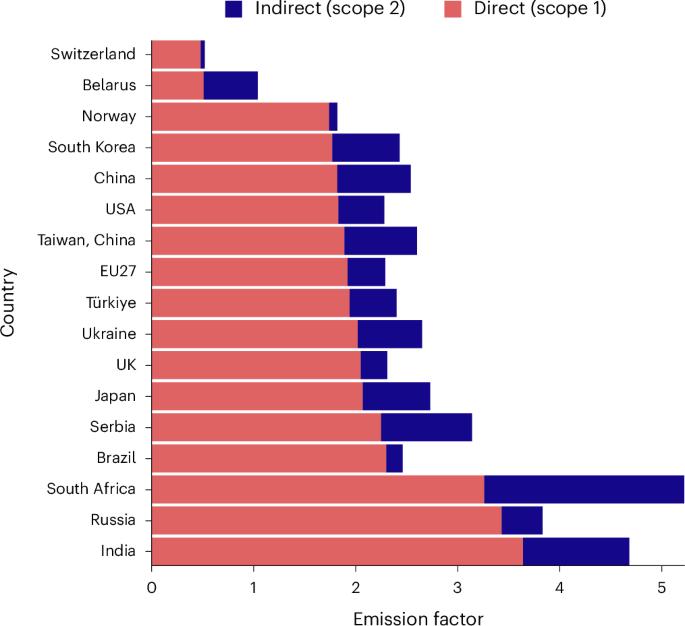
The EU Carbon Border Adjustment Mechanism (CBAM) aims to level carbon-related costs between domestic and foreign producers to avoid carbon leakage. Although most existing CBAM studies focus on country-level or sector-level aggregates, the policy is applied to individual goods, where emissions performance and trade strategies vary widely across producers. Item-level compliance therefore depends on facility-level characteristics, making firm-level analysis critical to understanding actual exposure and early behavioural adjustments. Here early signals of the CBAM on India’s iron and steel exporters are investigated by integrating firm-level export data with independent estimates of manufacturers’ emissions and production. The analysis reveals that high-emission firms significantly reduced both export quantities and revenues to the EU during the CBAM reporting phase, whereas low-emission firms maintained their export levels. Such supply chain adjustments are in line with EU policy intentions, creating opportunities for low-emission producers while reducing reliance on high-emission suppliers to the EU. The EU Carbon Border Adjustment Mechanism (CBAM) was introduced to curb carbon leakage, but its impact is debated. Using export and emissions data from Indian steel plants, researchers show early evidence that the CBAM could penalize high-emission producers, rather than act as a blanket trade barrier.
早期迹象表明,欧盟碳边界调整机制正在重塑欧盟与印度的钢铁贸易
欧盟碳边界调整机制(CBAM)旨在平衡国内外生产商之间的碳相关成本,以避免碳泄漏。虽然大多数现有的CBAM研究侧重于国家一级或部门一级的总量,但该政策适用于个别商品,其中各生产商的排放绩效和贸易战略差异很大。因此,项目层面的合规取决于设施层面的特征,这使得公司层面的分析对于理解实际暴露和早期行为调整至关重要。在这里,通过将企业层面的出口数据与制造商排放和生产的独立估计相结合,研究了CBAM对印度钢铁出口商的早期信号。分析表明,在CBAM报告阶段,高排放企业对欧盟的出口数量和收入都显著减少,而低排放企业则保持其出口水平。这种供应链调整符合欧盟的政策意图,为低排放生产商创造机会,同时减少对欧盟高排放供应商的依赖。欧盟碳边界调整机制(CBAM)是为了遏制碳泄漏而引入的,但其影响存在争议。研究人员利用印度钢铁厂的出口和排放数据,展示了早期证据,表明CBAM可以惩罚高排放的生产商,而不是作为一个全面的贸易壁垒。
本文章由计算机程序翻译,如有差异,请以英文原文为准。
求助全文
约1分钟内获得全文
求助全文
来源期刊
Nature Climate Change
ENVIRONMENTAL SCIENCES-METEOROLOGY & ATMOSPHERIC SCIENCES
CiteScore
40.30
自引率
1.60%
发文量
267
审稿时长
4-8 weeks
期刊介绍:
Nature Climate Change is dedicated to addressing the scientific challenge of understanding Earth's changing climate and its societal implications. As a monthly journal, it publishes significant and cutting-edge research on the nature, causes, and impacts of global climate change, as well as its implications for the economy, policy, and the world at large.
The journal publishes original research spanning the natural and social sciences, synthesizing interdisciplinary research to provide a comprehensive understanding of climate change. It upholds the high standards set by all Nature-branded journals, ensuring top-tier original research through a fair and rigorous review process, broad readership access, high standards of copy editing and production, rapid publication, and independence from academic societies and other vested interests.
Nature Climate Change serves as a platform for discussion among experts, publishing opinion, analysis, and review articles. It also features Research Highlights to highlight important developments in the field and original reporting from renowned science journalists in the form of feature articles.
Topics covered in the journal include adaptation, atmospheric science, ecology, economics, energy, impacts and vulnerability, mitigation, oceanography, policy, sociology, and sustainability, among others.
 求助内容:
求助内容: 应助结果提醒方式:

 京公网安备 11010802042870号


