
High-latitude Southern Ocean warming hotspot induced by ocean mesoscale eddies
IF 26.9
1区 地球科学
Q1 ENVIRONMENTAL SCIENCES
引用次数: 0
Abstract
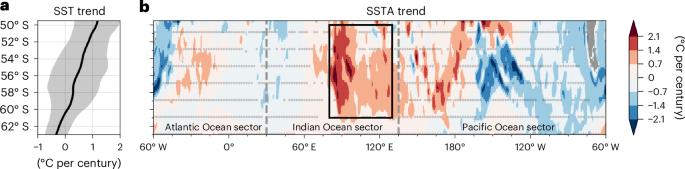
The high-latitude (poleward of ~50° S) Southern Ocean is recognized as a region of delayed surface warming during periods of transient CO2 increase; however, the uniformity of this pattern remains unclear. Here, based on observational and reanalysis datasets, we identify locally (50° S–61° S, 80° E–130° E) accelerated surface warming of 1.5 °C per century for 1982–2023 in the high-latitude Indian Ocean sector. This warming rate is three times the average over the high-latitude Southern Ocean (0.5 °C per century) and close to the global mean of 1.6 °C per century. Analysis of a state-of-the-art high-resolution climate simulation suggests that the hotspot warming is primarily attributed to increased upward heat transport by mesoscale eddies in response to an enhanced Antarctic Circumpolar Current under anthropogenic climate change. Our findings underscore the important role of mesoscale eddies in regulating Southern Ocean warming and the need for their faithful representation in models to ensure reliable projections of future climate change. The Southern Ocean is important for anthropogenic heat uptake, and this regional analysis shows an area with enhanced warming in the high-latitude Indian sector. Model analyses indicate that mesoscale eddies drive upward heat transport, linked to a strengthening of the Antarctic Circumpolar Current.
海洋中尺度涡旋诱发的高纬度南大洋变暖热点
高纬度(~50°S极向)南大洋被认为是在CO2瞬态增加期间地表变暖延迟的区域;然而,这种模式的一致性仍不清楚。在此,基于观测和再分析数据集,我们确定了1982-2023年高纬度印度洋区域局部(50°S - 61°S, 80°E - 130°E)地表加速升温1.5°C /世纪。这一升温速度是高纬度南大洋平均速度(每世纪0.5°C)的三倍,接近每世纪1.6°C的全球平均速度。对最新的高分辨率气候模拟的分析表明,热点变暖主要归因于人为气候变化下南极环极流增强导致的中尺度涡旋向上热输送增加。我们的研究结果强调了中尺度涡旋在调节南大洋变暖方面的重要作用,以及在模式中对它们的忠实代表的必要性,以确保对未来气候变化的可靠预测。南大洋对人为热吸收很重要,而这一区域分析表明,高纬度的印度板块变暖加剧。模式分析表明,中尺度涡旋驱动向上的热输送,与南极环极流的加强有关。
本文章由计算机程序翻译,如有差异,请以英文原文为准。
求助全文
约1分钟内获得全文
求助全文
来源期刊
Nature Climate Change
ENVIRONMENTAL SCIENCES-METEOROLOGY & ATMOSPHERIC SCIENCES
CiteScore
40.30
自引率
1.60%
发文量
267
审稿时长
4-8 weeks
期刊介绍:
Nature Climate Change is dedicated to addressing the scientific challenge of understanding Earth's changing climate and its societal implications. As a monthly journal, it publishes significant and cutting-edge research on the nature, causes, and impacts of global climate change, as well as its implications for the economy, policy, and the world at large.
The journal publishes original research spanning the natural and social sciences, synthesizing interdisciplinary research to provide a comprehensive understanding of climate change. It upholds the high standards set by all Nature-branded journals, ensuring top-tier original research through a fair and rigorous review process, broad readership access, high standards of copy editing and production, rapid publication, and independence from academic societies and other vested interests.
Nature Climate Change serves as a platform for discussion among experts, publishing opinion, analysis, and review articles. It also features Research Highlights to highlight important developments in the field and original reporting from renowned science journalists in the form of feature articles.
Topics covered in the journal include adaptation, atmospheric science, ecology, economics, energy, impacts and vulnerability, mitigation, oceanography, policy, sociology, and sustainability, among others.
 求助内容:
求助内容: 应助结果提醒方式:

 京公网安备 11010802042870号


