{"title":"A Worm-like Robot Combining Artificial Skin and Mechanical Skeleton for Locomotion in Various Environments","authors":"Yu Liu, Yokky Tee, Yuncong Huang","doi":"10.1007/s42235-026-00872-3","DOIUrl":null,"url":null,"abstract":"<div>\n \n <p>Limbless creatures such as snakes and worms can effectively move in various environments such as narrow spaces, ruins, rugged terrain, soft or muddy ground, and so on, becoming the imitation targets for biomimetic robots. However, existing worm-like robots mainly move in pipes or on a hard plane, and their adaptability to environments is still limited. This paper presents a new design and prototype of a worm-like robot that can crawl in various environments. The robot consists of a soft skin and a metameric skeleton. The skin has biomimetic setae that assist in movement, and integrates ripple and folding structures to achieve tight wrapping of the skeleton and low resistance adaptation to the large deformation of robot peristalsis. The skeleton is constructed based on a novel telescopic module that mimics the deformations of the earthworm segments through a space symmetric parallel coupled gear linkage mechanism. A kinematic analysis of the telescopic module provides the quantitative relationship between the input torque and output forces of the telescopic module to ensure necessary output forces for the robot crawling. Three gait modes of a prototype robot with four telescopic modules are introduced based on the concept of anchoring segments. A kinematic analysis method for the worm robot under different gait modes is provided. The slip rate to evaluate the efficiency of robot crawling has been defined. Experimental results indicate that the prototype robot can crawl more efficiently with more anchoring segments in various environments such as pipes, sand, water, and so on.</p>\n </div>","PeriodicalId":614,"journal":{"name":"Journal of Bionic Engineering","volume":"23 3","pages":"1413 - 1432"},"PeriodicalIF":4.4000,"publicationDate":"2026-04-02","publicationTypes":"Journal Article","fieldsOfStudy":null,"isOpenAccess":false,"openAccessPdf":"","citationCount":"0","resultStr":null,"platform":"Semanticscholar","paperid":null,"PeriodicalName":"Journal of Bionic Engineering","FirstCategoryId":"94","ListUrlMain":"https://link.springer.com/article/10.1007/s42235-026-00872-3","RegionNum":3,"RegionCategory":"计算机科学","ArticlePicture":[],"TitleCN":null,"AbstractTextCN":null,"PMCID":null,"EPubDate":"","PubModel":"","JCR":"Q1","JCRName":"ENGINEERING, MULTIDISCIPLINARY","Score":null,"Total":0}
引用次数: 0
Abstract
Limbless creatures such as snakes and worms can effectively move in various environments such as narrow spaces, ruins, rugged terrain, soft or muddy ground, and so on, becoming the imitation targets for biomimetic robots. However, existing worm-like robots mainly move in pipes or on a hard plane, and their adaptability to environments is still limited. This paper presents a new design and prototype of a worm-like robot that can crawl in various environments. The robot consists of a soft skin and a metameric skeleton. The skin has biomimetic setae that assist in movement, and integrates ripple and folding structures to achieve tight wrapping of the skeleton and low resistance adaptation to the large deformation of robot peristalsis. The skeleton is constructed based on a novel telescopic module that mimics the deformations of the earthworm segments through a space symmetric parallel coupled gear linkage mechanism. A kinematic analysis of the telescopic module provides the quantitative relationship between the input torque and output forces of the telescopic module to ensure necessary output forces for the robot crawling. Three gait modes of a prototype robot with four telescopic modules are introduced based on the concept of anchoring segments. A kinematic analysis method for the worm robot under different gait modes is provided. The slip rate to evaluate the efficiency of robot crawling has been defined. Experimental results indicate that the prototype robot can crawl more efficiently with more anchoring segments in various environments such as pipes, sand, water, and so on.
期刊介绍:
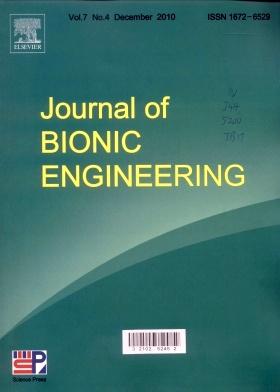
The Journal of Bionic Engineering (JBE) is a peer-reviewed journal that publishes original research papers and reviews that apply the knowledge learned from nature and biological systems to solve concrete engineering problems. The topics that JBE covers include but are not limited to:
Mechanisms, kinematical mechanics and control of animal locomotion, development of mobile robots with walking (running and crawling), swimming or flying abilities inspired by animal locomotion.
Structures, morphologies, composition and physical properties of natural and biomaterials; fabrication of new materials mimicking the properties and functions of natural and biomaterials.
Biomedical materials, artificial organs and tissue engineering for medical applications; rehabilitation equipment and devices.
Development of bioinspired computation methods and artificial intelligence for engineering applications.


 求助内容:
 应助结果提醒方式:


 京公网安备 11010802042870号


