
Research progress on genetic regulation of the yellow-seeded trait in Brassica Crops

IF 4.4 Q3 Agricultural and Biological Sciences
Oil Crop Science Pub Date : 2026-06-01 Epub Date: 2026-05-18 DOI:10.1016/j.ocsci.2026.02.003
Jiayu Yang , Kaimei Dai , Wei Li , Junxing Lu
{"title":"Research progress on genetic regulation of the yellow-seeded trait in Brassica Crops","authors":"Jiayu Yang ,&nbsp;Kaimei Dai ,&nbsp;Wei Li ,&nbsp;Junxing Lu","doi":"10.1016/j.ocsci.2026.02.003","DOIUrl":null,"url":null,"abstract":"<div><div><em>Brassica</em> crops represent a vital global source of oilseeds and vegetables. The yellow-seeded trait has become a primary genetic improvement objective due to its close association with superior quality attributes, specifically high oil content and low fiber content. The yellow-seeded phenotype results in the inhibition of proanthocyanidin biosynthesis and deposition in the seed coat. This process is regulated by the upstream conserved MBW (<em>TT2/TT8/TTG1</em>) transcriptional complex, which exhibits a more complex multi-genic regulatory network influenced by maternal effects, environmental factors, and epigenetic modifications. This review provides a comprehensive comparison on the current researches across six <em>Brassica</em> species (<em>B. rapa, B. oleracea, B. nigra, B. napus, B. juncea,</em> and <em>B. carinata</em>), summarizes the key genes that have been functionally validated, and analyzes the metabolic and genetic basis underlying the synergistic formation of multiple traits, including yellow seeds, high oil, and low fiber. Finally, we discuss the applications and challenges in the molecular breeding strategies targeting for the yellow-seeded trait improvement, such as marker-assisted selection (MAS), CRISPR/Cas9 gene editing, and multi-omics integration. We also provide perspectives on the future potential of achieving the synergistic enhancement of quality and yield through <em>de novo</em> design breeding.</div></div>","PeriodicalId":34095,"journal":{"name":"Oil Crop Science","volume":"11 2","pages":"Pages 179-187"},"PeriodicalIF":4.4000,"publicationDate":"2026-06-01","publicationTypes":"Journal Article","fieldsOfStudy":null,"isOpenAccess":false,"openAccessPdf":"","citationCount":"0","resultStr":null,"platform":"Semanticscholar","paperid":null,"PeriodicalName":"Oil Crop Science","FirstCategoryId":"1091","ListUrlMain":"https://www.sciencedirect.com/science/article/pii/S2096242826000321","RegionNum":0,"RegionCategory":null,"ArticlePicture":[],"TitleCN":null,"AbstractTextCN":null,"PMCID":null,"EPubDate":"2026/5/18 0:00:00","PubModel":"Epub","JCR":"Q3","JCRName":"Agricultural and Biological Sciences","Score":null,"Total":0}
引用次数: 0

Abstract

Brassica crops represent a vital global source of oilseeds and vegetables. The yellow-seeded trait has become a primary genetic improvement objective due to its close association with superior quality attributes, specifically high oil content and low fiber content. The yellow-seeded phenotype results in the inhibition of proanthocyanidin biosynthesis and deposition in the seed coat. This process is regulated by the upstream conserved MBW (TT2/TT8/TTG1) transcriptional complex, which exhibits a more complex multi-genic regulatory network influenced by maternal effects, environmental factors, and epigenetic modifications. This review provides a comprehensive comparison on the current researches across six Brassica species (B. rapa, B. oleracea, B. nigra, B. napus, B. juncea, and B. carinata), summarizes the key genes that have been functionally validated, and analyzes the metabolic and genetic basis underlying the synergistic formation of multiple traits, including yellow seeds, high oil, and low fiber. Finally, we discuss the applications and challenges in the molecular breeding strategies targeting for the yellow-seeded trait improvement, such as marker-assisted selection (MAS), CRISPR/Cas9 gene editing, and multi-omics integration. We also provide perspectives on the future potential of achieving the synergistic enhancement of quality and yield through de novo design breeding.
芸苔属作物黄籽性状遗传调控的研究进展
芸苔属作物是全球油籽和蔬菜的重要来源。由于黄籽性状与优质性状,特别是高含油量和低纤维含量密切相关,已成为主要的遗传改良目标。黄种子表型导致原花青素的生物合成和种在种皮中的沉积受到抑制。这一过程由上游保守的MBW (TT2/TT8/TTG1)转录复合体调控,该复合体表现出更复杂的多基因调控网络,受母体效应、环境因素和表观遗传修饰的影响。本文对6种芸苔属植物(rapa、甘蓝、黑甘蓝、甘蓝型芸苔、芥菜和carinata)的研究现状进行了全面比较,总结了已功能验证的关键基因,并分析了黄籽、高油、低纤维等多种性状协同形成的代谢和遗传基础。最后,讨论了标记辅助选择(MAS)、CRISPR/Cas9基因编辑、多组学整合等分子育种策略在黄种性状改良中的应用及面临的挑战。我们还提供了通过重新设计育种实现质量和产量协同提高的未来潜力的观点。
本文章由计算机程序翻译,如有差异,请以英文原文为准。
求助全文
约1分钟内获得全文 求助全文
来源期刊
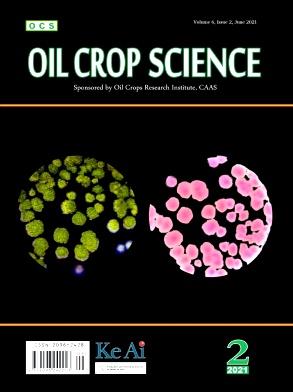
Oil Crop Science
Oil Crop Science Food Science, Plant Science, Agronomy and Crop Science
CiteScore
3.40
自引率
0.00%
发文量
20
审稿时长
74 days

×
引用
GB/T 7714-2015
复制
MLA
复制
APA
复制
导出至
BibTeX EndNote RefMan NoteFirst NoteExpress
×
提示
您的信息不完整,为了账户安全,请先补充。
现在去补充
×
提示
您因"违规操作"
具体请查看互助需知
我知道了
×
提示
确定
请完成安全验证×
copy
已复制链接
快去分享给好友吧!
我知道了
右上角分享
点击右上角分享
0
联系我们:info@booksci.cn Book学术提供免费学术资源搜索服务,方便国内外学者检索中英文文献。致力于提供最便捷和优质的服务体验。 Copyright © 2023 布克学术 All rights reserved.
京ICP备2023020795号-1
ghs 京公网安备 11010802042870号
Book学术文献互助
Book学术文献互助群
群 号:604180095
Book学术官方微信
小红书


