
Salt stress-induced alterations in mungbean (Vigna radiata L.) root exudates facilitate the recruitment of stress-ameliorating rhizobacteria
IF 3.9
3区 生物学
Q1 PLANT SCIENCES
引用次数: 0
Abstract
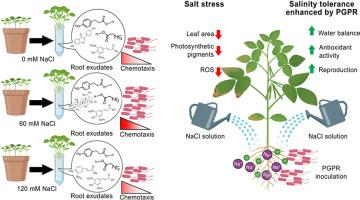
Soil salinity severely constrains global crop productivity, particularly in salt-sensitive crops such as mungbean (Vigna radiata L.). To mitigate this, plant growth-promoting rhizobacteria (PGPR)-based biofertilizers offer a sustainable and cost-effective strategy. However, their effectiveness depends on plant-microbe communication and plant-derived belowground chemical signals that remain poorly understood. This study aimed to characterize changes in mungbean root exudates (RE) under salt stress and evaluate their influence on the recruitment and colonization traits of the stress-ameliorating salt tolerant PGPR Niallia circulans JPR79. Using a hybrid soil-hydroponic system and high-resolution mass spectrometry, we profiled mungbean RE under 60 and 120 mM NaCl stress and a control condition. Salinity markedly altered exudate composition, with significant enrichment of lipids and phenylpropanoids. Among the most strongly induced metabolites, palmitic acid and p-hydroxyhydrocinnamic acid elicited concentration-dependent chemotaxis and swarming motility in JPR79. Whole exudates from salt-stressed plants also induced stronger bacterial chemotactic responses and biofilm formation than exudates from control plants. Furthermore, inoculation with JPR79 alleviated salinity-induced growth inhibition by improving biomass accumulation, plant water status, membrane stability, and grain yield under salt stress. These findings suggest that salt stress in mungbean potentially induces alterations in the RE profile that may enhance beneficial plant-microbe interactions by influencing PGPR behavioural traits associated with chemotaxis, biofilm formation, and potential root colonization. Overall, this study provides a basis for a potential ‘cry-for-help’ strategy in mungbean, wherein salt stress alters RE chemistry in ways that may facilitate interactions with stress-ameliorating PGPR and contribute to improved plant resilience under saline conditions.
盐胁迫诱导的绿豆根系分泌物的变化促进了抗逆性根瘤菌的招募
土壤盐分严重制约了全球作物生产力,特别是绿豆等对盐敏感的作物。为了缓解这种情况,植物生长促进根菌(PGPR)为基础的生物肥料提供了一个可持续的和具有成本效益的策略。然而,它们的有效性依赖于植物-微生物的交流和植物衍生的地下化学信号,这些信号仍然知之甚少。本研究旨在研究盐胁迫下绿豆根分泌物(RE)的变化,并评估其对胁迫改良耐盐PGPR Niallia circulans JPR79招募和定植性状的影响。利用土壤-水培杂交系统和高分辨率质谱技术,研究了绿豆在60和120 mM NaCl胁迫和对照条件下的稀土含量。盐度显著改变了渗出液的组成,脂类和苯丙类显著富集。在诱导最强烈的代谢物中,棕榈酸和对羟基羟基肉桂酸在JPR79中诱导了浓度依赖性的趋化性和蜂群运动。与对照植物的分泌物相比,盐胁迫植物的整个分泌物也诱导了更强的细菌趋化反应和生物膜的形成。此外,接种JPR79可通过改善盐胁迫下的生物量积累、植株水分状况、膜稳定性和籽粒产量来缓解盐胁迫诱导的生长抑制。这些发现表明,绿豆中的盐胁迫可能会诱导RE谱的改变,从而通过影响与趋化性、生物膜形成和潜在的根定植相关的PGPR行为特征,增强有益的植物-微生物相互作用。总的来说,这项研究为绿豆潜在的“呼救”策略提供了基础,其中盐胁迫改变了RE化学,可能促进了与胁迫改善PGPR的相互作用,并有助于提高植物在盐条件下的恢复力。
本文章由计算机程序翻译,如有差异,请以英文原文为准。
求助全文
约1分钟内获得全文
求助全文
来源期刊
Rhizosphere
Agricultural and Biological Sciences-Agronomy and Crop Science
CiteScore
5.70
自引率
8.10%
发文量
155
审稿时长
29 days
期刊介绍:
Rhizosphere aims to advance the frontier of our understanding of plant-soil interactions. Rhizosphere is a multidisciplinary journal that publishes research on the interactions between plant roots, soil organisms, nutrients, and water. Except carbon fixation by photosynthesis, plants obtain all other elements primarily from soil through roots.
We are beginning to understand how communications at the rhizosphere, with soil organisms and other plant species, affect root exudates and nutrient uptake. This rapidly evolving subject utilizes molecular biology and genomic tools, food web or community structure manipulations, high performance liquid chromatography, isotopic analysis, diverse spectroscopic analytics, tomography and other microscopy, complex statistical and modeling tools.
 求助内容:
求助内容: 应助结果提醒方式:

 京公网安备 11010802042870号


