
Arc plasma synthesis of sulfur-doped graphene flakes and impact of the doping concentration on oxygen reduction reaction
IF 5.2
3区 材料科学
Q2 MATERIALS SCIENCE, COATINGS & FILMS
Diamond and Related Materials
Pub Date : 2026-06-01
Epub Date: 2026-05-26
DOI:10.1016/j.diamond.2026.113783
引用次数: 0
Abstract
The scalable and efficient production of heteroatom-doped graphene remains a significant challenge. The fast, process-efficient arc plasma gas-phase synthesis method had clear advantages for meeting this challenge. In this study, we employed a one-step, millisecond-scale rapid synthesis method to produce sulfur-doped graphene flakes using arc plasma. The plasma region's temperature was modulated by adjusting power. We generated sulfur-doped graphene flakes with varying doping concentrations. Experimental results showed that the average gas temperature rose with increasing input power. Rising temperature increased the sulfur concentration of sulfur-doped graphene flakes. Raman and XRD analyses revealed that sulfur introduction distorted the graphene lattice and generated additional defects. XPS analysis confirmed sulfur had been in the form of thiophene-S structures. Defects and heteroatoms promoted the catalytic reaction. Oxygen reduction reaction (ORR) catalytic tests were conducted on sulfur-doped graphene. The results demonstrated that the ORR activity of the sulfur-doped graphene catalyst was comparable to that of the Pt/C catalyst, exhibiting a four-electron transfer process in alkaline media. Additionally, the catalyst exhibited excellent methanol tolerance and durability. Density functional theory (DFT) calculations showed that Sulfur-doped graphene outperformed graphene, presumably because sulfur modified the spin density of adjacent carbons and reduced reaction energy barrier. This synthesis method offered a feasible solution for the large-scale production of low-cost oxygen reduction catalysts of carbon-based materials.
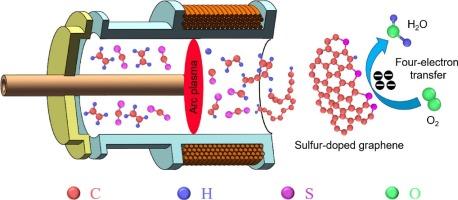
电弧等离子体合成硫掺杂石墨烯薄片及掺杂浓度对氧还原反应的影响
杂原子掺杂石墨烯的可扩展和高效生产仍然是一个重大挑战。快速、高效的电弧等离子体气相合成方法在应对这一挑战方面具有明显的优势。在这项研究中,我们采用了一步、毫秒级的快速合成方法,利用电弧等离子体生产硫掺杂石墨烯薄片。通过调节功率调节等离子体区域的温度。我们制备了不同掺杂浓度的硫掺杂石墨烯薄片。实验结果表明,气体平均温度随输入功率的增大而升高。温度升高使掺硫石墨烯薄片的硫浓度升高。拉曼和XRD分析表明,硫的引入扭曲了石墨烯晶格并产生了额外的缺陷。XPS分析证实硫以噻吩- s结构的形式存在。缺陷和杂原子促进了催化反应。对掺硫石墨烯进行了氧还原反应(ORR)催化试验。结果表明,硫掺杂石墨烯催化剂的ORR活性与Pt/C催化剂相当,在碱性介质中表现出四电子转移过程。此外,该催化剂表现出优异的甲醇耐受性和耐久性。密度泛函理论(DFT)计算表明,硫掺杂石墨烯的性能优于石墨烯,可能是因为硫改变了相邻碳的自旋密度,降低了反应能垒。该合成方法为大规模生产低成本的碳基材料氧还原催化剂提供了可行的解决方案。
本文章由计算机程序翻译,如有差异,请以英文原文为准。
求助全文
约1分钟内获得全文
求助全文
来源期刊
Diamond and Related Materials
工程技术-材料科学:综合
CiteScore
6.00
自引率
14.60%
发文量
702
审稿时长
2.1 months
期刊介绍:
DRM is a leading international journal that publishes new fundamental and applied research on all forms of diamond, the integration of diamond with other advanced materials and development of technologies exploiting diamond. The synthesis, characterization and processing of single crystal diamond, polycrystalline films, nanodiamond powders and heterostructures with other advanced materials are encouraged topics for technical and review articles. In addition to diamond, the journal publishes manuscripts on the synthesis, characterization and application of other related materials including diamond-like carbons, carbon nanotubes, graphene, and boron and carbon nitrides. Articles are sought on the chemical functionalization of diamond and related materials as well as their use in electrochemistry, energy storage and conversion, chemical and biological sensing, imaging, thermal management, photonic and quantum applications, electron emission and electronic devices.
The International Conference on Diamond and Carbon Materials has evolved into the largest and most well attended forum in the field of diamond, providing a forum to showcase the latest results in the science and technology of diamond and other carbon materials such as carbon nanotubes, graphene, and diamond-like carbon. Run annually in association with Diamond and Related Materials the conference provides junior and established researchers the opportunity to exchange the latest results ranging from fundamental physical and chemical concepts to applied research focusing on the next generation carbon-based devices.
 求助内容:
求助内容: 应助结果提醒方式:

 京公网安备 11010802042870号


