
Synergistic integration of graphene and ZnMn3O7 via green hydrothermal route for high-capacitance electrodes
IF 5.2
3区 材料科学
Q2 MATERIALS SCIENCE, COATINGS & FILMS
Diamond and Related Materials
Pub Date : 2026-06-01
Epub Date: 2026-05-09
DOI:10.1016/j.diamond.2026.113739
引用次数: 0
Abstract
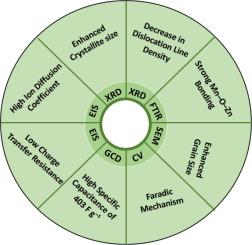
The development of sustainable, high-performance electrode materials is critical for next-generation supercapacitors. Herein, we report a green and eco-friendly hydrothermal synthesis of ZnMn₃O₇ and Graphene@ZnMn₃O₇ nanocomposites using neem (Azadirachta indica) leaf extract as a natural reductant and stabilizer. X-ray Diffraction (XRD) analysis confirms successful phase integration with an optimized crystallite size of ~20.9 nm and reduced dislocation line density (2.29 × 10¹⁵ m−2) for the composite. Fourier Transform Infrared Spectroscopy (FTIR) reveals strong Mn–O–Zn bonding and effective graphene coupling through C![]() C vibrations. Scanning Electron Microscopy (SEM) images show a porous, flake-like interconnected morphology that suppresses agglomeration and improves electrolyte accessibility. Cyclic Voltammetry (CV) measurements show enlarged enclosed areas with mixed capacitive–diffusion-controlled charge storage behavior. Galvanostatic Charge–Discharge (GCD) results reveal that the Graphene@ZnMn3O7 composite delivers a high specific capacitance of 306 F g−1 at 0.8 A g−1 with excellent rate capability, significantly outperforming the pristine electrodes. Electrochemical Impedance Spectroscopy (EIS) analysis yields a low charge-transfer resistance of 1.19 Ω and a high ion diffusion coefficient of 7.96 × 10⁻⁹ cm2 s−1, confirming rapid charge transport. Overall, the synergistic graphene–ZnMn₃O₇ architecture offers strong potential for scalable, high-energy, and sustainable supercapacitor applications.
C vibrations. Scanning Electron Microscopy (SEM) images show a porous, flake-like interconnected morphology that suppresses agglomeration and improves electrolyte accessibility. Cyclic Voltammetry (CV) measurements show enlarged enclosed areas with mixed capacitive–diffusion-controlled charge storage behavior. Galvanostatic Charge–Discharge (GCD) results reveal that the Graphene@ZnMn3O7 composite delivers a high specific capacitance of 306 F g−1 at 0.8 A g−1 with excellent rate capability, significantly outperforming the pristine electrodes. Electrochemical Impedance Spectroscopy (EIS) analysis yields a low charge-transfer resistance of 1.19 Ω and a high ion diffusion coefficient of 7.96 × 10⁻⁹ cm2 s−1, confirming rapid charge transport. Overall, the synergistic graphene–ZnMn₃O₇ architecture offers strong potential for scalable, high-energy, and sustainable supercapacitor applications.
石墨烯与ZnMn3O7绿色水热协同集成制备高电容电极
开发可持续的高性能电极材料对下一代超级电容器至关重要。本文报道了一种绿色环保的水热合成ZnMn₃O₇和Graphene@ZnMn₃O₇纳米复合材料,该复合材料以印楝叶提取物为天然还原剂和稳定剂。x射线衍射(XRD)分析证实了该复合材料成功的相整合,优化后的晶体尺寸为~20.9 nm,位错线密度(2.29 × 10¹⁵ m−2)降低。傅里叶变换红外光谱(FTIR)通过CC振动揭示了强Mn-O-Zn键和有效的石墨烯耦合。扫描电子显微镜(SEM)图像显示多孔,片状互连形态,抑制团聚和提高电解质的可及性。循环伏安法(CV)测量表明,扩大的封闭区域具有混合电容-扩散控制的电荷存储行为。恒流充放电(GCD)结果表明,Graphene@ZnMn3O7复合材料在0.8 a g−1时具有306 F g−1的高比电容,具有优异的倍率能力,显著优于原始电极。电化学阻抗谱(EIS)分析表明,该材料的电荷转移电阻为1.19 Ω,离子扩散系数为7.96 × 10⁻⁹ cm2 s−1,证实了电荷的快速传输。总体而言,协同石墨烯- znmn₃O₇结构为可扩展、高能量和可持续的超级电容器应用提供了强大的潜力。
本文章由计算机程序翻译,如有差异,请以英文原文为准。
求助全文
约1分钟内获得全文
求助全文
来源期刊
Diamond and Related Materials
工程技术-材料科学:综合
CiteScore
6.00
自引率
14.60%
发文量
702
审稿时长
2.1 months
期刊介绍:
DRM is a leading international journal that publishes new fundamental and applied research on all forms of diamond, the integration of diamond with other advanced materials and development of technologies exploiting diamond. The synthesis, characterization and processing of single crystal diamond, polycrystalline films, nanodiamond powders and heterostructures with other advanced materials are encouraged topics for technical and review articles. In addition to diamond, the journal publishes manuscripts on the synthesis, characterization and application of other related materials including diamond-like carbons, carbon nanotubes, graphene, and boron and carbon nitrides. Articles are sought on the chemical functionalization of diamond and related materials as well as their use in electrochemistry, energy storage and conversion, chemical and biological sensing, imaging, thermal management, photonic and quantum applications, electron emission and electronic devices.
The International Conference on Diamond and Carbon Materials has evolved into the largest and most well attended forum in the field of diamond, providing a forum to showcase the latest results in the science and technology of diamond and other carbon materials such as carbon nanotubes, graphene, and diamond-like carbon. Run annually in association with Diamond and Related Materials the conference provides junior and established researchers the opportunity to exchange the latest results ranging from fundamental physical and chemical concepts to applied research focusing on the next generation carbon-based devices.
 求助内容:
求助内容: 应助结果提醒方式:

 京公网安备 11010802042870号


