
Reactive spark plasma sintering of diamond-B4C-SiC composites: Effect of diamond size on microstructural evolution
IF 5.2
3区 材料科学
Q2 MATERIALS SCIENCE, COATINGS & FILMS
Diamond and Related Materials
Pub Date : 2026-06-01
Epub Date: 2026-05-25
DOI:10.1016/j.diamond.2026.113784
引用次数: 0
Abstract
Diamond-B4C-SiC composites were synthesized at 1600 °C via reactive spark plasma sintering of SiB6 and 30 wt% diamond powder blends. This processing route leverages the surface graphitization of metastable diamond to provide a free carbon source for the in-situ formation of SiC and B12 (C,Si,B)3 reaction products. The investigation focused on the role of diamond particle size (D50 = 2.8, 12.4, 32.4, and 188.8 μm) in governing phase evolution, densification and porosity, and residual thermal cracking. Finer diamond particles (≤12.4 μm) promoted nearly complete consumption of the SiB6 matrix due to high surface area and short inter-particle distances but resulted in elevated porosity (~4%). This behavior is attributed to rapid reaction-driven shrinkage and limited matrix flow. Conversely, the 188.8 μm diamond composite exhibited limited reaction formation and developed through-thickness macro-cracks upon cooling due to severe thermal-expansion mismatch between diamond and the SiB6-rich matrix, which drives a size-dependent stress intensity factor that exceeds the matrix fracture toughness in coarse-grained microstructures. Optimal densification was identified for the 32.4 μm diamond composite that exhibits 0.43% porosity due to the larger inter-particle distances and increased matrix flow. This composite also fully transformed SiB6 into B12(C,Si,B)3 and SiC with negligible residual Si.
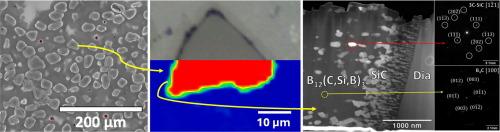
反应放电等离子烧结金刚石- b4c - sic复合材料:金刚石尺寸对微观组织演变的影响
采用反应放电等离子烧结的方法,在1600℃下合成了金刚石- b4c - sic复合材料。该工艺路线利用亚稳金刚石的表面石墨化,为原位生成SiC和B12 (C,Si,B)3反应产物提供了自由碳源。研究了金刚石粒度(D50 = 2.8、12.4、32.4和188.8 μm)对相演化、致密化、孔隙度和残余热裂的影响。较细的金刚石颗粒(≤12.4 μm)由于具有较高的比表面积和较短的颗粒间距,促进了SiB6基体的几乎完全消耗,但导致孔隙率升高(~4%)。这种行为归因于快速反应驱动的收缩和有限的基质流动。相反,由于金刚石与富含sib6的基体之间存在严重的热膨胀失配,188.8 μm金刚石复合材料在冷却时反应形成有限,并形成了贯穿厚度的宏观裂纹,这导致了粗晶显微组织中与尺寸相关的应力强度因子超过了基体断裂韧性。32.4 μm金刚石复合材料致密化效果最佳,孔隙率为0.43%,晶粒间距增大,基体流动增大。该复合材料还将SiB6完全转化为B12(C,Si,B)3和SiC,残余Si可以忽略不计。
本文章由计算机程序翻译,如有差异,请以英文原文为准。
求助全文
约1分钟内获得全文
求助全文
来源期刊
Diamond and Related Materials
工程技术-材料科学:综合
CiteScore
6.00
自引率
14.60%
发文量
702
审稿时长
2.1 months
期刊介绍:
DRM is a leading international journal that publishes new fundamental and applied research on all forms of diamond, the integration of diamond with other advanced materials and development of technologies exploiting diamond. The synthesis, characterization and processing of single crystal diamond, polycrystalline films, nanodiamond powders and heterostructures with other advanced materials are encouraged topics for technical and review articles. In addition to diamond, the journal publishes manuscripts on the synthesis, characterization and application of other related materials including diamond-like carbons, carbon nanotubes, graphene, and boron and carbon nitrides. Articles are sought on the chemical functionalization of diamond and related materials as well as their use in electrochemistry, energy storage and conversion, chemical and biological sensing, imaging, thermal management, photonic and quantum applications, electron emission and electronic devices.
The International Conference on Diamond and Carbon Materials has evolved into the largest and most well attended forum in the field of diamond, providing a forum to showcase the latest results in the science and technology of diamond and other carbon materials such as carbon nanotubes, graphene, and diamond-like carbon. Run annually in association with Diamond and Related Materials the conference provides junior and established researchers the opportunity to exchange the latest results ranging from fundamental physical and chemical concepts to applied research focusing on the next generation carbon-based devices.
 求助内容:
求助内容: 应助结果提醒方式:

 京公网安备 11010802042870号


