
Machine learning–guided prediction of graphene layer numbers from electrochemical synthesis parameters
IF 5.2
3区 材料科学
Q2 MATERIALS SCIENCE, COATINGS & FILMS
Diamond and Related Materials
Pub Date : 2026-06-01
Epub Date: 2026-05-23
DOI:10.1016/j.diamond.2026.113780
引用次数: 0
Abstract
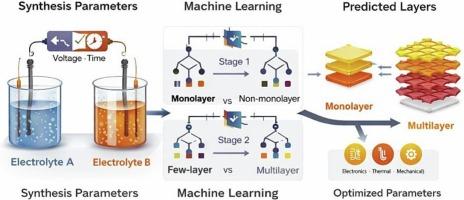
Precise control of number of layers in graphene is critical in order to ensure consistent properties in graphene-based applications; however, traditional characterization methods are time consuming and resource intensive. In this work, we present a machine learning–guided framework in order to predict number of layers in graphene directly from electrochemical based synthesis parameters, eliminating the need for post-synthesis spectroscopic techniques. A two-stage classification method is employed, which distinguish monolayer graphene from non-monolayer samples, followed by classification of few-layer (2–3 layers) and multilayer (≥4 layers) graphene. Using a curated dataset of 441 samples extracted from the literature, and class imbalance was addressed using the Synthetic Minority Over-sampling Technique (SMOTE). Eight different machine learning algorithms were analyzed, with XGBoost emerging as the top performer in both stages, achieving an AUC of 0.98 and an overall accuracy of 95.91% in Stage 1, and an AUC of 0.81 in Stage 2. SHAP-based interpretability analysis identified centrifugation time, electrolyte molarity, and sonication time as the most influential synthesis parameters governing layer formation outcomes. The proposed approach provides a fast, scalable, and cost-effective route for synthesis-level quality assurance of graphene, highlighting the potential of artificial intelligence in carbon materials manufacturing.
基于电化学合成参数的石墨烯层数机器学习预测
精确控制石墨烯的层数对于确保石墨烯应用中性能的一致性至关重要;然而,传统的表征方法耗时且资源密集。在这项工作中,我们提出了一个机器学习指导的框架,以便直接从电化学合成参数中预测石墨烯的层数,从而消除了对合成后光谱技术的需要。采用两阶段分类方法,首先将单层石墨烯与非单层石墨烯进行区分,然后对少层(2-3层)和多层(≥4层)石墨烯进行分类。使用从文献中提取的441个样本的精选数据集,使用合成少数过度抽样技术(SMOTE)解决类别不平衡问题。我们分析了8种不同的机器学习算法,其中XGBoost在两个阶段都表现最佳,在第一阶段实现了0.98的AUC和95.91%的总体准确率,在第二阶段实现了0.81的AUC。基于shap的可解释性分析发现,离心时间、电解质摩尔浓度和超声时间是影响层形成结果的最重要的合成参数。该方法为石墨烯的合成级质量保证提供了一种快速、可扩展且经济高效的途径,突出了人工智能在碳材料制造中的潜力。
本文章由计算机程序翻译,如有差异,请以英文原文为准。
求助全文
约1分钟内获得全文
求助全文
来源期刊
Diamond and Related Materials
工程技术-材料科学:综合
CiteScore
6.00
自引率
14.60%
发文量
702
审稿时长
2.1 months
期刊介绍:
DRM is a leading international journal that publishes new fundamental and applied research on all forms of diamond, the integration of diamond with other advanced materials and development of technologies exploiting diamond. The synthesis, characterization and processing of single crystal diamond, polycrystalline films, nanodiamond powders and heterostructures with other advanced materials are encouraged topics for technical and review articles. In addition to diamond, the journal publishes manuscripts on the synthesis, characterization and application of other related materials including diamond-like carbons, carbon nanotubes, graphene, and boron and carbon nitrides. Articles are sought on the chemical functionalization of diamond and related materials as well as their use in electrochemistry, energy storage and conversion, chemical and biological sensing, imaging, thermal management, photonic and quantum applications, electron emission and electronic devices.
The International Conference on Diamond and Carbon Materials has evolved into the largest and most well attended forum in the field of diamond, providing a forum to showcase the latest results in the science and technology of diamond and other carbon materials such as carbon nanotubes, graphene, and diamond-like carbon. Run annually in association with Diamond and Related Materials the conference provides junior and established researchers the opportunity to exchange the latest results ranging from fundamental physical and chemical concepts to applied research focusing on the next generation carbon-based devices.
 求助内容:
求助内容: 应助结果提醒方式:

 京公网安备 11010802042870号


