{"title":"[Data collection and processing considerations in epidemiological studies using the 2018 Case Definition of Periodontitis].","authors":"W Meng, S C Wu, Z C Song, Z M Man, H X Lu","doi":"10.3760/cma.j.cn112144-20250915-00364","DOIUrl":null,"url":null,"abstract":"<p><p>The classification system for periodontal diseases proposed by the European Federation of Periodontology (EFP) and the American Academy of Periodontology (AAP) in 2018 provides a standardized framework for the diagnosis and classification of periodontitis (the 2018 new classification of periodontal diseases). However, its application in epidemiological studies still faces numerous challenges. In 2024, to address these issues, the new framework for the application of 2018 periodontal status classification scheme to epidemiological survey data (the ACES framework) was formally introduced to accommodate the practical needs for epidemiological investigations. This paper systematically outlines the key points for the standardized application of new classifications in epidemiological studies, focusing on four aspects: case diagnosis, staging, extent and grading description. In terms of case diagnosis, it emphasizes the need to report edentulous and non-classified cases, clarifies the threshold for detectable interproximal clinical attachment loss (CAL), and standardizes the diagnosis of gingivitis. Regarding staging, it provides detailed guidelines for the standardized use of parameters such as CAL, probing depth, furcation involvement, as well as the standardization of data recording for tooth loss due to periodontitis and methods for calculating opposing pairs. For extent description, it specifies the definitions and calculation methods for generalized and localized periodontitis. Regarding grading, this paper highlights the difference between direct and indirect methods for grading assignment. This paper provides a reference for clinicians and researchers on the proper implementation of the new classification in epidemiological studies, enhancing the comparability of results across different studies and promoting the standardized epidemiological research in periodontology.</p>","PeriodicalId":23965,"journal":{"name":"中华口腔医学杂志","volume":"61 6","pages":"807-813"},"PeriodicalIF":0.0000,"publicationDate":"2026-06-09","publicationTypes":"Journal Article","fieldsOfStudy":null,"isOpenAccess":false,"openAccessPdf":"","citationCount":"0","resultStr":null,"platform":"Semanticscholar","paperid":null,"PeriodicalName":"中华口腔医学杂志","FirstCategoryId":"3","ListUrlMain":"https://doi.org/10.3760/cma.j.cn112144-20250915-00364","RegionNum":0,"RegionCategory":null,"ArticlePicture":[],"TitleCN":null,"AbstractTextCN":null,"PMCID":null,"EPubDate":"","PubModel":"","JCR":"Q4","JCRName":"Medicine","Score":null,"Total":0}
引用次数: 0
Abstract
The classification system for periodontal diseases proposed by the European Federation of Periodontology (EFP) and the American Academy of Periodontology (AAP) in 2018 provides a standardized framework for the diagnosis and classification of periodontitis (the 2018 new classification of periodontal diseases). However, its application in epidemiological studies still faces numerous challenges. In 2024, to address these issues, the new framework for the application of 2018 periodontal status classification scheme to epidemiological survey data (the ACES framework) was formally introduced to accommodate the practical needs for epidemiological investigations. This paper systematically outlines the key points for the standardized application of new classifications in epidemiological studies, focusing on four aspects: case diagnosis, staging, extent and grading description. In terms of case diagnosis, it emphasizes the need to report edentulous and non-classified cases, clarifies the threshold for detectable interproximal clinical attachment loss (CAL), and standardizes the diagnosis of gingivitis. Regarding staging, it provides detailed guidelines for the standardized use of parameters such as CAL, probing depth, furcation involvement, as well as the standardization of data recording for tooth loss due to periodontitis and methods for calculating opposing pairs. For extent description, it specifies the definitions and calculation methods for generalized and localized periodontitis. Regarding grading, this paper highlights the difference between direct and indirect methods for grading assignment. This paper provides a reference for clinicians and researchers on the proper implementation of the new classification in epidemiological studies, enhancing the comparability of results across different studies and promoting the standardized epidemiological research in periodontology.
期刊介绍:
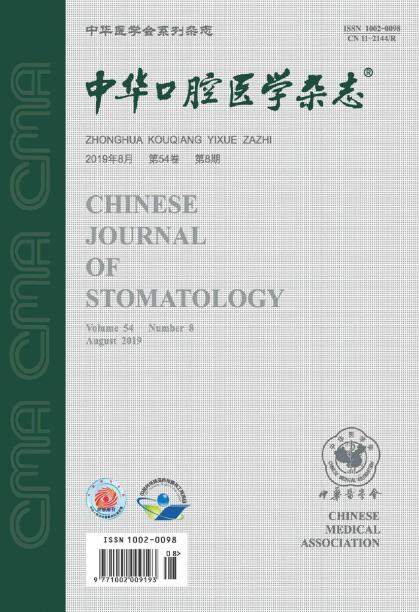
Founded in August 1953, Chinese Journal of Stomatology is a monthly academic journal of stomatology published publicly at home and abroad, sponsored by the Chinese Medical Association and co-sponsored by the Chinese Stomatology Association. It mainly reports the leading scientific research results and clinical diagnosis and treatment experience in the field of oral medicine, as well as the basic theoretical research that has a guiding role in oral clinical practice and is closely combined with oral clinical practice.
Chinese Journal of Over the years, Stomatology has been published in Medline, Scopus database, Toxicology Abstracts Database, Chemical Abstracts Database, American Cancer database, Russian Abstracts database, China Core Journal of Science and Technology, Peking University Core Journal, CSCD and other more than 20 important journals at home and abroad Physical medicine database and retrieval system included.

 求助内容:
 应助结果提醒方式:


 京公网安备 11010802042870号


