Christopher A Lepczyk, Vasavi Prakash, Jean E Fantle-Lepczyk
{"title":"The need for economics in wildlife conservation and management","authors":"Christopher A Lepczyk, Vasavi Prakash, Jean E Fantle-Lepczyk","doi":"10.1002/fee.70039","DOIUrl":null,"url":null,"abstract":"<p><i>Money makes the world go around</i> – from the song “Sitting Pretty (The Money Song)” in the musical <i>Cabaret</i>*</p><p>At its heart, the development of economics is rooted in land, agriculture, and natural resources and has guided resource management agencies and policymakers, including those involved with fisheries and forestry. However, one area where economics is used far less than it should be is wildlife conservation and management, whose practitioners are charged with a variety of tasks that collectively focus on managing wildlife populations. Whether recovering, maintaining, or controlling populations of endangered, game, or invasive species, respectively, wildlife managers use various tools to directly or indirectly influence a species’ population trajectory. Moreover, they often manage multiple species concurrently, working to restore ecosystems, manage landscapes, or address human–wildlife conflicts. While there are specific cases where a government agency or non-profit organization provides an economic evaluation of one or more management activities, rarely have such analyses been applied to issues related to wildlife.</p><p>Economics lends itself well to conservation and management because ecology and economics inherently use the same underlying concepts to explain how trade-offs, fluxes, and interactions work. Economic analysis shows that some wildlife, as an asset and if protected, can generate substantial economic benefits. Conversely, other wildlife (e.g., invasive species), as a liability, can impose substantial economic costs. Viewing wildlife through an economic lens either as a natural asset or a potential liability, similar to manufactured capital, offers fresh perspectives for mitigating human–wildlife conflicts, reconciling conservation with hunting, generating new funding sources, and supporting innovative financial mechanisms that address market and governance shortcomings.</p><p>Economic analysis is particularly valuable in areas of wildlife conservation where decisions are characterized by high uncertainty, limited funding, and irreversible ecological consequences. Threatened and endangered species represent the clearest case. Agencies routinely face implicit triage decisions, but species recovery plans often outline biological targets, rarely assessing the relative cost-effectiveness of alternative interventions such as habitat restoration, predator control, or captive breeding. Because conservation budgets are persistently limited, economic analysis can help managers prioritize actions that deliver the greatest improvement per dollar spent, rather than relying on tradition or political appeal. Similarly, the IUCN Red List process increasingly emphasizes quantitative criteria; economic valuation could complement these assessments by identifying where investments would yield the largest payoffs in avoided losses or improved ecosystem services.</p><p>Invasive wildlife is another area ripe for economic evaluation. Invasions often create long-term, compounding costs for ecosystems, agriculture, and public health. Yet managers frequently lack side-by-side comparisons of strategies for prevention, early detection, rapid response, and long-term control. These strategies typically yield far greater net benefits than delayed eradication efforts, as costs escalate rapidly over time. Economic tools—particularly dynamic optimization and cost-effectiveness analysis—can clarify when it is most efficient to invest in border inspections, to intensify removal efforts, and to accept a managed equilibrium. Without such analyses, agencies risk overinvesting in late-stage control or underinvesting in early-stage prevention.</p><p>A critical economic lens, often overlooked in wildlife management, is substitutability: many wildlife functions are effectively non-substitutable or replaceable only at prohibitive cost. Large frugivores (e.g., elephants, hornbills) enable long-distance seed dispersal; certain bats pollinate crops; and apex predators regulate herbivores and mesopredators—services that hand-pollination, mechanical planting, or culling/fencing only crudely mimic. When such species are functionally extinct, ecosystems lose these roles despite the persistence of residual populations. Partial ecological redundancy does not equal economic replaceability. Recognizing when functions are weakly substitutable helps justify early conservation spending, whereas identifying genuine redundancy can support flexible, cost-effective management without compromising system resilience. Typically, prevention vastly outperforms post-collapse replacement, where delayed action often leads to higher restoration expenses and escalating opportunity costs as ecosystems lose irreplaceable functions, thereby transforming wildlife from a renewable asset to an ongoing liability.</p><p>Economic analysis also strengthens decisions on human–wildlife conflict, habitat restoration, ecosystem-service valuation, market-based incentives, illegal trade, zoonotic disease management, and sustainable financing by identifying which actions deliver the greatest ecological and financial returns. Across these domains, an economic approach requires careful attention to costs over time. Equally important is the role of economics in comparing alternative management strategies rather than merely justifying whether intervention should occur at all. Many conservation investments involve up-front expenditures with benefits that accrue decades later. Discounting, sensitivity analysis, and present value calculations make these temporal dynamics explicit, helping managers understand whether a policy that looks expensive today may, in fact, produce substantial net benefits in the future. Conversely, some policies impose hidden long-term maintenance obligations that should be recognized early to avoid unsustainable commitments. Finally, integrating measures such as return on investment, benefit–cost ratios, or marginal cost curves can greatly improve decision-making transparency.</p><p>Overall, incorporating economic metrics into wildlife management planning allows practitioners, policymakers, and the public to compare interventions on common economic grounds without diminishing their ecological importance. Rather than replacing biological judgment, economic analysis clarifies the trade-offs, opportunity costs, and efficiency considerations inherent in management decisions. When used alongside ecological indicators and social considerations, these tools enable wildlife conservation and management to become more strategic, accountable, and effective in meeting the socioecological challenges ahead.</p>","PeriodicalId":171,"journal":{"name":"Frontiers in Ecology and the Environment","volume":"24 5","pages":""},"PeriodicalIF":6.5000,"publicationDate":"2026-06-01","publicationTypes":"Journal Article","fieldsOfStudy":null,"isOpenAccess":false,"openAccessPdf":"https://onlinelibrary.wiley.com/doi/epdf/10.1002/fee.70039","citationCount":"0","resultStr":null,"platform":"Semanticscholar","paperid":null,"PeriodicalName":"Frontiers in Ecology and the Environment","FirstCategoryId":"93","ListUrlMain":"https://onlinelibrary.wiley.com/doi/10.1002/fee.70039","RegionNum":1,"RegionCategory":"环境科学与生态学","ArticlePicture":[],"TitleCN":null,"AbstractTextCN":null,"PMCID":null,"EPubDate":"2026/5/7 0:00:00","PubModel":"Epub","JCR":"Q1","JCRName":"ECOLOGY","Score":null,"Total":0}
引用次数: 0
Abstract
Money makes the world go around – from the song “Sitting Pretty (The Money Song)” in the musical Cabaret*
At its heart, the development of economics is rooted in land, agriculture, and natural resources and has guided resource management agencies and policymakers, including those involved with fisheries and forestry. However, one area where economics is used far less than it should be is wildlife conservation and management, whose practitioners are charged with a variety of tasks that collectively focus on managing wildlife populations. Whether recovering, maintaining, or controlling populations of endangered, game, or invasive species, respectively, wildlife managers use various tools to directly or indirectly influence a species’ population trajectory. Moreover, they often manage multiple species concurrently, working to restore ecosystems, manage landscapes, or address human–wildlife conflicts. While there are specific cases where a government agency or non-profit organization provides an economic evaluation of one or more management activities, rarely have such analyses been applied to issues related to wildlife.
Economics lends itself well to conservation and management because ecology and economics inherently use the same underlying concepts to explain how trade-offs, fluxes, and interactions work. Economic analysis shows that some wildlife, as an asset and if protected, can generate substantial economic benefits. Conversely, other wildlife (e.g., invasive species), as a liability, can impose substantial economic costs. Viewing wildlife through an economic lens either as a natural asset or a potential liability, similar to manufactured capital, offers fresh perspectives for mitigating human–wildlife conflicts, reconciling conservation with hunting, generating new funding sources, and supporting innovative financial mechanisms that address market and governance shortcomings.
Economic analysis is particularly valuable in areas of wildlife conservation where decisions are characterized by high uncertainty, limited funding, and irreversible ecological consequences. Threatened and endangered species represent the clearest case. Agencies routinely face implicit triage decisions, but species recovery plans often outline biological targets, rarely assessing the relative cost-effectiveness of alternative interventions such as habitat restoration, predator control, or captive breeding. Because conservation budgets are persistently limited, economic analysis can help managers prioritize actions that deliver the greatest improvement per dollar spent, rather than relying on tradition or political appeal. Similarly, the IUCN Red List process increasingly emphasizes quantitative criteria; economic valuation could complement these assessments by identifying where investments would yield the largest payoffs in avoided losses or improved ecosystem services.
Invasive wildlife is another area ripe for economic evaluation. Invasions often create long-term, compounding costs for ecosystems, agriculture, and public health. Yet managers frequently lack side-by-side comparisons of strategies for prevention, early detection, rapid response, and long-term control. These strategies typically yield far greater net benefits than delayed eradication efforts, as costs escalate rapidly over time. Economic tools—particularly dynamic optimization and cost-effectiveness analysis—can clarify when it is most efficient to invest in border inspections, to intensify removal efforts, and to accept a managed equilibrium. Without such analyses, agencies risk overinvesting in late-stage control or underinvesting in early-stage prevention.
A critical economic lens, often overlooked in wildlife management, is substitutability: many wildlife functions are effectively non-substitutable or replaceable only at prohibitive cost. Large frugivores (e.g., elephants, hornbills) enable long-distance seed dispersal; certain bats pollinate crops; and apex predators regulate herbivores and mesopredators—services that hand-pollination, mechanical planting, or culling/fencing only crudely mimic. When such species are functionally extinct, ecosystems lose these roles despite the persistence of residual populations. Partial ecological redundancy does not equal economic replaceability. Recognizing when functions are weakly substitutable helps justify early conservation spending, whereas identifying genuine redundancy can support flexible, cost-effective management without compromising system resilience. Typically, prevention vastly outperforms post-collapse replacement, where delayed action often leads to higher restoration expenses and escalating opportunity costs as ecosystems lose irreplaceable functions, thereby transforming wildlife from a renewable asset to an ongoing liability.
Economic analysis also strengthens decisions on human–wildlife conflict, habitat restoration, ecosystem-service valuation, market-based incentives, illegal trade, zoonotic disease management, and sustainable financing by identifying which actions deliver the greatest ecological and financial returns. Across these domains, an economic approach requires careful attention to costs over time. Equally important is the role of economics in comparing alternative management strategies rather than merely justifying whether intervention should occur at all. Many conservation investments involve up-front expenditures with benefits that accrue decades later. Discounting, sensitivity analysis, and present value calculations make these temporal dynamics explicit, helping managers understand whether a policy that looks expensive today may, in fact, produce substantial net benefits in the future. Conversely, some policies impose hidden long-term maintenance obligations that should be recognized early to avoid unsustainable commitments. Finally, integrating measures such as return on investment, benefit–cost ratios, or marginal cost curves can greatly improve decision-making transparency.
Overall, incorporating economic metrics into wildlife management planning allows practitioners, policymakers, and the public to compare interventions on common economic grounds without diminishing their ecological importance. Rather than replacing biological judgment, economic analysis clarifies the trade-offs, opportunity costs, and efficiency considerations inherent in management decisions. When used alongside ecological indicators and social considerations, these tools enable wildlife conservation and management to become more strategic, accountable, and effective in meeting the socioecological challenges ahead.
期刊介绍:
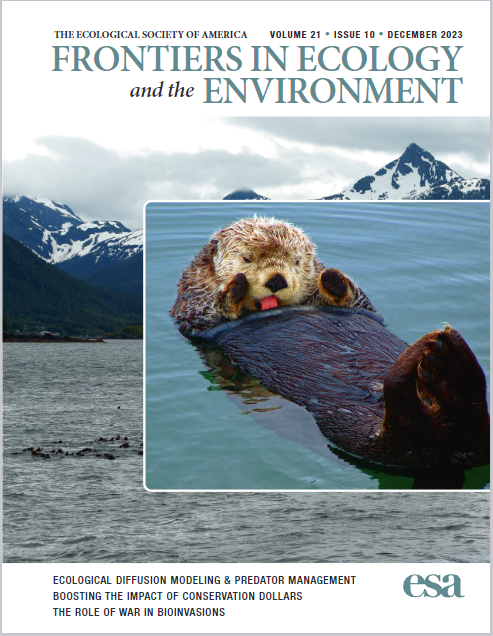
Frontiers in Ecology and the Environment is a publication by the Ecological Society of America that focuses on the significance of ecology and environmental science in various aspects of research and problem-solving. The journal covers topics such as biodiversity conservation, ecosystem preservation, natural resource management, public policy, and other related areas.
The publication features a range of content, including peer-reviewed articles, editorials, commentaries, letters, and occasional special issues and topical series. It releases ten issues per year, excluding January and July. ESA members receive both print and electronic copies of the journal, while institutional subscriptions are also available.
Frontiers in Ecology and the Environment is highly regarded in the field, as indicated by its ranking in the 2021 Journal Citation Reports by Clarivate Analytics. The journal is ranked 4th out of 174 in ecology journals and 11th out of 279 in environmental sciences journals. Its impact factor for 2021 is reported as 13.789, which further demonstrates its influence and importance in the scientific community.

 求助内容:
 应助结果提醒方式:


 京公网安备 11010802042870号


