Do Thi Ha, Nguyen Thi Kim Oanh, Nguyen Manh Khoa, Tran Thi Hien, Nguyen Thi Thu, Vu Huong Thuy, Nguyen Huy Van, Tran Quang Luc, Nguyen Thi Vinh Hue
{"title":"Anti-Allergic and Anti-Inflammatory Activities of a New Benzodioxane Derivative and Phenolic Compounds From Pharbitis nil Seeds.","authors":"Do Thi Ha, Nguyen Thi Kim Oanh, Nguyen Manh Khoa, Tran Thi Hien, Nguyen Thi Thu, Vu Huong Thuy, Nguyen Huy Van, Tran Quang Luc, Nguyen Thi Vinh Hue","doi":"10.1002/cbdv.202502992","DOIUrl":null,"url":null,"abstract":"<p><p>Pharbitis nil (L.) Choisy is a traditional medicinal plant exhibiting broad-spectrum pharmacological effects, including anti-cancer, renoprotective, and laxative effects; insecticidal activity; and antifungal, anti-inflammatory, antioxidant, neuroprotective, and hepatoprotective actions. In this study, 11 compounds were isolated from the seeds of the plant and structurally characterized. These included one novel benzodioxane derivative named pharbitan A (2), one phenolic compound (1), and nine caffeic acid derivatives (3-11). Bioactivity assays demonstrated that both fractions and isolated compounds from Pharbitis nil seeds significantly inhibited interleukin-4 and histamine secretion in phorbol 12-myristate 13-acetate/ionomycin-induced RBL-2H3 cells, as well as suppressed interlekin-1β production by lipopolysaccharide-stimulated RAW 264.7 macrophages. Notably, compounds 2 and 7 reduced cyclooxygenase-2 expression and modulated mitogen-activated protein kinase signaling pathways through inhibition of p38 MAPK and ERK phosphorylation. These results suggest that Pharbitis nil seeds and their constituents have notable anti-allergic and anti-inflammatory activities, highlighting their potential as natural therapeutic agents.</p>","PeriodicalId":9878,"journal":{"name":"Chemistry & Biodiversity","volume":"23 5","pages":"e02992"},"PeriodicalIF":2.9000,"publicationDate":"2026-05-01","publicationTypes":"Journal Article","fieldsOfStudy":null,"isOpenAccess":false,"openAccessPdf":"https://www.ncbi.nlm.nih.gov/pmc/articles/PMC13376997/pdf/","citationCount":"0","resultStr":null,"platform":"Semanticscholar","paperid":null,"PeriodicalName":"Chemistry & Biodiversity","FirstCategoryId":"92","ListUrlMain":"https://doi.org/10.1002/cbdv.202502992","RegionNum":3,"RegionCategory":"化学","ArticlePicture":[],"TitleCN":null,"AbstractTextCN":null,"PMCID":null,"EPubDate":"","PubModel":"","JCR":"Q3","JCRName":"BIOCHEMISTRY & MOLECULAR BIOLOGY","Score":null,"Total":0}
引用次数: 0
Abstract
Pharbitis nil (L.) Choisy is a traditional medicinal plant exhibiting broad-spectrum pharmacological effects, including anti-cancer, renoprotective, and laxative effects; insecticidal activity; and antifungal, anti-inflammatory, antioxidant, neuroprotective, and hepatoprotective actions. In this study, 11 compounds were isolated from the seeds of the plant and structurally characterized. These included one novel benzodioxane derivative named pharbitan A (2), one phenolic compound (1), and nine caffeic acid derivatives (3-11). Bioactivity assays demonstrated that both fractions and isolated compounds from Pharbitis nil seeds significantly inhibited interleukin-4 and histamine secretion in phorbol 12-myristate 13-acetate/ionomycin-induced RBL-2H3 cells, as well as suppressed interlekin-1β production by lipopolysaccharide-stimulated RAW 264.7 macrophages. Notably, compounds 2 and 7 reduced cyclooxygenase-2 expression and modulated mitogen-activated protein kinase signaling pathways through inhibition of p38 MAPK and ERK phosphorylation. These results suggest that Pharbitis nil seeds and their constituents have notable anti-allergic and anti-inflammatory activities, highlighting their potential as natural therapeutic agents.
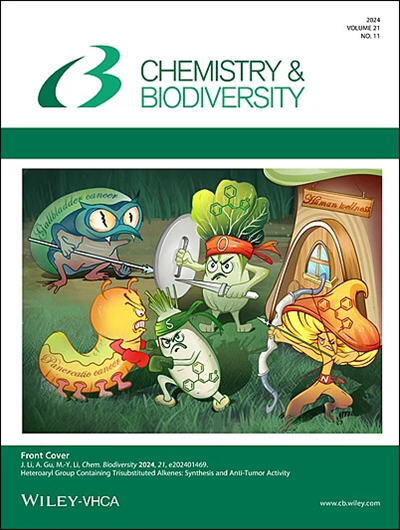
期刊介绍:
Chemistry & Biodiversity serves as a high-quality publishing forum covering a wide range of biorelevant topics for a truly international audience. This journal publishes both field-specific and interdisciplinary contributions on all aspects of biologically relevant chemistry research in the form of full-length original papers, short communications, invited reviews, and commentaries. It covers all research fields straddling the border between the chemical and biological sciences, with the ultimate goal of broadening our understanding of how nature works at a molecular level.
Since 2017, Chemistry & Biodiversity is published in an online-only format.

 求助内容:
 应助结果提醒方式:


 京公网安备 11010802042870号


