{"title":"Enhancing the performance of granisetron HCl orodispersible tablets using co-processed MCC-mannitol excipients: a direct compression approach","authors":"Shazia Naseem Chaudhry and Atiq Ur Rahman","doi":"10.1039/D5PM00276A","DOIUrl":null,"url":null,"abstract":"<p >Orodispersible tablets (ODTs) are favored for their rapid disintegration in the mouth without the need for water, thereby improving patient compliance, particularly in dysphagic, geriatric, and oncology patients. Advanced manufacturing technologies like Orasolv®, Durasolv®, and Zydis® offer unique benefits but are generally associated with high costs and intricate processes. Common manufacturing approaches include molding, freeze-drying, and direct compression, with the latter being the most economical and industrially practical method. The present study aimed to develop granisetron HCl ODTs using a laboratory-prepared co-processed excipient system composed of microcrystalline cellulose (MCC) and mannitol. The system was developed by combining the excipients at the sub-particle level to enhance flowability and compressibility, rather than relying on commercially available multifunctional excipients. The performance of this co-processed MCC–mannitol system was systematically compared with that of the corresponding physical mixtures. Granisetron HCl is a 5-HT3 receptor antagonist commonly prescribed to manage nausea and vomiting induced by chemotherapy. It is well-suited for ODTs due to its low dosage requirements and water solubility. In the formulations, microcrystalline cellulose and mannitol were used as bulking agents and sodium starch glycolate (SSG) and crospovidone (CP) as superdisintegrants. The performance of co-processed excipients was compared with that of physical mixtures. Precompression parameters, including the angle of repose and compressibility index, along with post-compression characteristics such as wetting time, water absorption ratio, disintegration time, and <em>in vitro</em> drug release, were evaluated. Among the tested formulations, formulation F7 containing 4% crospovidone and co-processed MCC–mannitol exhibited the most favorable performance, with a rapid disintegration time of 10 ± 0.12 s and 98.14% ± 0.25% drug release within 180 s. Comparative evaluation demonstrated that the co-processed excipient system provided improved powder flow and tablet performance relative to the physical mixtures. These findings indicate that at the sub-particle level, the co-processing of conventional excipients can be an effective and practical strategy to enhance the ODT performance using a cost-effective direct compression approach.</p>","PeriodicalId":101141,"journal":{"name":"RSC Pharmaceutics","volume":" 3","pages":" 809-819"},"PeriodicalIF":5.5000,"publicationDate":"2026-03-20","publicationTypes":"Journal Article","fieldsOfStudy":null,"isOpenAccess":false,"openAccessPdf":"https://pubs.rsc.org/en/content/articlepdf/2026/pm/d5pm00276a?page=search","citationCount":"0","resultStr":null,"platform":"Semanticscholar","paperid":null,"PeriodicalName":"RSC Pharmaceutics","FirstCategoryId":"1085","ListUrlMain":"https://pubs.rsc.org/en/content/articlelanding/2026/pm/d5pm00276a","RegionNum":0,"RegionCategory":null,"ArticlePicture":[],"TitleCN":null,"AbstractTextCN":null,"PMCID":null,"EPubDate":"","PubModel":"","JCR":"","JCRName":"","Score":null,"Total":0}
引用次数: 0
Abstract
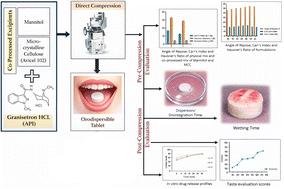
Orodispersible tablets (ODTs) are favored for their rapid disintegration in the mouth without the need for water, thereby improving patient compliance, particularly in dysphagic, geriatric, and oncology patients. Advanced manufacturing technologies like Orasolv®, Durasolv®, and Zydis® offer unique benefits but are generally associated with high costs and intricate processes. Common manufacturing approaches include molding, freeze-drying, and direct compression, with the latter being the most economical and industrially practical method. The present study aimed to develop granisetron HCl ODTs using a laboratory-prepared co-processed excipient system composed of microcrystalline cellulose (MCC) and mannitol. The system was developed by combining the excipients at the sub-particle level to enhance flowability and compressibility, rather than relying on commercially available multifunctional excipients. The performance of this co-processed MCC–mannitol system was systematically compared with that of the corresponding physical mixtures. Granisetron HCl is a 5-HT3 receptor antagonist commonly prescribed to manage nausea and vomiting induced by chemotherapy. It is well-suited for ODTs due to its low dosage requirements and water solubility. In the formulations, microcrystalline cellulose and mannitol were used as bulking agents and sodium starch glycolate (SSG) and crospovidone (CP) as superdisintegrants. The performance of co-processed excipients was compared with that of physical mixtures. Precompression parameters, including the angle of repose and compressibility index, along with post-compression characteristics such as wetting time, water absorption ratio, disintegration time, and in vitro drug release, were evaluated. Among the tested formulations, formulation F7 containing 4% crospovidone and co-processed MCC–mannitol exhibited the most favorable performance, with a rapid disintegration time of 10 ± 0.12 s and 98.14% ± 0.25% drug release within 180 s. Comparative evaluation demonstrated that the co-processed excipient system provided improved powder flow and tablet performance relative to the physical mixtures. These findings indicate that at the sub-particle level, the co-processing of conventional excipients can be an effective and practical strategy to enhance the ODT performance using a cost-effective direct compression approach.


 求助内容:
求助内容: 应助结果提醒方式:

 京公网安备 11010802042870号


