
Simple and robust forecasting of spatiotemporally correlated small Earth data with a tabular foundation model
IF 12.7
1区 地球科学
Q1 GEOSCIENCES, MULTIDISCIPLINARY
引用次数: 0
Abstract
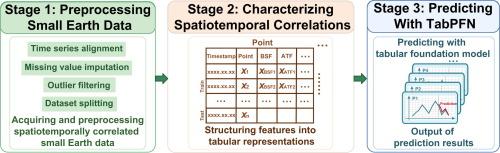
Spatiotemporally correlated small Earth data refer to geoscience time-series observations in which short-term monitoring provides limited informative variation, resulting in only sparse but meaningful measurements. Spatiotemporal forecasting on such data is crucial for understanding geoscientific processes despite their small scale. However, conventional deep learning models for spatiotemporal forecasting require task-specific training for different scenarios. Foundation models do not need task-specific training, but they often exhibit forecasting bias toward the global mean of the pretraining distribution. Here we propose a simple and robust approach for spatiotemporally correlated small Earth data forecasting. The essential idea is to characterize and quantify spatiotemporal patterns of small Earth data and then utilize tabular foundation models for accurate forecasting across different scenarios. Comparative results across three typical scenarios demonstrate that our forecasting approach achieves superior accuracy compared to the graph deep learning model and tabular foundation model in the majority of instances, exhibiting stronger robustness.
基于表格基础模型的时空相关小地球数据的简单可靠预测
时空相关的小地球数据是指地球科学时间序列观测,其中短期监测提供的信息变化有限,导致只有稀疏但有意义的测量结果。基于这些数据的时空预测对于理解地球科学过程至关重要,尽管它们的规模很小。然而,用于时空预测的传统深度学习模型需要针对不同场景进行特定任务的训练。基础模型不需要特定任务的训练,但它们经常表现出对预训练分布的全局均值的预测偏差。本文提出了一种简单可靠的时空相关小地球数据预测方法。其基本思想是表征和量化小地球数据的时空模式,然后利用表格基础模型在不同情景下进行准确预测。三种典型场景的对比结果表明,在大多数情况下,与图形深度学习模型和表格基础模型相比,我们的预测方法具有更高的准确性,表现出更强的鲁棒性。
本文章由计算机程序翻译,如有差异,请以英文原文为准。
求助全文
约1分钟内获得全文
求助全文
来源期刊
Geoscience frontiers
Earth and Planetary Sciences-General Earth and Planetary Sciences
CiteScore
17.80
自引率
3.40%
发文量
147
审稿时长
35 days
期刊介绍:
Geoscience Frontiers (GSF) is the Journal of China University of Geosciences (Beijing) and Peking University. It publishes peer-reviewed research articles and reviews in interdisciplinary fields of Earth and Planetary Sciences. GSF covers various research areas including petrology and geochemistry, lithospheric architecture and mantle dynamics, global tectonics, economic geology and fuel exploration, geophysics, stratigraphy and paleontology, environmental and engineering geology, astrogeology, and the nexus of resources-energy-emissions-climate under Sustainable Development Goals. The journal aims to bridge innovative, provocative, and challenging concepts and models in these fields, providing insights on correlations and evolution.
 求助内容:
求助内容: 应助结果提醒方式:

 京公网安备 11010802042870号


