
Juglone targets CBS to inhibit the Wnt/β-catenin pathway and promotes osteosarcoma cell apoptosis
IF 4.1
2区 综合性期刊
Q1 MULTIDISCIPLINARY SCIENCES
引用次数: 0
Abstract
Osteosarcoma (OS) is a severe primary bone cancer with current treatments facing high toxicity and limited success against metastasis. This study’s bioinformatics identified cystathionine beta-synthase (CBS) as a critical oncogene in OS, linked to poor prognosis via the Wnt/β-catenin pathway. CBS was manipulated in HOS and MG-63 cell lines to confirm its tumor-promoting role. Through the HERB database, juglone was discovered as a potential CBS inhibitor. Experiments showed juglone markedly inhibited OS cell proliferation, migration, invasion, and colony formation, while inducing cell death and G2/M phase arrest. Juglone degraded CBS and suppressed the Wnt/β-catenin pathway, reducing β-catenin and c-Myc levels. In vivo, juglone significantly reduced tumor growth in mice without toxicity. Clinical analysis confirmed CBS overexpression correlates with OS progression. These findings highlight juglone’s potential as a safe, effective anti-tumor agent targeting the CBS-Wnt/β-catenin pathway.
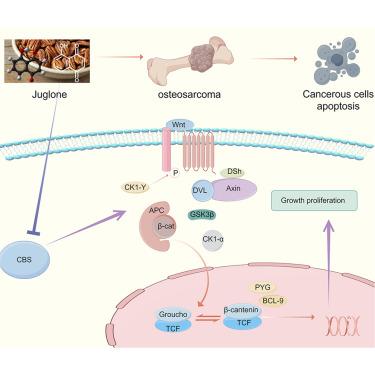
核桃酮靶向CBS抑制Wnt/β-catenin通路,促进骨肉瘤细胞凋亡
骨肉瘤(Osteosarcoma, OS)是一种严重的原发性骨癌,目前的治疗面临着高毒性和有限的成功转移。本研究的生物信息学鉴定出胱硫氨酸β-合成酶(CBS)是OS的一个关键致癌基因,通过Wnt/β-catenin通路与预后不良相关。在HOS和MG-63细胞系中操纵CBS以证实其促肿瘤作用。通过HERB数据库,发现木酮是一种潜在的CBS抑制剂。实验表明,核桃酮可显著抑制OS细胞的增殖、迁移、侵袭和集落形成,同时诱导细胞死亡和G2/M期阻滞。核桃酮降解CBS,抑制Wnt/β-catenin通路,降低β-catenin和c-Myc水平。在体内实验中,核桃酮可显著抑制小鼠肿瘤生长,且无毒性。临床分析证实CBS过表达与OS进展相关。这些发现强调了核桃酮作为一种安全、有效的靶向CBS-Wnt/β-catenin通路的抗肿瘤药物的潜力。
本文章由计算机程序翻译,如有差异,请以英文原文为准。
求助全文
约1分钟内获得全文
求助全文
来源期刊

iScience
Multidisciplinary-Multidisciplinary
CiteScore
7.20
自引率
1.70%
发文量
1972
审稿时长
6 weeks
期刊介绍:
Science has many big remaining questions. To address them, we will need to work collaboratively and across disciplines. The goal of iScience is to help fuel that type of interdisciplinary thinking. iScience is a new open-access journal from Cell Press that provides a platform for original research in the life, physical, and earth sciences. The primary criterion for publication in iScience is a significant contribution to a relevant field combined with robust results and underlying methodology. The advances appearing in iScience include both fundamental and applied investigations across this interdisciplinary range of topic areas. To support transparency in scientific investigation, we are happy to consider replication studies and papers that describe negative results.
We know you want your work to be published quickly and to be widely visible within your community and beyond. With the strong international reputation of Cell Press behind it, publication in iScience will help your work garner the attention and recognition it merits. Like all Cell Press journals, iScience prioritizes rapid publication. Our editorial team pays special attention to high-quality author service and to efficient, clear-cut decisions based on the information available within the manuscript. iScience taps into the expertise across Cell Press journals and selected partners to inform our editorial decisions and help publish your science in a timely and seamless way.
 求助内容:
求助内容: 应助结果提醒方式:

 京公网安备 11010802042870号


