
Synergistic ionic and hydrogen-bond locking in hydrogel electrolytes for all-climate high-performance flexible supercapacitors
IF 20.2
1区 材料科学
Q1 CHEMISTRY, PHYSICAL
引用次数: 0
Abstract
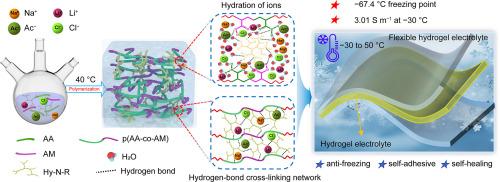
The practical implementation of flexible supercapacitors at sub - zero temperatures is impeded by the performance deterioration of hydrogel electrolytes induced by freezing. In this study, we present a synergistic "ionic and hydrogen - bond locking" strategy to surmount this limitation via a rationally engineered hydrogel electrolyte (Hy-p(AA/AM)1/2-(NaAc/LiCl)2.5). This design incorporates two complementary confinement mechanisms: an ionic lock stemming from a hydration-optimized dual-salt (NaAc/LiCl) system, which disrupts the hydrogen-bond network of water and inhibits ice nucleation, and a hydrogen-bond lock originating from a hyperbranched polymer network, which further confines water and restricts the growth of ice crystals. The resultant electrolyte demonstrates an ultra-low freezing point of −67.4 °C, high ionic conductivity of 3.01 S m−1 at −30 °C, and outstanding self-healing (92.7 % efficiency) and self-adhesive (11.38 kPa) properties. Flexible supercapacitors assembled with this electrolyte attain a wide voltage window of 1.6 V, yield an energy density of 21.8 Wh kg−1 at −30 °C, and retain 70.7 % of the initial capacitance after 15,000 cycles at −30 °C. A comparison with recent reports reveals that this work achieves an unparalleled equilibrium of ionic conductivity, low-temperature tolerance, and mechanical robustness. This dual-lock strategy offers a generalizable design principle for advanced energy storage materials for all - climate wearable electronics and other applications.
用于全天候高性能柔性超级电容器的水凝胶电解质中离子和氢键的协同锁定
低温下柔性超级电容器的实际应用受到水凝胶电解质冻结导致的性能下降的阻碍。在这项研究中,我们提出了一种协同的“离子和氢键锁定”策略,通过合理设计的水凝胶电解质(Hy-p(AA/AM)1/2-(NaAc/LiCl)2.5)来克服这一限制。这种设计结合了两种互补的约束机制:一种是源于水化优化的双盐(NaAc/LiCl)体系的离子锁,它破坏了水的氢键网络,抑制了冰的成核;另一种是源于超支化聚合物网络的氢键锁,它进一步限制了水,限制了冰晶的生长。该电解质具有- 67.4℃的超低凝固点、- 30℃时3.01 S m−1的高离子电导率、92.7%的自愈效率和11.38 kPa的自粘性能。用这种电解质组装的柔性超级电容器具有1.6 V的宽电压窗,在- 30°C下产生21.8 Wh kg - 1的能量密度,并且在- 30°C下循环15,000次后保持70.7%的初始电容。与最近报道的比较表明,这项工作实现了离子电导率,低温耐受性和机械稳健性的无与伦比的平衡。这种双锁策略为所有气候可穿戴电子产品和其他应用的先进储能材料提供了一种通用的设计原则。
本文章由计算机程序翻译,如有差异,请以英文原文为准。
求助全文
约1分钟内获得全文
求助全文
来源期刊
Energy Storage Materials
Materials Science-General Materials Science
CiteScore
33.00
自引率
5.90%
发文量
652
审稿时长
27 days
期刊介绍:
Energy Storage Materials is a global interdisciplinary journal dedicated to sharing scientific and technological advancements in materials and devices for advanced energy storage and related energy conversion, such as in metal-O2 batteries. The journal features comprehensive research articles, including full papers and short communications, as well as authoritative feature articles and reviews by leading experts in the field.
Energy Storage Materials covers a wide range of topics, including the synthesis, fabrication, structure, properties, performance, and technological applications of energy storage materials. Additionally, the journal explores strategies, policies, and developments in the field of energy storage materials and devices for sustainable energy.
Published papers are selected based on their scientific and technological significance, their ability to provide valuable new knowledge, and their relevance to the international research community.
 求助内容:
求助内容: 应助结果提醒方式:

 京公网安备 11010802042870号


