
Identification of a regulatory factor activating the xylanase promoter of the basidiomycetous yeast Pseudozymaantarctica and its application to enhance endogenous biodegradable plastic-degrading enzyme production via transcription factor multiplexing
IF 2.3
3区 生物学
Q3 GENETICS & HEREDITY
Fungal Genetics and Biology
Pub Date : 2026-05-01
Epub Date: 2026-05-04
DOI:10.1016/j.fgb.2026.104084
引用次数: 0
Abstract
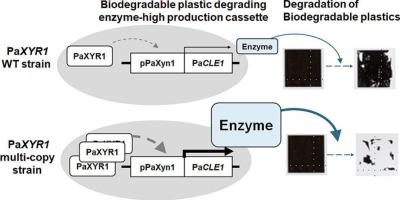
The basidiomycetous yeast Pseudozyma antarctica secretes the biodegradable plastic-degrading enzyme PaE. The xylanase promoter pPaXyn1 in P. antarctica is strongly induced by xylose. A P. antarctica reporter strain carrying the pPaXyn1 promoter-fused PaE gene (a PaE high-production cassette) produced a large amount of PaE in the presence of xylose. Accordingly, to further improve PaE productivity, this study aimed to isolate the transcription activation factor pPaXyn1. In total, 109 genes with Zn2Cys6-type DNA-binding domains were selected from the whole genome sequence of P. antarctica as candidate transcription factor genes. A set of strains was generated from the reporter strain in which each candidate transcription factor gene on the chromosome was disrupted. Among the disruptants, only the strain lacking the locus_tag PAN1_003r02005 (gene id: g2005) suppressed PaE production and did not show biodegradable plastic degrading activity. Moreover, a reporter strain with multiple copies of g2005 exhibited a 1.6-fold increase in PaE secretion. In addition, the strain also increased xylanase secretion. Overall, these results indicate that g2005 is a transcriptional activator of xylanase; hence, g2005 was named P. antarctica xylanase regulator 1 (PaXyr1). The amino acid sequence of g2005 is conserved only in the basidiomycete subphylum Smut (Ustilaginomycotina).
一种激活担子酵母南极假酶木聚糖酶启动子的调控因子的鉴定及其在通过转录因子多路复制提高内源性生物降解塑料降解酶生产中的应用。
担子菌酵母南极假酶分泌可生物降解的塑料降解酶PaE。木聚糖酶启动子pPaXyn1受到木糖的强烈诱导。携带pPaXyn1启动子融合PaE基因(PaE高产盒)的南极p.a nantarctica报告菌株在木糖存在下产生大量PaE。因此,为了进一步提高PaE的产率,本研究旨在分离转录激活因子pPaXyn1。总共109个基因与Zn2Cys6-type dna结合域选择从南极洲的整个基因组序列p .候选人转录因子基因。从报告菌株中产生一组菌株,其中染色体上的每个候选转录因子基因都被破坏。在这些干扰物中,只有缺少locus_tag PAN1_003r02005(基因id: g2005)的菌株抑制了PaE的产生,并且没有表现出生物降解塑料的降解活性。此外,具有多个g2005拷贝的报告菌株显示PaE分泌增加1.6倍。此外,菌株还增加了木聚糖酶的分泌。综上所述,g2005是木聚糖酶的转录激活因子;因此,g2005被命名为P. antarctica木聚糖酶调节剂1 (pxyr1)。g2005仅在黑穗病担子菌亚门(Ustilaginomycotina)中保守。
本文章由计算机程序翻译,如有差异,请以英文原文为准。
求助全文
约1分钟内获得全文
求助全文
来源期刊

Fungal Genetics and Biology
生物-遗传学
CiteScore
6.20
自引率
3.30%
发文量
66
审稿时长
85 days
期刊介绍:
Fungal Genetics and Biology, formerly known as Experimental Mycology, publishes experimental investigations of fungi and their traditional allies that relate structure and function to growth, reproduction, morphogenesis, and differentiation. This journal especially welcomes studies of gene organization and expression and of developmental processes at the cellular, subcellular, and molecular levels. The journal also includes suitable experimental inquiries into fungal cytology, biochemistry, physiology, genetics, and phylogeny.
Fungal Genetics and Biology publishes basic research conducted by mycologists, cell biologists, biochemists, geneticists, and molecular biologists.
Research Areas include:
• Biochemistry
• Cytology
• Developmental biology
• Evolutionary biology
• Genetics
• Molecular biology
• Phylogeny
• Physiology.
 求助内容:
求助内容: 应助结果提醒方式:

 京公网安备 11010802042870号


