Mohit Das, Eli Coronado-Chavez, Anusha D Bhatt, Reyhaneh Tirgar, Amanda A Amodeo, Jared T Nordman
{"title":"NASP functions in the cytoplasm to prevent histone H3 aggregation during early embryogenesis.","authors":"Mohit Das, Eli Coronado-Chavez, Anusha D Bhatt, Reyhaneh Tirgar, Amanda A Amodeo, Jared T Nordman","doi":"10.1083/jcb.202511182","DOIUrl":null,"url":null,"abstract":"<p><p>From their molecular birth until their incorporation into chromatin, histones are bound by specific chaperones that serve unique functions in histone trafficking, stability, and chromatin deposition. The H3-specific chaperone NASP binds directly to H3 and is required to prevent degradation of soluble H3 in vivo. Where NASP functions and how NASP affects H3 dynamics and stability are unknown. Using the Drosophila early embryo as a model system to understand NASP function in vivo, we show that NASP does not directly affect H3 nuclear import or export rates. Rather, reduced H3 levels in NASP-deficient embryos indirectly affect nuclear import and the amount of H3 deposited into chromatin. Crucially, we find that cytoplasmic NASP prevents H3 aggregation in vivo and that H3 aggregation and degradation are developmentally separable events. Thus, we propose the main function of NASP in vivo is to prevent H3 aggregation, thereby indirectly protecting H3 from degradation.</p>","PeriodicalId":15211,"journal":{"name":"Journal of Cell Biology","volume":"225 7","pages":""},"PeriodicalIF":6.4000,"publicationDate":"2026-07-06","publicationTypes":"Journal Article","fieldsOfStudy":null,"isOpenAccess":false,"openAccessPdf":"https://www.ncbi.nlm.nih.gov/pmc/articles/PMC13148224/pdf/","citationCount":"0","resultStr":null,"platform":"Semanticscholar","paperid":null,"PeriodicalName":"Journal of Cell Biology","FirstCategoryId":"99","ListUrlMain":"https://doi.org/10.1083/jcb.202511182","RegionNum":1,"RegionCategory":"生物学","ArticlePicture":[],"TitleCN":null,"AbstractTextCN":null,"PMCID":null,"EPubDate":"2026/5/6 0:00:00","PubModel":"Epub","JCR":"Q1","JCRName":"CELL BIOLOGY","Score":null,"Total":0}
引用次数: 0
Abstract
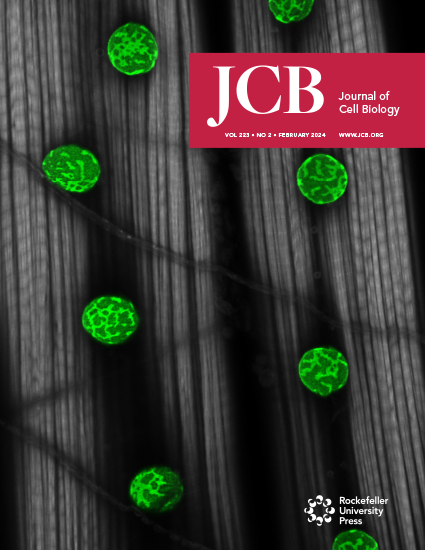
From their molecular birth until their incorporation into chromatin, histones are bound by specific chaperones that serve unique functions in histone trafficking, stability, and chromatin deposition. The H3-specific chaperone NASP binds directly to H3 and is required to prevent degradation of soluble H3 in vivo. Where NASP functions and how NASP affects H3 dynamics and stability are unknown. Using the Drosophila early embryo as a model system to understand NASP function in vivo, we show that NASP does not directly affect H3 nuclear import or export rates. Rather, reduced H3 levels in NASP-deficient embryos indirectly affect nuclear import and the amount of H3 deposited into chromatin. Crucially, we find that cytoplasmic NASP prevents H3 aggregation in vivo and that H3 aggregation and degradation are developmentally separable events. Thus, we propose the main function of NASP in vivo is to prevent H3 aggregation, thereby indirectly protecting H3 from degradation.
期刊介绍:
The Journal of Cell Biology (JCB) is a comprehensive journal dedicated to publishing original discoveries across all realms of cell biology. We invite papers presenting novel cellular or molecular advancements in various domains of basic cell biology, along with applied cell biology research in diverse systems such as immunology, neurobiology, metabolism, virology, developmental biology, and plant biology. We enthusiastically welcome submissions showcasing significant findings of interest to cell biologists, irrespective of the experimental approach.

 求助内容:
求助内容: 应助结果提醒方式:

 京公网安备 11010802042870号


